

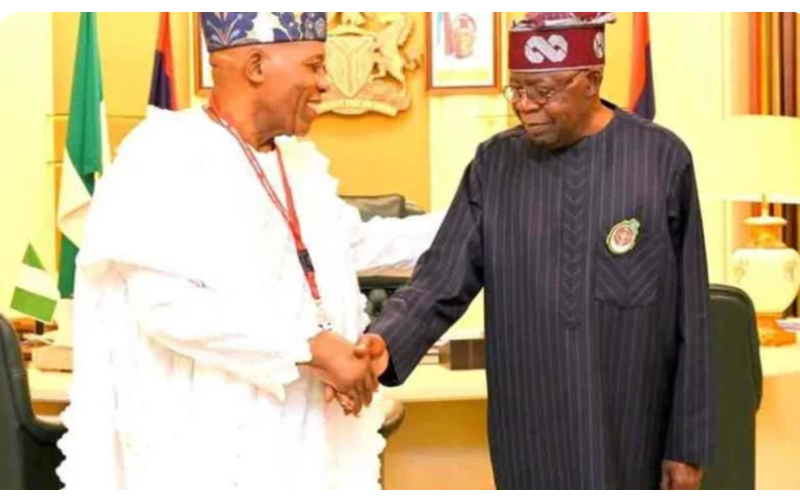
Speaking in an interview with The Sun, Okupe
acknowledged the growing mobilization among northern elites and young political
minds, describing it as a positive step toward addressing long-standing neglect
of the region’s masses.
However, he dismissed the possibility of a northern
presidency in 2027, citing Nigeria’s established tradition of power rotation.
“ Power cannot return to the North. We rotate
between the North and the South. The North does eight years, after which the
South does eight years ,” Okupe stated. “ I’m not saying that Bola
Tinubu must be president in 2027, but it is not going to be a northerner.”
Okupe highlighted the historical precedent of
balancing regional representation in leadership to maintain national unity.
He cited past instances, such as the presidency of
Chief Olusegun Obasanjo, which followed an unwritten consensus to assuage the
South-West after the annulled June 12, 1993, presidential election.
He said: “ I want to remind you that when Chief
Olusegun Obasanjo became president, there was an unwritten national consensus
that somebody from the South-West, would be president because if you looked at
it, the two candidates for that election were Obasanjo and Chief Olu Falae. So
head and tail, South-West wins.
“That was the national concession and it was not for
nothing. It was because the stakeholders felt then that following Chief MKO
Abiola’s death, who was presumed to have won an election, there was a need to
assuage the South-West. It was not a question of Northern interest. You see,
those who controlled the affairs of this nation in terms of politics before now
were more interested in national interest than sectional interest. And our
failure to evolve a national elite system is one of the most fundamental problems
why Nigeria is stagnating because we all pull in different directions.”
Responding to concerns from some northerners that a
southern president in 2027 might seek to extend their tenure beyond the agreed
rotation, Okupe described the situation as a “political quagmire.”
He argued that any attempt to field another southern
candidate against Tinubu could inadvertently prolong southern dominance, given
the absence of enforceable agreements to limit a tenure to one term.
Okupe said: “ It’s a political quagmire. If the
North decides to field another southern candidate against Bola Tinubu, then the
North will have shot itself on the leg. Don’t forget, this is a third-world
country. Let us assume that you bring a new person and he wins. There’s no
agreement he will make with you. He will not spend another eight years. So, you
just extended the lifespan of the rotation to the South by another four years.
What has Tinubu done? Let’s come to terms with this. Tinubu has come with very
serious reforms that will take the country away from the situation which it has
been undergoing for the past eight to ten years. I will say it here because
that is the truth.
“This government has not been able to articulate this
position but those of us who are watching from the outside can see it. As of
the time that the Tinubu administration was coming to power, the country was
finished and was socially and economically finished. We were spending 98 per
cent of our revenue and 98 cents on every dollar was being used for debt
servicing. We were subsidizing fuel. We were subsidizing power. We were
subsidizing virtually everything. There was severe arbitrage in the foreign exchange
market.
“What did the Muhammadu Buhari administration do? They
just went ahead and printed and continued to print money until they printed up
to N30 trillion. Nigerians did not feel it because money was available although
it was not backed by anything. There are a few countries that have done this in
the past. So, it’s not a matter of Nigeria being rich. Venezuela is one of the
largest reservoirs of crude oil in the world. The poverty in Venezuela is worse
than here. If you look at 100 trillion Zimbabwe dollars, it is probably worth
about $15 or $16 .”
Turning to President Tinubu’s administration, Okupe
praised its bold economic reforms, including the removal of fuel subsidies and
unification of exchange rates. He described these measures as essential steps
to stabilize a nation on the brink of collapse.
Okupe acknowledged the public’s frustration with
rising costs, including fuel prices and inflation, but emphasized that these
sacrifices were necessary to avert economic catastrophe.
Okupe urged Nigerians to exercise patience, arguing
that it was premature to judge Tinubu’s administration after just 18 months. He
called for understanding of the administration’s efforts to lay the foundation
for long-term economic recovery.
Comments:
Leave a Reply