

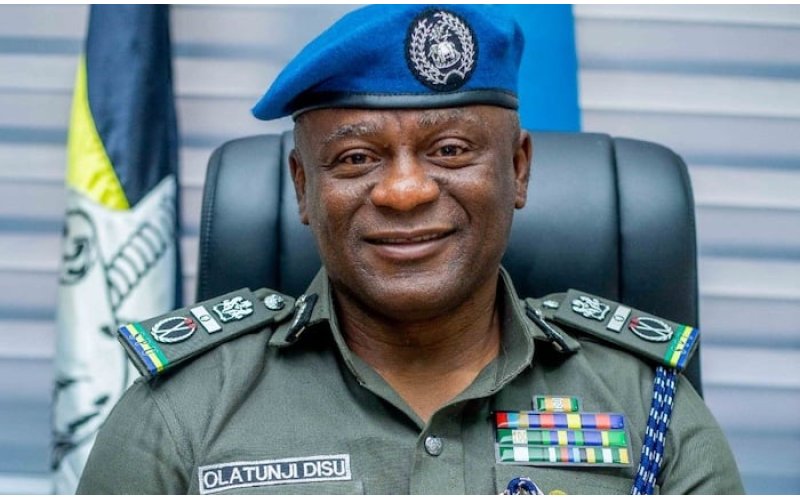
Inspector-General of Police Olatunji Disu has assured
Nigerians that the Nigeria Police Force will not become a political tool ahead
of the 2027 general elections, warning that officers who support candidates or
parties will face disciplinary action.
Disu spoke on Tuesday, November 24, on the second day
of the Media Development Conference organised by the Centre for Journalism
Innovation and Development at the Abuja Continental Hotel. He said policing
must be built on public trust and accountability, guided by professionalism,
neutrality and the law. "Any police officer found to be partisan, to have
taken sides, or to have aided any candidate or the party will face disciplinary
action under the force's code of conduct," he said.
On concerns about the alleged use of cybercrime
legislation against journalists, he pledged that the police under his
leadership would not assist politically motivated efforts to suppress or
intimidate people. He said the force had held two symposiums since he assumed
office to examine the Cybercrime Act and digital offences, and encouraged
journalists and other Nigerians to familiarise themselves with the law, noting
that some online activities regarded as minor could constitute offences.
Personnel in the police cyber section are also being trained and equipped to
deal with emerging digital threats. He affirmed that journalism is not a crime
and described media practitioners as important partners in development and
government accountability.
Disu also warned that threats to elections
increasingly go beyond physical attacks to the information environment.
Fabricated videos, manipulated audio, coordinated falsehoods on social media
and misleading reports could disrupt elections and provoke violence, he said.
During a panel on people-centred public safety and
state policing, he sought to reassure Nigerians worried that governors could
misuse state police structures. He said safeguards were being developed to
prevent such institutions from being captured for personal or political
purposes, including provisions for federal intervention where necessary. The
National Assembly and other stakeholders, he said, were working on a framework
suited to Nigeria's circumstances rather than simply adopting foreign models,
and training standards would remain uniform nationwide so that officers in
states such as Lagos and Kano receive consistent professional preparation.
Disu said Nigeria's press freedom environment compares
relatively favourably with that of some neighbouring Sahel countries, while
acknowledging that relations between journalists and the police still need
improvement. Recalling a paper he wrote during a management course at the Staff
College in Jos, he said he had advocated allowing journalists to accompany
officers during serious crime investigations, to improve understanding of
police work. He stressed, however, that sensitive operations require discretion.
He cited an incident during his time as Commander of the Rapid Response Squad
in Lagos, when premature reporting that a suspect had been arrested in the
rescue of a kidnapped state Accountant-General alerted the kidnappers'
associates and complicated the operation. He also recalled officers reacting
aggressively when someone began filming them as they helped a stranded
motorist, which he linked to anxiety over earlier cases in which viral footage
cost officers their jobs.
He said police personnel are being sensitised to
respect and protect journalists covering events and avoid obstructing their
work, and that Commissioners of Police have been directed to hold regular
meetings with journalists in their areas. Joint lectures and pre-election
training are planned in Abuja and other states to improve election reporting
and introduce journalists to relevant police commanders and unit officers
before the polls.
Disu expressed hope that the conference discussions
would produce practical ideas to strengthen Nigeria's media environment.
Comments:
Leave a Reply