

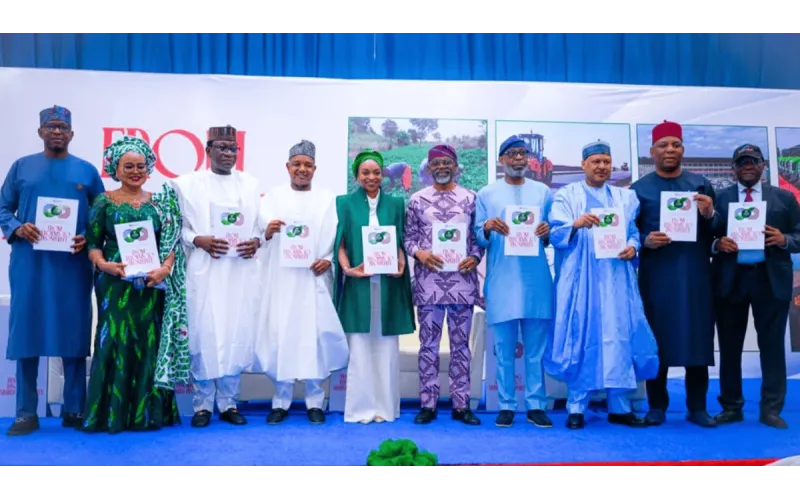
Selling a second-term vision on the back of painful
economic reforms is one of the hardest pitches in politics. On Tuesday,
November 10, 2026, the All Progressives Congress Presidential Campaign Council
(APC-PCC) gathered in Abuja to unveil President Bola Tinubu's 2027 re-election
manifesto, but the President himself was absent. In his place, Chief of Staff
Femi Gbajabiamila, campaign council spokesman Dele Alake and Budget and
Economic Planning Minister Atiku Bagudu admitted that the removal of petrol subsidies
and the unification of the foreign exchange windows since May 2023 have put
severe pressure on households. They insisted, however, that the worst of the
reforms is over.
The 109-page manifesto, titled the Renewed Hope Agenda
2.0 and themed "Translating Reforms into Shared Prosperity," covers
the 2027 to 2031 term. To justify a second mandate, it leans on recent
indicators: foreign reserves of $55.3 billion in September 2026, headline
inflation easing to 14.63 per cent the same month, Q2 2026 GDP growth of 4.43
per cent, and Federation Account Allocation Committee (FAAC) distributions of
?18.72 trillion in the first half of 2026, up from ?6.76 trillion in the first
half of 2023. For the tech ecosystem, however, a strong national balance sheet
does not automatically pay cloud bills or power data centres.
Four pillars, 35 promises
Instead of fresh slogans, the document consolidates
the administration's original eight-point framework into four pillars with at
least 35 commitments:
Key promises for the tech community
Technology runs through all four pillars, and the
manifesto moves digital policy away from isolated ministry programmes toward
state-supported industrial infrastructure:
Three operational concerns
The report argues that the manifesto addresses
friction points founders have complained about for a decade, but three
realities need scrutiny:
1.
Tax relief versus revenue pressure. Gbajabiamila
highlighted recent tax reforms as relief for lower-income earners and
qualifying small companies. Yet startups still face a fragmented compliance
environment of multi-agency enforcement and statutory levies, and automation of
corporate taxes will help only if federal and state agencies stop overlapping
assessments.
2.
Bureaucratic risk in state-backed
venture lending. Collateral-free credit through a Youth
Bank sounds transformative, but public credit vehicles in Nigeria have
historically struggled with adverse selection and political patronage. Without
private-sector venture debt mechanics or co-investment rules with vetted angel
syndicates, loan windows risk bypassing genuine high-growth ventures.
3.
Execution timeline for hard
infrastructure. Reaching 10,000 megawatts and laying
90,000 km of fibre require harmonised right-of-way across 36 state governors
and firm protection against cable vandalism. Until dedicated power reaches
industrial clusters, startups and data centres will keep spending working
capital on diesel and off-grid solar.
Waiting on Obi and Atiku
Minor contenders such as Donald Duke of the Peoples
Redemption Party (PRP) and Seyi Makinde of the Allied Peoples Movement (APM)
have outlined broad developmental visions. The two main opposition candidates,
Peter Obi of the Nigeria Democratic Congress (NDC) and former Vice President
Atiku Abubakar of the African Democratic Congress (ADC), have yet to publish
their formal 2027 manifestos.
Based on their established economic positions, the
report expects an Obi manifesto to centre on fiscal austerity, cutting
governance costs and a "consumption-to-production" industrial
mandate, with no discretionary waivers and strict tax transparency. An Atiku
blueprint, it predicts, would champion aggressive market liberalisation,
privatising state infrastructure rather than relying on government-led special
purpose vehicles like Project BRIDGE, and broad corporate tax cuts to attract
foreign direct investment. These are the writer's expectations, not published
positions.
The report concludes that the tech community should
judge candidates not only on the breadth of promises but on implementation
mechanisms, regulatory restraint and monetary predictability. It cites the APC
document's own line, "A manifesto is only as strong as the promises a
citizen can check," and urges the community to hold the incumbent to its
promised public delivery dashboards, demand equally detailed blueprints from
the opposition, and vote on verifiable execution rather than rhetoric.
Comments:
Leave a Reply