

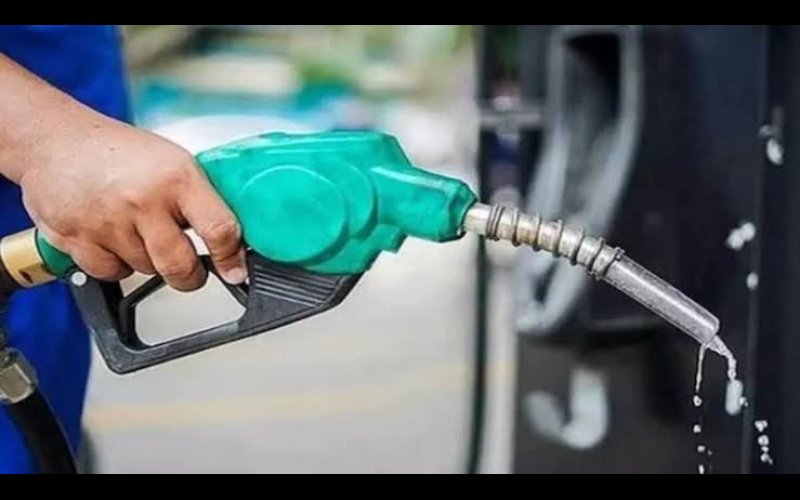
PAINS OF SUBSIDY REMOVAL: A 12-year-old Nightmare made manifest by the Man who saw the Vision
by Jude A. Inyangetoh
---------------
0.1 Intro
1.0 Governing by Bureaucratic Fiat
2.0 Jonathan Tax vs Tinubu Tax
3.0 A Vision made Manifest by the Visioner
4.0 The Seer's Bone of Contention (Govt vs Tinubu)
5.0 A Foretold Condition Precedent Boggled
---------------
INTRO
It is an irony of fate that the man who saw a vision of what would become of Nigerian if fuel subsidy is removed now sits behind the presidential wheels, driving the affairs of our nation.
What’s more! The visioner now turned President has completely lost touch of memories of his past musings that should have reminded him of the challenges of today that needs his sound predictions of yesterday to navigate our present difficulties.
It is regrettably awful that the visioner had no sooner than he became President, abandoned his 12-year old premonitory exhortation on what needs to be done to enforce that which need not be done. To the utter surprise of many Nigerians and yours truly, the Seer-President in less than 9 months of his reign, has visited on Nigerians all the nightmarish plagues he once foretold will befall the country, should Nigeria exit the fuel subsidy regime. In other words, he has turned around to adapt and unabashedly superintend over the wholesale implementation of the tabooed vision he once disparaged and outrightly repudiated.
Recall that in January, 2012 when former President Goodluck Jonathan removed fuel subsidy, members of the organized labour, civil society organizations and a good number of ‘present day champions of subsidy removal’, were stoutly against the policy. They led a nationwide protest that saw them march through the streets of Lagos and across other major cities of the country in a mass demonstration exercise that was codenamed ‘Occupy Nigeria.’ The protests began on January 2, 2012 and lasted till January 16, 2012 when the former President eventually backtracked and partially reinstated the contentious fuel subsidy regime. Consequently, the pump price of petrol which had soared to N141 per litre was reduced to N97 per litre.
During the aforementioned period of turmoil, the Jonathan’s administration had in its belated effort belaboured to school Nigerians on the long term benefits of fuel subsidy removal. Just like we are being told today, government had argued that the removal of fuel subsidy would free up more funds for mass infrastructural development in health, education, transport, energy and other key sectors of the economy. It was in the mix of the ensuing cacophony of persuasive admonitions about what Nigerians stand to benefit from fuel subsidy removal, that the historic epistle to President Jonathan from no less a towering personality but Asiwaju Bola Ahmed Tinubu, hit the newsstand. By that time, Tinubu was pretty much reckoned with as the number one opposition leader and the indisputable national leader of the Action Congress of Nigeria (ACN). His message titled, “Removal of Oil Subsidy: President Jonathan breaks social contract with the people,” is a tell-tale prophetic essay that has today become his nemesis and incidentally the choice subject of this literary review.
1.0 GOVERNING BY BUREAUCRATIC FIAT
In paragraph one of Tinubu’s message to President Jonathan, he pointedly accused the Jonathan’s administration of using bureaucratic fiat in governing Nigerians, this he noted, was a ‘breach of government social contract with the people.’
The paragraph reads in part: “This government which owes its very existence to the people desires to be governed by someone more humbled than elitist, has turned its back on the collective will. By bureaucratic fiat, government made the most fateful economic decision any administration has made since the inception of the fourth republic and it has done so with an arrogant wave of the hand as if issuing a minor regulation.
“Because of the terrible substance of the decision and the haughty style of its enactment, the people feel betrayed and angry. At this moment, we know not to where this anger will lead. In good conscience, we pray against violence. Also in good conscience, it is the duty of every citizen to peacefully demonstrate and record their opposition to this draconian measure that is swiftly crippling the economy more than it will ever cure it,” he stated.
Fast forward to 29th May 2023, when Asiwaju Bola Ahmed Tinubu mounted the podium to make his inaugural speech as the 16th President of Nigeria but ended up removing fuel subsidy by ‘inaugural fiat’, can we safely say that President Tinubu did not betray Nigerians by this singular act? If Nigerians had felt betrayed by the Jonathan’s subsidy removal policy, are Nigerians today not fatally betrayed, emotionally traumatized, economically sabotaged and utterly dehumanized on account of the Tinubu’s subsidy removal scheme?
2.0 JONATHAN TAX vs TINUBU TAX
What President Tinubu satirically referred to as the 'Jonathan Tax' was a mere 117% increment in the pump price of petrol that went from N65 per litre to N141 per litre. Compare that to the 'Tinubu Tax' that is a whopping 254% one-fell-swoop price adjustment from N195 per litre to N690 per litre. Judging from the two scenarios above, if the Jonathan Tax was said to be draconian, how then shall we describe the Tinubu Tax if not hyper-draconian.
Yet our dear President when he never had access to the levers of power, admonished Jonathan in this witty terms: “What this government claims to be economic decisions are essentially political ones. As there is progressive politics, there is elitist politics, there is elitist economics. It all depends on what and who in society government would rather favour. The Jonathan Tax represents a new standard of elitism.”
And I ask, if the Jonathan Tax was meant to benefit the elites, which group or sect is the Tinubu Tax meant to profit? Certainly, not the hapless Nigerian masses who already, are immiserated and hard done by the Tinubu Tax.
In any case, facts are sacred. On this issue of fuel subsidy removal, whether it rears it ugly head in the form of a benign Jonathan Tax or the malignant Tinubu Tax, one thing is certain, it is solely designed to benefit the corrupt political elites. It is an obnoxious policy that takes away the uniform resource allocation via low cost fuel pricing that benefits the common people, to feed the unquenchable avarice of the ruling elites.
Is it not foolhardy and sheer political skulduggery that government wants to remove subsidy on fuel in order to save money to subsidise other needs of the citizenry that are pretty much dependent on the price of fuel? Does it make any sense that government is removing subsidy on one relevant item just to subsidise other irrelevant items? Why is government acting as if the citizens are complaining and asking them to come and take away fuel subsidy and hand them 'palliative subsidy' in return?
Instead of doing the needful: naming, shaming and prosecuting the unpatriotic subsidy thieves, with a view to recouping the avalanche of stolen funds in their coffers, government has decided to shot itself in the foot by removing the only good thing that the common people have been enjoying from the stable of government in recent years.
3.0 A VISION MADE MANIFEST BY THE VISIONER
Quite interestingly, a 15-point litany of what fuel subsidy removal will cause Nigerians was canonically put together by our President to guide his predecessors on this vexed issue of subsidy removal. Below are the nightmarish thematic points he listed, that were pretty much of essence then as they are today:
3.1 Fuel Subsidy removal will increase the price of petrol, transport fares and prices of consumer items.
3.2 A twofold or more increase in fuel price will result in doubling transportation cost.
3.3 The prices of staple food will increase by 25 to 50 percent.
3.4 Citizens income will remain low and stagnant.
3.5 Citizens will have no way to augment their earnings.
3.6 Citizens will have little or no lesser expenses to make for they know no luxuries, so Nigerians will be tapped out.
3.7 There will be less food, less medicine and less school across the land.
3.8 More children will cry in hunger and more parents will cry at the children’s despair.
3.9 The poor and middle class consumers will spend the same amount to buy much less.
3.10 The volume of economic activity will drop like a stone tossed from a high building.
3.11 The subsidy tax will push Nigerians to untold hardship that will endure for years.
3.12 Small businesses will face higher operational costs and lower revenues.
3.13 People will starve and families shall crumble while the state officials shall pride itself with ‘saving money’ for the country.
3.14 The promised benefits of the ill-fated petroleum deregulation will not be substantially realized.
3.15 This miserly measure will inexorably put Nigerians in severe harm’s way.
4.0 THE SEER’S BONE OF CONTENTION (GOVERNMENT Vs TINUBU)
4.1 Government said subsidy expenditure is unsustainable yet on the other hand, it claimed the amount now earmarked for subsidy will be used to fund other people-oriented programs.
In his response, Tinubu contended that "if subsidy is bankrupting us, then relocating funds to different programs will be no less harmful. A bankrupting expenditure retains its quality whether used for subsidy or another purpose.”
4.2 On Government’s intent to align itself with what Tinubu referred to as 'the goals of European conservatives', he said, “There has been no nation on the face of the planet that has developed or achieved long-term prosperity by devotion to conservative, ultra-free market economic ideas that dominate this government.”
4.3 Government said that “subsidy removal will stabilize the exchange rate” whereas Tinubu contended that “the assertion makes no sense.” He then added that “since marketers convert so much of the naira from the gain of selling petrol into dollars, there is downward pressure on the exchange rate and foreign reserves. However, this pressure is not a by-product of the subsidy, it is a by-product of importation. With the subsidy lifted, the marketers will earn the same or more from the sale of petrol.”
4.4 Government argued that “subsidy must be removed to end the unjust enrichment of the importing cabal,” this Tinubu called a ‘philosophical mystery.’ On the contrary, he maintained that “if this is truly a subsidy, there should be no unjust enrichment. A subsidy is created to allow the general public pay a lesser price while sellers earn the prevailing market price. Subsidy removal should not increase or decrease the amount earned per litre by the suppliers.”
4.5 Government said that “subsidy removal will create jobs.” In response, Tinubu said that the claim is utterly misleading. He went further to state that “subsidy removal will destroy more jobs than it creates. For every job it creates in the capital intensive petroleum sector, it will terminate several jobs in the rest of the labour intensive economy……salaries will not increase. This means demand for goods will lessen as will sales volume and overall economic activity. The removal will have a recessionary impact on the economy as a whole.”
5.0 A FORETOLD CONDITION PRECEDENT BOGGLED
In the second paragraph of his premonitive essay, Tinubu clearly spelt out the conditions precedent for fuel subsidy to be removed. He noted: “Though someday, Nigeria will have to remove the subsidy, the time to do it is not now. This subsidy is ill-timed and violates the condition precedent necessary before such a decision is made.”
Then he went on to outline these three conditions precedent viz:
(i) “First, government needs to clean up and throw away the salad of corruption in the NNPC….. which was a clear acceptance of the fact that there is endemic corruption in NNPC that needs to be rooted out before the thought of subsidy removal can be entertained.
(ii) “Then proceed to lay the foundation for a mass transit system in the railways and road network with long-term bonds”…… this was another open acceptance of the fact that our country lacks a functional mass transit system, particularly rail transportation which is globally adjudged the cheapest means of mass transit; that could have been used to cushion the negative impact of subsidy removal.
(iii) “And fully develop the energy sector towards revitalizing Nigeria’s economy and easing the burden any subsidy removal may have on the people.” This too was another indication that the prevailing infrastructural deficit in our power sector cannot support subsidy removal.
Now below are some posers for Mr President to pore through:
• Were the above conditions precedent met as at May 29, 2023 when he mounted the podium to declare that ‘subsidy is gone’ ?
• Was the President's action not akin to putting the cart before the horse? And if so, how does he expect the cart to drive the horse?
• Can the President beat his chest in honest satisfaction that the NNPC was purged of the so-called ‘salad of corruption’ before he proceeded to announce the removal of fuel subsidy?
• In the area of rail transportation, is it not a thing of shame that our leaders have curiously been settling for the 18th century brand of refurbished coaches they ferry in from the dumb sites of Europe and Asia to be used as our choice means of rail transit instead of the high speed, trackless and highly developed rail transportation system of the modern era?
• In the area of power, what has changed? Recall that the last time the country was close to getting it right was when former President Goodluck Jonathan moved to unbundle the power sector from NEPA's satanic grip. But quite regrettably, rather than follow the Obasanjo template of telecom industry unbundling - where competent, qualified and result-oriented multinational companies were assembled and granted licence to take over the runnings of the telecom industry; he was unduly pressured to relegate the runnings of the unbundled NEPA into the hands of a prebendal, rent-seeking, incompetent and unqualified Nigerian-owned companies otherwise called the Distribution Companies (DISCOS). True to their form, it is over a decade since they took over the facilities of NEPA in their respective localities, yet no commensurate investment has been added to grow the sector from it parlours state, instead what we hear is that government has from time to time been subsidizing their crass inefficiencies.
• Recently, Nigerians were shocked to hear the unbelievable, that the IMF and the World Bank are asking its government to remove electricity subsidy. And I ask, how do you subsidize inefficiency? Or to put it succinctly, how do you subsidize what does not exist? Nigerians are busy complaining of erratic power supply and all of a sudden we are being told that even the dysfunctional electricity supply we are being served is a product of subsidy. Is this not the height of man's inhumanity to man? Till date, the DISCOS still operate largely on the disapproved template of estimated billing which they have deployed over the years to milk the citizens dry. This is so because, our government did not find it pertinent to order the mandatory installation of prepaid meters in every Nigerian home as a condition precedent for the start-up operation of the DISCOS.
• If as a nation, we have not succeeded in ridding the NNPCL of endemic corruption; if we have not moved an inch closer to having a functional rail transportation system that runs the gamut through the North, South, state capitals and major cities of the country; if we have not addressed the age-old dysfunctional power problem; then what really informed President Tinubu’s hasty decision to remove fuel subsidy at a point in time he had yet to step into his presidential precinct to review the position of things? Could it be the consequence of a pact he may have signed with the predatory West that want to tank Nigeria by any means? Or is it all about the narcissistic urge to further enrich himself and the prebendal elites of his time, like he once foretold?
Someone needs to remind our President that the state of the nation at present is even worse than our situation in 2012 when he penned down his historic SOS on why subsidy should not be removed. If 12 years ago was a bad time to remove fuel subsidy, now is even worse because the situation has further deteriorated and nothing has positively changed. To state the obvious, the conditions precedent as reeled out by the Seer-President, are still far from being met.
Telling Nigerians that the monies saved from subsidy removal will be used to subsidize public transportation, education and health care services and build more infrastructure is a mere hogwash meant to sedate the masses and put them on a command-and-control button of the ruling class. Because subsidy removal is akin to financially demobilizing well-to-do citizens and turning them to ‘adult almajiris’ who then will have to depend on a disuniformly distributed government handouts/palliatives for survival. The policy is socio-economically deleterious as it is most inimical to nation building.
Removing fuel subsidy and giving palliatives in return to the citizens is a clear cut strategy at weaponizing poverty. It is a subtle scheme aimed at reducing the citizens to mere pawns in the hands of the ruling class.
So long as the three primary conditions precedent are not met, the idea of going ahead with subsidy removal remains elitist, anti-people and unintentionally aimed at capsizing the ship of State. The Seer-President cannot at this point in time invalidate his 12-year-old prophecy just because he is no longer a spectator but an actor on the stage of power play. Rather than play the villain by bringing to manifestation his doomsday prophetic plague on Nigerians, the time is now for him to retrace his steps and be the hero who would not sit to watch in reckless abandon as Nigerians continue to suffer inconsolably the after-effect of a policy he had long ago predicted to be elitist, anti-people and a no-gooder for the nation.
Comrade Jude Inyangetoh is a Public Affairs Analyst. He writes from Uyo, Akwa Ibom State.
email: inyangetohjude@gmail.com
whatsapp @ 08068240444
Comments:
Leave a Reply