

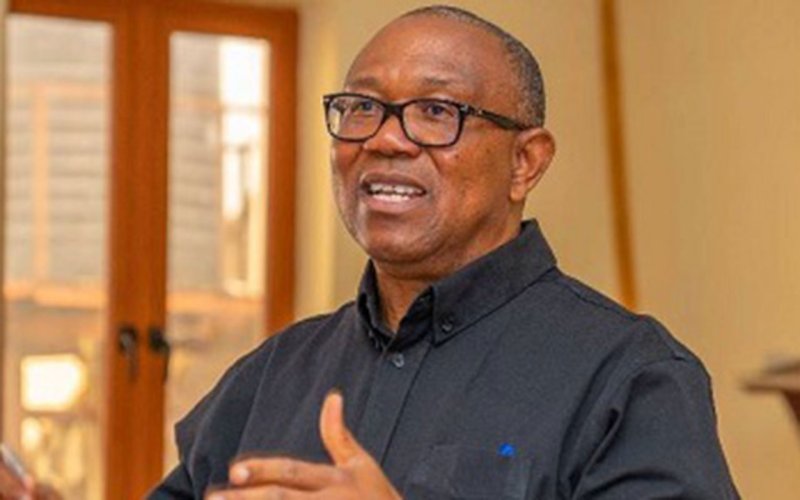
Former presidential candidate of the Labour Party, Peter
Obi, has accused the Federal Government of presiding over the alleged fabrication
of laws, following the presentation of the 2026 national budget by
President Bola Ahmed Tinubu.
In a statement titled “Migrating from Padded
Budgets to Forged Laws,” posted on his official X (formerly Twitter) handle
on Saturday, Obi warned that the alleged actions pose a serious threat to constitutional
governance and could further erode public trust in government
institutions.
President Tinubu on Friday presented the 2026
Appropriation Bill before a joint session of the National Assembly,
outlining key fiscal assumptions for the coming year.
According to the President, the proposed budget
provides for ?26.08 trillion in capital expenditure, with a crude oil
benchmark of $64.85 per barrel. The government projects total revenue of ?34.33
trillion, while ?15.52 trillion is earmarked for debt servicing. The
budget deficit stands at ?23.85 trillion, representing 4.28 percent
of Nigeria’s Gross Domestic Product (GDP).
The proposal is based on an estimated crude oil
production of 1.84 million barrels per day and an exchange rate
assumption of ?1,400 to the US dollar for the 2026 fiscal year.
However, Obi alleged that discrepancies exist between
bills passed by the National Assembly and the versions eventually
published and enforced by the executive arm of government.
“Our national shame continues to unfold, evident in
the decisions made by our leaders, even at the highest levels of government,”
Obi said.
He described the alleged discrepancies as “deeply
troubling and unacceptable,” stressing that they go beyond administrative
errors and strike at the heart of Nigeria’s constitutional order.
“This is not merely an administrative oversight; it is
a serious matter that reveals the extent of our institutional decay,” he
stated.
Obi further claimed that the country has moved “from
padded budgets to forged laws,” arguing that such practices undermine
taxpayers’ rights and access to justice.
He raised concerns over what he described as the introduction
of enforcement and coercive provisions that were allegedly never approved
by the House of Representatives, including a proposed mandatory 20 percent
deposit before appeals can be heard, asset sales without judicial
oversight, and the granting of arrest powers to tax authorities.
“Perhaps most disturbing is the silence of the
Presidency on a matter involving allegations of forgery, institutional
sabotage, and abuse of process,” Obi said, demanding full disclosure on how the
alleged alterations were made.
He urged the government to clarify what was passed by
lawmakers, what was signed into law, and what was officially gazetted, warning
that citizens cannot be asked to bear increased tax burdens while confidence in
governance continues to decline.
Obi concluded by calling for leadership anchored on due
process, transparency, accountability, and respect for the rule of law,
insisting that no nation can thrive where laws are allegedly forged and silence
replaces accountability.
Comments:
Leave a Reply