

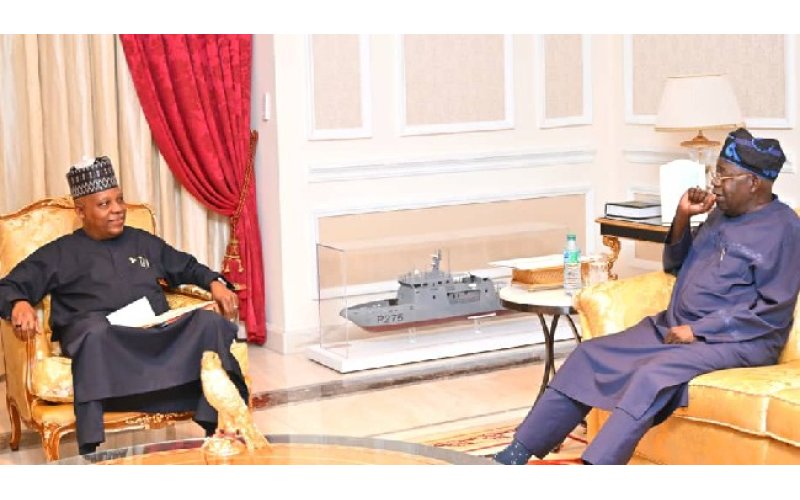
Vice President Kashim Shettima has defended the
economic reforms introduced by President Bola Tinubu, saying the measures
helped prevent Nigeria from sliding into a deeper economic crisis.
Shettima made the remarks on Saturday while speaking
with journalists in Lagos after meeting with President Tinubu.
According to the Vice President, Nigeria’s foreign
reserves were below $3.9 billion when the Tinubu administration came into
office in 2023. He argued that the situation left the country in a financially
precarious position, with the available reserves insufficient to cover even a
month’s fuel imports.
Shettima said the administration nevertheless
proceeded with major economic decisions, including the removal of fuel subsidy
and the unification of the country’s multiple exchange-rate windows.
He described the reforms as difficult but necessary
steps, insisting that the government inherited an economy that was approaching
a critical point.
“The economy was actually on the verge of collapse. He
saved the economy,” Shettima said, referring to President Tinubu.
The Vice President further argued that Nigeria had
been heading towards a situation similar to what Venezuela experienced before
the current administration intervened.
Shettima also acknowledged the economic difficulties
facing Nigerians, but maintained that the government was working on measures
designed to reduce the impact of the reforms on households and businesses.
“We appreciate the pains Nigerians are going through,
but tough times do not last forever; tough people do,” he said.
He disclosed that the Federal Government would soon
introduce additional initiatives aimed at easing transportation and logistics
challenges in different parts of the country.
Among the planned programmes, according to Shettima,
is an e-logistics initiative in the North-West, alongside the deployment of
10,600 electric tricycles in the North-East.
He added that the government also plans to introduce
300 buses and e-taxis as part of efforts to improve transportation and reduce
the burden on citizens.
The meeting between Tinubu and Shettima in Lagos was
their first public engagement since the President returned from his European
vacation and the Vice President returned from the 81st United Nations General
Assembly in New York.
Tinubu had, in his Independence Day address, said
Nigeria was gradually moving from the reform stage towards economic prosperity.
However, opposition figures have challenged the
administration’s assessment of the economy.
Former Vice President Atiku Abubakar, who is
associated with the African Democratic Congress, criticised the government over
what he described as worsening poverty since Tinubu assumed office.
Similarly, Peter Obi of the Nigeria Democratic
Congress has raised concerns over hunger and insecurity, arguing that Nigerians
continue to face significant economic hardship under the current
administration.
Comments:
Leave a Reply