

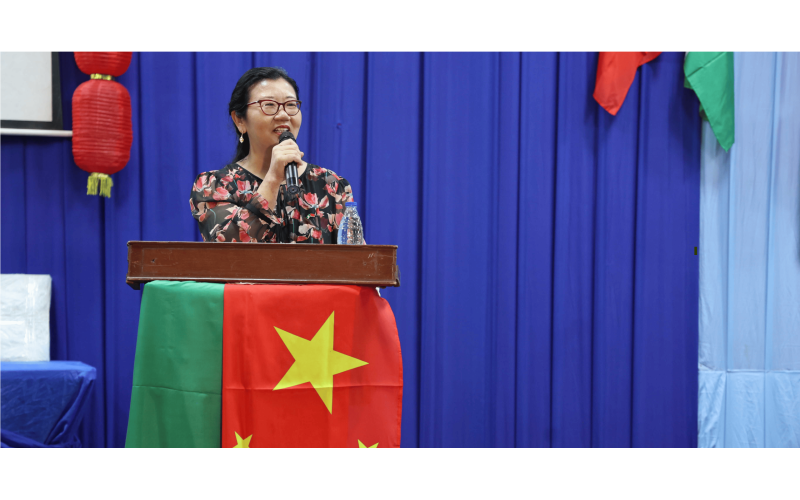
The Chinese envoy noted that her country adhered to
multilateralism and supported the reform of the WTO.
The Chinese Consulate General in Lagos, Nigeria, Yan
Yuqing, says African nations should leverage their resources and market
advantages to engage more in international cooperation while maintaining
sovereignty and economic independence.
According to Ms Yuqing, the global trade system is
undergoing restructuring, and countries need to strengthen cooperation and
dialogue to jointly address challenges and promote inclusive growth.
Ms Yuqing made this known in an interview with the
News Agency of Nigeria (NAN) in Lagos.
She said that recently, the intensification of
competition between China and the US has had a profound impact on global trade
and international organisations such as the World Trade Organisation (WTO).
The envoy noted that her country adhered to
multilateralism and supported the reform of the WTO to address the challenges
of unilateralism and protectionism.
“The Sino-American rivalry may lead to further
fragmentation of the global economic landscape, prompting more nations to seek
new models of economic cooperation, such as expansion of the BRICS mechanism.
BRICS stands for Brazil, Russia, India, China, and
South Africa. It’s an acronym for a group of emerging market economies that
work together to promote cooperation, development, and security.
It is an intergovernmental organisation consisting of
10 countries – Brazil, Russia, India, China, South Africa, Egypt, Ethiopia,
Indonesia, Iran and the United Arab Emirates.
BRICS is considered to be a counterpart and
alternative to the [G7] bloc of the world’s largest economies,
According to the envoy, amidst competition between
China, the US, and emerging powers, African countries are actively adopting
diversified diplomatic strategies, strengthening regional cooperation, and
participating in multilateral mechanisms to balance the interests of all
parties and ensure their own development space.
Speaking on Nigeria’s partnership with BRICS, she said
the country is expected to gain more opportunities for investments, technology
transfer, and market access, thereby promoting its economic development.
On China’s Belt and Road Initiative (BRI), Ms Yuqing
noted that since its proposal in 2013, it had evolved into a highly acclaimed
international public good and a broadly participatory platform for
international cooperation in today’s world.
“Landmark BRI projects undertaken by Chinese
enterprises in Nigeria, include the Lagos-Ibadan Railway and the Lekki Deep Sea
Port.”
Ms Yuqing said the development of the BRI had also
made a positive contribution to promoting the healthy progress of economic
globalisation, solving global development challenges, and improving the global
governance system, carving out a new pathway for humanity to achieve
modernisation together.
According to her, the advancement of the Belt and Road
cooperation between China and Africa is conducive to fostering economic and
social development in Africa and leading the countries of the Global South
toward modernisation collectively.
She, however, said China firmly opposed certain
Western countries’ smear and sabotage of the BRI, through the means of
pressuring and coercion.
“We appreciate Nigeria for its support and active
participation in the three major global initiatives of development, security,
and civilisation.
“China is willing to synergise the joint construction
of the BRI and the 10 partnership actions of the Forum on China-Africa
Cooperation (FOCAC) Beijing Summit with the priority areas of Nigeria’s Renewed
Hope policy.”
She said the strength of the Global South,
characterised by the unity and cooperation of developing countries, is
increasingly converging.
This, Ms Yuqing said, is against the backdrop of
geopolitics becoming more visible, global governance facing a deficit, major
power relations becoming confrontational, and the international situation
growing turbulent.
“On her part, the Global South is gradually emerging
as a positive, stabilising, and constructive force in international affairs,
breaking the long-standing pattern of Western dominance in global governance.”
According to her, the collective rise of the Global
South is a distinctive feature of the profound changes in the world.
This, she said, remained an inevitable outcome of the
growing importance of developing countries in international affairs and
reflected profound shifts in the balance of international power.
“This trend aligns with the tide of the times in the
development of international relations and meets common aspirations of people
across the world.
“I believe that mutually beneficial cooperation should
be the basic principle of all countries’ policy in handling international
relations and China will always adhere to the Five Principles of Peaceful
Coexistence.
“We are willing to work together with all parties in
unity and cooperation, like passengers in the same boat, seeking win-win
outcomes and avoiding multiple losses, to inject more certainty into the world
and promote the global governance system toward a more equitable and reasonable
direction.”
Highlighting the tariff wars between the US and other
economies, she said the general consensus of the international community is
that there are no winners in trade wars.
She further said China had always adhered to the
diplomatic concepts of mutual respect, fairness and justice, and win-win
cooperation.
Ms Yuqing said China remained willing to work together
with all countries, including the US, to promote the building of a new type of
international relations and make positive contributions to world peace and
development.
“At the same time, China opposes any form of hegemony
and power politics, and advocates resolving differences through dialogue and
cooperation on an equal footing to achieve common prosperity.
“We welcome positive changes from the US, building
mutual respect with other countries and working together for a better tomorrow
for the world,” Ms Yuqing said.
Comments:
Leave a Reply