

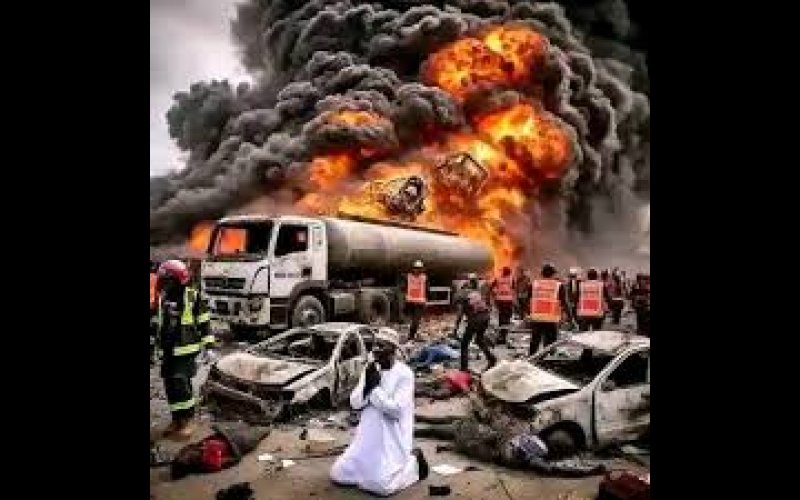
A tragic
explosion near the Nyanya Bridge along the Abuja-Keffi Expressway on Wednesday
evening has left at least six people dead and several others injured, while
numerous vehicles were completely destroyed. The incident, which occurred
during rush hour traffic, has sparked widespread grief and renewed concerns
about road safety in Nigeria’s capital city. Witnesses reported hearing
multiple explosions following a massive collision involving a Dangote trailer
and other vehicles, causing panic among commuters and residents.
The explosion happened at approximately 6:58 pm when a
trailer, reportedly transporting cement, lost control while approaching the
Nyanya Bridge from the AYA axis. The driver, unable to stop the heavy-loaded
vehicle in time, crashed into a line of stationary cars caught in traffic
congestion. The impact of the collision led to a violent chain reaction,
setting off a massive fire that quickly engulfed fourteen vehicles, including
private cars, buses, and motorcycles. Many motorists and passengers found themselves
trapped in their vehicles as the flames rapidly spread, leading to significant
casualties.
Emergency responders, including personnel from the
Federal Capital Territory (FCT) Police Command, the Fire Service, and other
security agencies, arrived at the scene within minutes. Firefighters battled
tirelessly to contain the inferno while rescue teams worked to evacuate victims
from the wreckage. Despite their swift intervention, six individuals were
confirmed dead, while others sustained varying degrees of injuries. The victims
were immediately rushed to nearby hospitals, including the National Hospital,
Asokoro Hospital, State House Clinic, Custom Hospital, and Nyanya General
Hospital, where medical teams provided urgent care. Unfortunately, those who
had suffered severe burns or injuries succumbed to their wounds, and their
remains were deposited at the Karu General Hospital Morgue for identification
and further investigations.
The explosion also left behind a trail of destruction,
with charred vehicles and debris scattered across the highway. The intense heat
from the fire made it difficult for emergency responders to access some of the
affected vehicles in time, leading to the tragic loss of lives. Eyewitness
accounts describe a horrifying scene, with people screaming for help as they
attempted to flee the flames. Some survivors recounted how they barely managed
to escape before their vehicles were completely engulfed. Others were not so
fortunate, as they remained trapped in their vehicles due to the rapid spread
of the fire.
Preliminary investigations by the FCT Emergency
Management Department (FEMD) revealed that the trailer involved in the crash
was powered by Compressed Natural Gas (CNG), which may have contributed to the
scale of the explosion. The FEMD confirmed that the collision triggered a fire
outbreak, which quickly escalated due to the presence of highly flammable
materials in some of the vehicles involved. The authorities are currently
investigating whether the trailer was properly maintained and whether its braking
system was in good condition at the time of the accident.
As news of the tragic incident spread, President Bola
Tinubu expressed his condolences to the families of the victims and called for
a thorough investigation to determine the exact cause of the explosion. He
instructed security agencies and road safety officials to intensify monitoring
of major roads and highways to prevent similar disasters in the future. The
President also emphasized the need for immediate medical attention for the
injured, urging hospitals and emergency responders to prioritize their treatment.
The tragedy has once again highlighted Nigeria’s
ongoing road safety challenges, particularly the frequent accidents involving
heavy-duty vehicles on major highways. Experts have long warned that the
over-reliance on road transport for the movement of goods and passengers,
coupled with poor road maintenance and reckless driving, has made Nigerian
roads among the most dangerous in the world. Tanker and trailer accidents are
alarmingly common, often leading to devastating loss of lives and property.
In January, a similarly tragic accident occurred in
north-central Nigeria when a gasoline tanker exploded, killing 98 people. The
recurring nature of these incidents has prompted renewed calls for stricter
enforcement of traffic regulations, improved road infrastructure, and better
safety protocols for transporting hazardous materials. Many Nigerians are now
urging the federal and state governments to take decisive action to address
these concerns before more lives are lost.
The FCT Police Command has assured the public that a
comprehensive investigation is underway to determine the exact circumstances
leading to Wednesday’s explosion. Authorities have also advised motorists to
exercise extreme caution, particularly when driving in areas prone to traffic
congestion. In addition, they have called for increased road safety education
for commercial and heavy-duty vehicle drivers to prevent reckless driving and
mechanical failures that could result in disasters.
Beyond the immediate tragedy, the explosion has left
many families in mourning, with some still searching for their loved ones.
Social media has been flooded with messages of condolences and calls for
justice, with citizens demanding accountability from both the government and
transportation companies. Community leaders in Karu and Nyanya have also
expressed their deep sorrow over the loss of lives and destruction caused by
the explosion, urging authorities to provide support to affected families and
survivors.
As the investigation continues, the focus remains on
ensuring that those responsible for any negligence leading to the explosion are
held accountable. Authorities are expected to release a detailed report on
their findings in the coming days, which could lead to policy changes regarding
road transportation regulations. In the meantime, many Nigerians are left to
grapple with the emotional and economic toll of yet another preventable tragedy
on the country’s roads.
The scene of the explosion has since been cleared,
with traffic movement gradually returning to normal. However, for the families
of the victims and those who witnessed the horrific events of that evening, the
scars left by the tragedy will not be easily erased. The Karu explosion serves as
yet another painful reminder of the urgent need for reforms in Nigeria’s
transportation sector, improved emergency response systems, and stricter
enforcement of safety regulations to protect lives on the country’s highways.
Comments:
Leave a Reply