

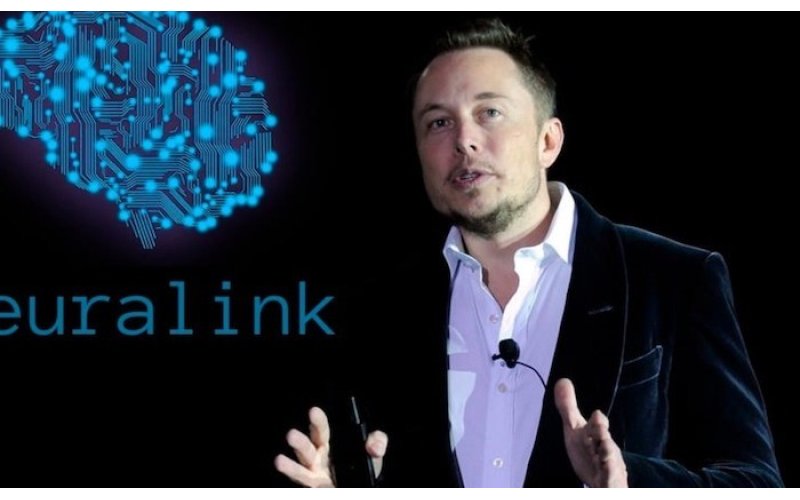
He also said that Neuralink’s new product, Telepathy, will be
initially used by those who have lost use of their limbs.
Tech billionaire Elon Musk has claimed his Neuralink Company
has successfully implanted one of its wireless brain chips in a human.
In a post on X, formerly Twitter, he said “promising” brain
activity had been detected after the procedure and the patient was “recovering
well”.
The company’s goal is to connect human brains to computers to
help tackle complex neurological conditions.
A number of rival firms have already implanted similar
devices.
“For any company producing medical devices, the first test in
humans is a significant milestone,” said Professor Anne Vanhoestenberghe of
King’s College London.
“For the brain chip implant community, we must place this
news in the context that whilst there are many companies working on exciting
products, there are only a few other companies who have implanted their devices
in humans, so Neuralink has joined a rather small group.”
However, she also suggested there needed to be a note of
caution as “true success” could only be evaluated in the long-term.
“We know Elon Musk is
very adept at generating publicity for his company,” she added.
Among the other companies to make similar advances in the
field is the École Polytechnique Fédérale in Lausanne (EPFL), in Switzerland,
which has successfully enabled a paralyzed man to walk just by thinking.
That was achieved by putting electronic implants on his brain
and spine which wirelessly communicate thoughts to his legs and feet.
Details of the breakthrough were published in the
peer-reviewed journal Nature in May 2023.
There has been no independent verification of Mr Musk’s
claims, nor has Neuralink provided any information about the procedure he says
has taken place.
BBC News has approached both Neuralink and the US’s medical
regulator, the Food and Drug Administration (FDA), for comment.
Neuralink has been criticized in the past, with Reuters
reporting in December 2022 that the company engaged in testing which resulted
in the deaths of approximately 1,500 animals, including sheep, monkeys and
pigs.
In July 2023, the head of the US Department of Agriculture –
which investigates animal welfare concerns – said it had not found any
violations of animal research rules at the firm.
However, a separate investigation by the agency is ongoing.
Mr Musk’s company was given permission to test the chip on
humans by the FDA in May 2023.
That gave the green light for the start of the six-year study
during which a robot is being used to surgically place 64 flexible threads,
thinner than a human hair, onto a part of the brain that controls “movement
intention”, according to Neuralink.
The company says that these threads allow its experimental
implant – powered by a battery that can be charged wirelessly – to record and
transmit brain signals wirelessly to an app that decodes how the person intends
to move.
“[It] has great potential to help people with neurological
disorders in future and is an excellent example of how fundamental neuroscience
research is being harnessed for medical advances,” said Professor Tara
Spires-Jones, president of the British Neuroscience Association.
“However, most of these interfaces require invasive
neurosurgery and are still in experimental stages thus it will likely be many
years before they are commonly available.”
In another post on X, Mr Musk said Neuralink’s first product
would be called Telepathy.
Telepathy, he said, would enable “control of your phone or
computer, and through them almost any device, just by thinking”.
“Initial users will be those who have lost the use of their
limbs,” he continued.
Referring to the late British scientist who had motor neuronal
disease, he added: “Imagine if Stephen Hawking could communicate faster than a
speed typist or auctioneer. That is the goal.”
While Mr Musk’s involvement raises the profile of Neuralink,
some of his rivals have a track record dating back two decades. Utah-based
Blackrock Neurotech implanted its first of many brain-computer interfaces in
2004.
Precision Neuroscience, formed by a Neuralink co-founder,
also aims to help people with paralysis. And its implant resembles a very thin
piece of tape that sits on the surface of the brain and can be implanted via a
“cranial micro-slit”, which it says is a much simpler procedure.
Existing devices have also generated results. In two separate
recent US scientific studies, implants were used to monitor brain activity when
a person tried to speak, which could then be decoded to help them communicate.
Comments:
Leave a Reply