

In
Ayder hospital in Mekelle, the capital of Ethiopia's Tigray region, the
corridors are filled with the hubbub of any busy medical facility. But in the
paediatric wing, there is a stillness to the wards.
For here lie
children numbly bearing witness to the latest food crisis to ravage northern
Ethiopia. Mostly babies, they are suffering from severe acute malnutrition.
Their mothers sit
silently at their beds, staring into the middle distance, clutching their
infants to their breast, hoping what milk they have can deliver the salvation
for which they yearn.
For they and
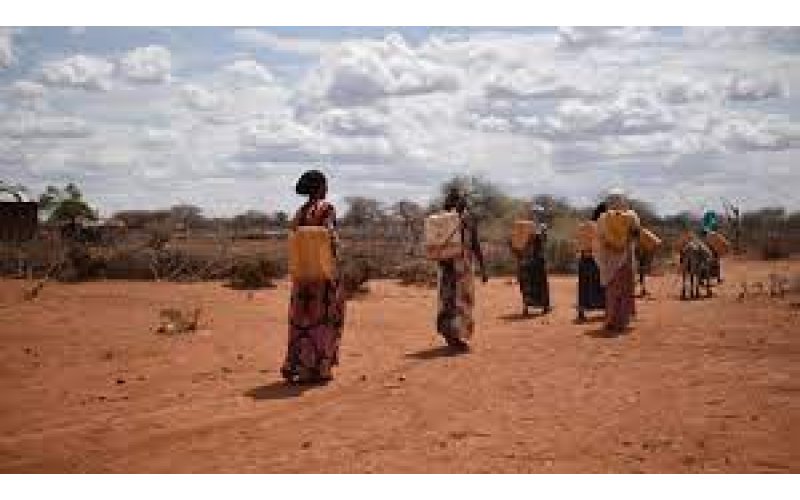
Ethiopia are suffering once again from a devastating legacy of conflict and
drought, twin evils that in recent years have destroyed farms and crops and
forced millions from their homes
The government says
16 million people across the country are facing food shortages, with almost
half of those suffering emergency or severe levels of food insecurity. That
means many are not just hungry, they are starving.
This is why Tsega
Tsigabu, 23, and her four-month-old son, Kidisty, are languishing in Ayder
hospital.
Her family were
farmers. But their crops failed and they moved to Mekelle to try to survive.
Like so many others, they ended up in a camp for people forced from their
homes.
Mrs Tsega's husband
was in the army but he injured his hand and cannot work. She took her baby for
a vaccination and the nurses saw instantly it was malnourished.
"Even when I
was pregnant, I was not eating a balanced diet," Mrs Tsega tells us.
"I was not producing enough breast milk, that's why the baby has developed
malnutrition. I just didn't have enough to eat at home."
A ceasefire was
agreed in 2022 but the impact of the conflict still lingers with at least one
million people still unable to return home remaining in the region.
We travelled with
the British Africa minister, Andrew Mitchell, to Agulae, an hours' drive north
into the hills, where a clinic was assessing children from outlying villages.
He watched as
anxious mothers lined up to have the circumference of their children's arms
measured; the less flesh on the bone, the more likely the malnutrition. The
nurses showed him their charts and they all told a similar story of the numbers
getting worse.
"There is
clearly a risk of famine if we don't now take action," Mr Mitchell said..
He promised Britain
would commit a further £100m ($125m) to help up to three million mothers and
babies in Ethiopia get access to health care; a new fund to provide medicines
and vaccines designed to end preventable deaths.
But is famine in
Ethiopia really likely?
International aid
agencies are cautious about using what some call "the F- word".
It has a precise
technical definition - 20% of households facing extreme food shortages, 30% of
children under five with acute malnutrition, and two people out of every 10,000
dying every day. Few suggest those criteria have been formally met in Ethiopia.
But for Getachew
Reda, president of the Tigray interim regional administration, those
definitions are otiose.
He said there was an
"unfolding famine" in Tigray. The numbers of those "staring
death in the eye" were rising all the time, he told us, criticising the
international community for its "lacklustre" response.
"Whether you
call it famine or a risk of famine or a potential famine, for me it's purely
academic… What transpired in 1985, for example, would pale into comparison, if
we fail to address the kind of unfolding famine that's staring us in the
eye."
What he was
referring to were the devastating crises of the mid-1980s when many hundreds of
thousands died in a famine in Tigray and elsewhere.
The media’s reporting
of the humanitarian disaster prompted a wave of publicity and campaigning,
including the Live Aid concert led by the musician Bob Geldof.
These comparisons
infuriate the federal government in Addis Ababa which denies there is famine.
Shiferaw
Teklemariam, commissioner of the Ethiopian disaster risk management commission,
said Ethiopia was a victim of climate change. He warned regional governments
against politicising the issue and urged them and the international community
to do more.
"The government
is responding very seriously, but at the same time we call on all stakeholders
to do their share."
There are politics
here.
Past famines in
Ethiopia have sometimes been linked to the downfall of governments. Analysts
say the word makes the current administration - led by Prime Minister Abiy
Ahmed - nervous.
The government is
working with the UN to tackle the food crisis but the economy here is weak and
budgets are being cut.
The truth is that
no-one really knows how bad this crisis is because hard data is difficult to
obtain.
Media access is
limited. Many areas in the north are impossible for humanitarian agencies to
visit because of continuing fighting, especially in Amhara.
There, and in
neighbouring Afar region, there are fears the food crisis could be even worse than
in Tigray. Successive anecdotal evidence - reports from villages and towns
across northern Ethiopia - suggest the situation is deteriorating.
What most sides
agree is the international community should be doing more.
Last year USAID,
America's development agency, and the United Nation's World Food Programme
suspended humanitarian support for five months after it emerged that huge
amounts were being stolen, much of it to feed various armed forces.
The head of the UN
here, Ramiz Alakbarov, said this was a forgotten crisis. "The world is not
paying attention," he said.
"We grieve for
all the troubles and difficulties elsewhere, yet people in this part of the
world cannot be forgotten. We need to get organised and donors need to step up
contributions."
At a food
distribution centre in Mekelle, we saw the World Food Programme doing what it
could, handing out scoops of wheat and lentils along with cups of oil.
The hungry queue up
bearing QR codes which identify them, their households and their needs. But the
food they get is a bare minimum and budgets are running thin.
The problem is that
parts of the country are still occupied by militias and Eritrean forces.
"In Ethiopia
you have several overlapping crises at a time," she said.
"We have
drought, people recovering from a two-year conflict, rising inflation, an
upsurge in cases of disease and all of this together just pushes people further
into hunger and malnutrition. So if we don't get food assistance to people
right now, the situation will worsen."
Back in Ayder
hospital we met Tsige Degef, 28, whose 15-month old daughter, Bereket, was
malnourished.
And her story was
typical. Ms Tsige's extended family were forced to sell their oxen during the
war to pay for expensive cereals. When peace came, the crops failed and there
was nothing to fall back on.
Ms Tsige was already
struggling when Bereket fell ill. "Her feet and legs were swollen,"
she said. "I was so worried. She was vomiting every day. The fear of a
mother with a sick child is the fear of death."
But Bereket is
getting better and Ms Tsige is hopeful of leaving hospital. "I wish she
will heal soon," she said.
"I want to open
a tea shop and sell things so I can better protect my child. I promise to do
the best I can so that she doesn't suffer in the future."
Comments:
Leave a Reply