

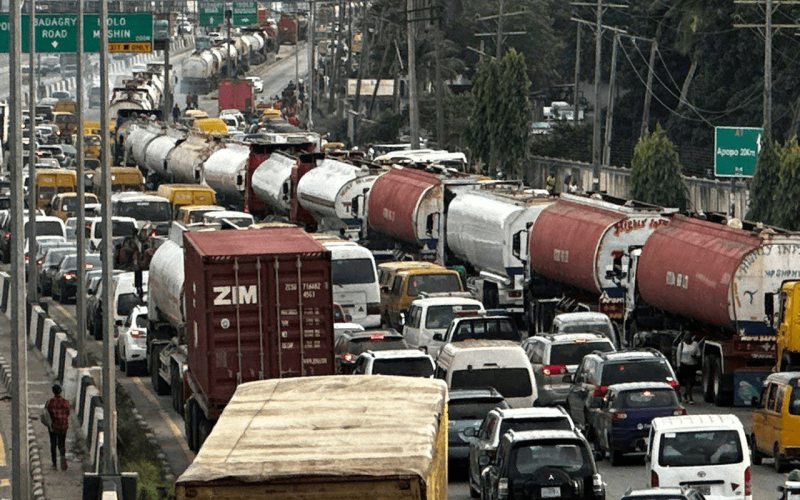
The Lagos State Government (LASG), in collaboration
with key transport unions and Dangote Industries Ltd., has successfully
negotiated a new ?10,000 enforcement fee for the e-call-up system for trucks
operating along the Lekki-Epe Corridor, averting a potential fuel scarcity
crisis.
The agreement, finalised during a stakeholders’
meeting at Dangote Oil Refining Ltd., was announced in a joint communiqué
obtained by the News Agency of Nigeria (NAN) on Thursday. Full
enforcement of the system is set to commence on August 1, 2025.
The communiqué, signed by Seun Osiyemi, Lagos State
Commissioner for Transportation; Williams Akporcha, President of the Nigeria
Union of Petroleum and Natural Gas Workers (NUPENG); Alhaji Yusuf Othman,
President of the Nigerian Association of Road Transport Owners (NARTO); and
Alhaji Hammed Fasola, President of the Independent Petroleum Marketers
Association of Nigeria (IPMAN), marks a significant step toward resolving
longstanding issues of gridlock and safety concerns along the Lekki-Epe
Corridor.
The e-call-up system, designed to regulate the
movement of articulated trucks, particularly fuel tankers, was introduced to
prevent the chaotic gridlock that plagued Apapa in previous years.
The system, first implemented by the Nigerian Ports Authority in 2020 to
address Apapa’s congestion, has been adapted for the Lekki-Epe Corridor to
ensure smooth operations around the Lekki Deep Sea Port and adjoining
industrial zones, including the Dangote Refinery.
The agreed ?10,000 fee, a reduction from the earlier
proposed ?12,500, will cover expenses related to parking infrastructure,
technology deployment, logistics, and enforcement mechanisms. Importantly, the
communiqué clarified that no revenue from the fee will accrue to the Lagos
State Government, ensuring transparency in its application.
A history of challenges
The agreement follows months of tension, as earlier
reports highlighted resistance from tanker drivers.
In June 2025, tanker drivers under NUPENG threatened
to boycott loading activities due to disputes over the proposed ?12,500
e-call-up fee, citing financial strain and lack of clarity on its
implementation.
This boycott, reported by Technext on June 16, 2025, raised concerns about
potential fuel scarcity, as the Lekki-Epe Corridor serves as a critical route
for fuel distribution from the Dangote Refinery and other facilities.
Subsequent negotiations, as reported by Technext on June 23, 2025, saw progress with the
initial agreement on a ?10,000 fee for petrol tankers. However, the latest
stakeholders’ meeting has formalised this fee across all trucks operating in
the corridor, and unions have pledged to support voluntary compliance to
minimise the need for forceful enforcement.
To ensure the system’s success, all truck operators
are required to onboard the e-call-up platform before the August 1 enforcement
date – about two weeks from today. The Lagos State Ministry of Transportation
has been directed to launch comprehensive sensitisation campaigns to educate
union members and truck drivers on the system’s requirements and benefits.
Only trucks with legitimate business within the Lekki
Free Zone, listed on a pre-uploaded Approved Truck List, will be granted entry
into the corridor. Seven designated truck parks, equipped with paved floors,
CCTV cameras, toilets, and driver lodges, have been established along the
corridor to support orderly movement and reduce roadside parking.
The Lekki Residents Association, which had previously
raised alarms over frequent truck-related accidents, has welcomed the
initiative, noting that tighter regulation will enhance safety and reduce
disruptions in the area.
Learning from Apapa’s past
The e-call-up system draws inspiration from the
Nigerian Ports Authority’s 2020 initiative to tackle Apapa’s gridlock, which
was caused by unregulated truck movements. The Apapa system significantly
reduced congestion by controlling truck access to the port through a digital
platform. The Lekki-Epe system aims to replicate this success, leveraging
technology to preempt similar challenges in the rapidly developing Lekki
industrial zone.
Comments:
Leave a Reply