

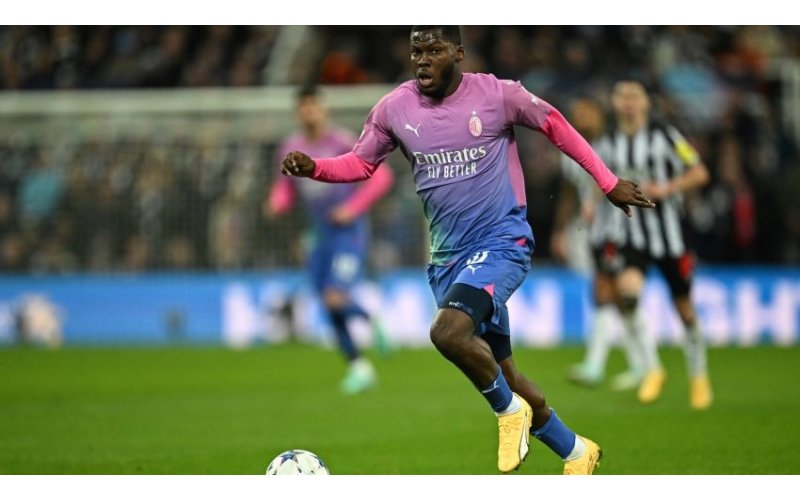
WE and AC Milan midfielder Yuns Musah is used to
hostility – passionate and aggressive crowds are part of the game after all.
Soccer players are often advised to get their heads down and focus on their
game in adverse situations.
When a boundary is crossed, however, action must
be taken.
“We’re used to obviously having away fans and
them not liking you and stuff, but when it becomes personal, racial, it really
affects you deep down,” Musah told CNN Senior Sports Analyst Darren Lewis.
In the first half of a Serie A match between AC
Milan and Udinese on Saturday, Milan
players walked off the pitch in support of their goalkeeper Mike
Maignan after he allegedly had racist abuse directed towards him by some home
Udinese fans.
The players eventually returned and earned a
hard-fought 3-2 win after Noah Okafor scored in the third minute of additional
time, but naturally, the postgame headlines were not about the result.
Instead, Italian soccer found itself in the midst
of another alleged racism scandal – one that Musah was around to witness
firsthand.
“All of a sudden we saw that our goalkeeper,
Mike, was coming across, telling the referee that there were some people making
monkey chants and just being abusive to him behind the goal,” Musah recalled.
“Obviously, we’re in an away stadium as well, so
the majority of fans from the other team – it was very intense for Mike to be
receiving all that abuse from so many fans.
“So it was really, really important that when we
saw that, the whole team reacted great. We all stuck by our friend.
“We’re people before athletes and we just forgot
about the game and focused on our friend.”
Udinese was ordered by Serie A to play a
game behind
closed doors and the club announced that it had identified and issued a
lifetime ban to five fans for “discrimination towards AC Milan player
Mike Maignan.”
Maignan talks with referee Fabio Maresca during
the match against Udinese.
“Udinese
Calcio stands firmly against any form of discrimination, and we are determined
to create an inclusive and respectful environment within our football
community,” the club said in a statement.
Musah revealed that Maignan did not want to
return to the field but eventually decided to so when he realized that his
teammates were standing with him.
“When [Maignan] saw that everyone was totally
with him, he felt that he couldn’t let the team down. So when he felt like he
wouldn’t let the team down and he saw that everyone was behind him, we came
back out together even stronger than before.”
Saturday’s events are far from a standalone
occurrence at the top level of soccer in Italy – Serie A has a history of
these type of incidents. In fact, Lazio was punished earlier this month with a
one-match stand closure after supporters directed racist chants at Romelu
Lukaku during their team’s Italian Cup win over local rivals Roma.
“It felt like a déjà vu moment,” said Musah.
“We’ve seen it before – it was like, ‘Here we go again.’ The situation,
I’ve seen it before; it is very ugly.”
This type of abuse is not exclusive to Italian
soccer either. Prior to joining Milan, Musah spent the first three years of his
senior career with Spanish side Valencia. During a league match against Real
Madrid in May last year, a Valencia fan subjected opposing forward Vinícius Jr.
to persistent
racist abuse.
Musah played in that fixture and said that the
abuse shows “ignorance” as Valencia also had a number of Black players in its
squad and condemned the supporters’ behavior.
“Before footballers, we are people, and people
[should] respect each other and treat each other equally – and then the game
comes afterwards,” he said.
Vinícius Jr. imitates the abuse directed towards
him by a fan.
Pablo Morano/Reuters
Musah posted a message on Instagram in support of Vinícius at the
time with the phrase: “If you are racist to him, you are racist to me.”
“Ultimately, they’re being racist to Black people
at that time, and I really didn’t appreciate that,” Musah said. “Being in that
situation as well and feeling powerless really hurt me as well.”
Milan’s decision to leave the field is part of a
wider debate around how players should react when there are instances of racist
abuse from supporters. Musah believes that walking off the pitch is the right
thing to do in order to send a message of zero tolerance.
“I feel like it’s a good thing to do because then
fans, or people that were behaving that way and made Mike walk off the field,
realize that they’re affecting the outcome of the game by being like that,” he
explains.
“And maybe it would stop them doing it because
they’ll know that, if they do that, the match is going to be suspended.”
The immediate response is only half the story,
however.
Omar Beckles, head of England’s Professional
Footballers’ Association, said that the union’s members do not believe that
there are “real,
consistent and significant consequences for racism,” a sentiment Musah
shares.
“The standard thing is that people would post
about on social media, the federations and clubs will ask us to make messages
about racism, to send it to people and then in two or three weeks’ time, it
dies out and we forget about it,” said Musah.
“And then, obviously, it happens again. So that’s
why players feel like there’s not enough being done.”
Musah, 21, was born in New York to Ghanaian
parents, who he says were subject to hardships when it came to employment and
accommodation as a result of their immigrant status.
He moved twice as a child, first to Italy and
then to London, England, where he grew up.
He opted to represent the US internationally and
has been capped 33 times after making his debut in 2020, the same year that
Black Lives Matter protests reached a peak worldwide after the death of George
Floyd.
Musah, representing the US, battles with
Germany's Leon Goretzka in an international friendly match last year.
Mike Lawrence/ISI Photos/USSF/Getty Images
Soccer played its part in the global movement,
with clubs in England taking a knee prior to kickoff throughout the 2020/21
season, as players and teams acknowledged the fight against racism outside of
the sport too.
“We’d go out on the field with messages written
on our pre-match jerseys; messages to show the whole world that we are on top
of this – we haven’t forgotten about it,” Musah said, recalling the US national
team’s show of solidarity in 2020.
“We’re active on doing things like that. We’re on
top of it.”
Despite the issues within the sport and in the
wider world, Musah believes that progress is being made.
He describes Udinese’s one-game crowd ban as a
“much bigger step” and explains that he is able to freely practice his faith,
whereas in the past, teams may not have been so accepting.
“So now in our locker room, for example, there’s
times where I’ll say to the guys like, ‘Look, can you give us some space to
pray, please?’” said Musah, who is a devout Muslim. “And they’re more than
happy to do that, so it’s really nice to have that.”
Musah is leading the charge against
discrimination in the sport through AC Milan’s “All the Colors of Sport”
initiative.
The program recently expanded internationally,
with Musah, alongside Milan Women’s Christy Grimshaw, connected with children
worldwide to discuss topics such as racism, multiculturalism and inclusivity
while also providing career advice.
Despite the positive steps that have been made in
the last few years, the 21-year-old asserts that there is still much to be done
and hopes that people will take a lasting lesson from Maignan’s experience.
“I feel like the ultimate message is just to
teach and to educate people on the gravity of this. Not just: ‘You’re being
racial’ or ‘you’re being offensive…’ You’ve got to treat each other with
respect. Ultimately, at the end of the day – we’re all human beings,” he said.
“We’ll be in a better place if we all respect
each other and treat each other equally.”
Comments:
Leave a Reply