

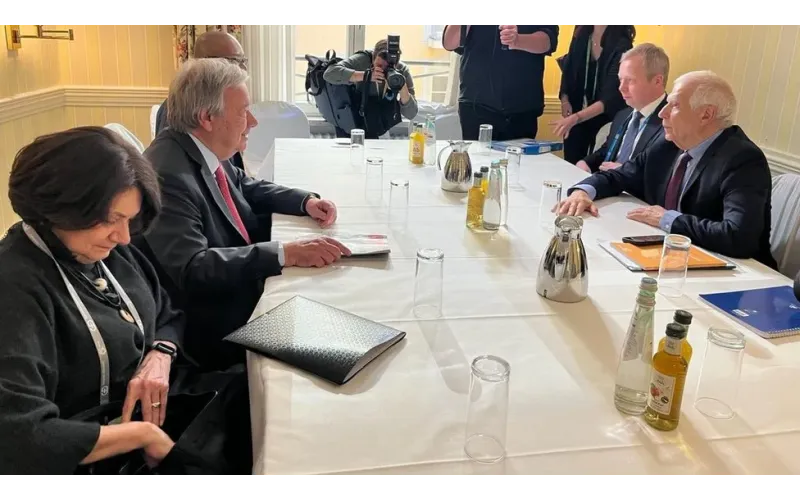
It's called the Munich Rule: engage and interact; don't lecture or ignore one another.
But this year, at the 60th Munich Security Conference (MSC), two of the most talked-about people weren't even here.
That included former US President Donald Trump, whose possible return to the White House could throw a spanner in the work of the transatlantic relationship, which lies at the heart of this premier international forum.
And Russia's President Vladimir Putin, who was vehemently blamed by one world leader after another for the death of his most prominent critic Alexei Navalny, not to mention his full-scale invasion of Ukraine, which continues to cast a long dark shadow across Europe and far beyond.
The staggering news of Navalny's death, which broke just hours before the conference kicked off on Friday, underlined again the perilous unpredictability of a world carved up by multiple fault lines and entrenched interests.
"We live in a world where there is more and more confrontation and less co-operation," regretted the EU's High Representative for Foreign Affairs and Security Policy, Josep Borrell. "The world has become a much more dangerous place," he told me as the conference drew to a close on Sunday.
"Lose-Lose?" was the maxim of this year's gathering, at a time of deepening geopolitical tensions and jarring economic uncertainties.
The MSC's annual report warned that it could give rise to "lose-lose" dynamics among governments, "a downwards spiral that jeopardises co-operation and undermines the existing international order".
"I think this has been the conference of a disordered world," reflected David Miliband, the CEO and president of the International Rescue Committee (IRC).
"It's a world dominated by impunity, where the guardrail stabilisers are not working and that's why there's so much disorder, not just in Ukraine and in Gaza and Israel, but more widely in places like Sudan, whose humanitarian crisis isn't even getting on the agenda," he said.
Comments:
Leave a Reply