

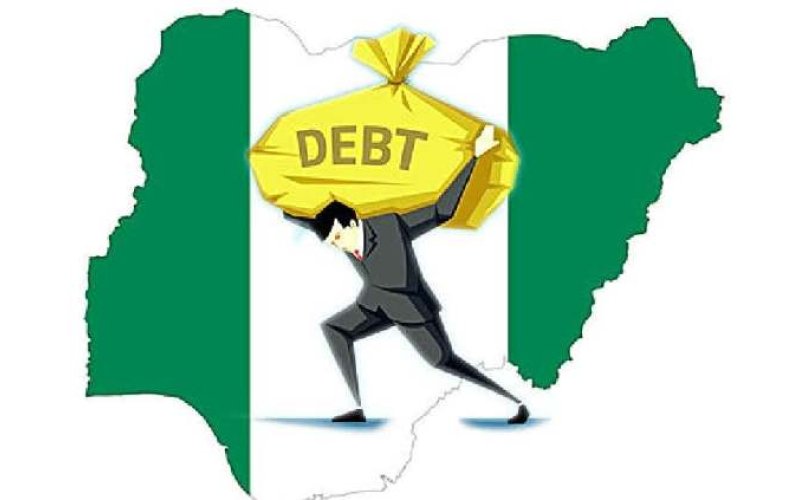
Fresh figures from the Budget Office of the Federation
have revealed that the Federal Government spent ?12.63 trillion on debt-related
obligations between January and September 2025, exceeding the amount allocated
for the period by ?1.90 trillion.
According to the 2025 Third Quarter Budget
Implementation Report, total debt repayments—including domestic debt, foreign
debt, and sinking fund obligations—surpassed the prorated budget provision of
?10.74 trillion by 17.65 percent.
The report showed that debt servicing alone accounted
for ?12.52 trillion during the nine-month period, exceeding the budgeted ?10.45
trillion by ?2.07 trillion, representing an overspend of nearly 20 percent.
A breakdown of the figures revealed that domestic debt
servicing consumed ?6.23 trillion, exceeding its allocation of ?5.39 trillion
by ?832.42 billion. Foreign debt servicing was even higher at ?6.30 trillion,
surpassing the budgeted ?5.06 trillion by ?1.24 trillion.
The growing debt burden significantly affected
government finances, with debt servicing accounting for 67.2 percent of the
Federal Government’s retained revenue of ?18.63 trillion during the period.
When sinking fund payments are included, debt-related obligations consumed
approximately 67.8 percent of total revenue.
This means that out of every ?100 earned by the
Federal Government between January and September 2025, about ?67 was used to
service debts, leaving only ?33 available for salaries, infrastructure
projects, government operations, and other critical expenditures.
The report also highlighted a major revenue shortfall.
Actual revenue stood at ?18.63 trillion, falling ?12.03 trillion below the
projected ?30.67 trillion target for the first three quarters of the year. This
represented a revenue underperformance of 39.24 percent.
In the third quarter alone, government revenue
amounted to ?7.70 trillion, which was ?2.52 trillion below the quarterly target
of ?10.22 trillion. The Budget Office attributed the shortfall primarily to
lower-than-expected oil revenues, despite improved collections from non-oil
sources.
Rising debt obligations also continued to limit
infrastructure investment. Capital expenditure during the first nine months of
the year stood at just ?3.10 trillion, significantly below the ?17.58 trillion
budgeted for the same period. As a result, debt-related payments were more than
four times higher than spending on capital projects.
While total government expenditure reached ?24.66
trillion, it remained below the prorated budget estimate of ?41.24 trillion.
However, the spending pattern showed that debt obligations received greater
priority than capital project funding.
The fiscal deficit for the period stood at ?6.03
trillion, lower than the projected ?10.58 trillion deficit. Financing sources
totalled ?12.07 trillion, including ?4.81 trillion from multilateral and
bilateral project loans and ?7.08 trillion from domestic borrowing.
The figures underscore the challenge facing Nigeria’s
public finances, where weak revenue generation and rising debt costs continue
to restrict the government’s ability to invest in infrastructure and
development projects.
Meanwhile, the Federal Government is exploring options
to refinance some of its expensive debt obligations while seeking additional
funding to bridge its budget deficit.
Speaking in an interview with Bloomberg TV, Finance
Minister Taiwo Oyedele said current market conditions provide an opportunity
for Nigeria to refinance costly debts and secure additional financing for
development projects.
According to him, the government remains open to
various funding options, including concessional loans, while discussions
continue with the World Bank and other multilateral institutions.
Recent increases in global crude oil prices have
improved Nigeria’s revenue outlook and strengthened investor confidence.
However, officials caution that higher oil prices could also contribute to
inflationary pressures, creating additional economic challenges.
Despite plans to raise more funds, Oyedele stressed
that Nigeria cannot continue relying heavily on borrowing to drive development
and must instead build a more sustainable fiscal framework capable of
supporting long-term economic growth and infrastructure development.
Comments:
Leave a Reply