

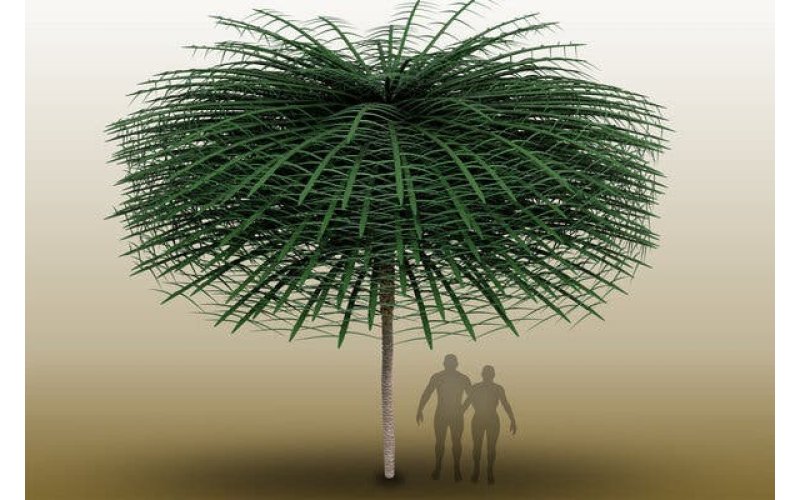
A Fossilized Tree That Dr. Seuss Might Have Dreamed Up
The toilet brushlike specimen from a Canadian quarry hints at
the evolutionary experiments that occurred during a 15-million-year gap in the
fossil record.
Sanfordiacaulis densifolia, a tree found in present day New
Brunswick, Canada, was the result of earthquakes in a 352-million-year-old
rift-lake system.Credit...Matthew Stimson
In the ancient prehistory of Earth, there is a chapter that
waits to be told known as Romer’s gap. Researchers have identified a hiatus in
the tetrapod fossil record between 360 million and 345 million years ago, after
fish had begun to adapt to land and more than 80 million years before the first
dinosaurs.
While mysteries remain about evolution’s experiments with
living things during that 15-million-year gap, a fossilized tree described in a
new paper offers greater insights to some of what was happening during this
period in nature’s laboratory.
Named Sanfordiacaulis densifolia, the tree had a
six-inch diameter with a nearly 10-foot-tall trunk composed not of wood, but of
vascular plant material, like ferns. Its crown had more than 200 finely
striated, compound leaves emanating from spiral-patterned branches that
radiated 2½ feet outward. Robert Gastaldo, a geology professor at Colby College
in Maine who is an author of the study, which was published Friday in the journal Current Biology,
compared it to “an upside-down toilet brush.” Comically top-heavy, even
Seussian, the tree most likely remained upright by intertwining its branches
with those of neighboring trees.
“This is a totally new and different kind of plant” than had
been found in the Late Paleozoic Era, said Patricia Gensel, a professor of
biology at the University of North Carolina at Chapel Hill and another author
of the paper. She added, “We typically get bits and pieces of plants, or
mineralized tree trunks, from Romer’s Gap. We don’t have many whole plants we
can reconstruct. This one we can.”
The tree was unearthed near Valley Waters, New Brunswick, in
an active private quarry within Canada’s Stonehammer UNESCO Global Geopark. (A new fossil museum will open
in the village later this year.) The area is part of the 350-million-year-old
Albert Formation, a geological layer that has also yielded fossilized fish and
trace fossils. Although partial fossils of the same tree species had previously
been found, the new discovery represents the only such fossil whose trunk and
crown were preserved together.
“It’s very rare to find something this well preserved and
unique,” said Matt Stimson, an author of the study who works at the New Brunswick Museum and
who first excavated S. densifolia with another study author, Olivia King of
Saint Mary’s University. “It’s like finding a cactus in the middle of a
Canadian boreal forest.”
Trees with spongy, vascular-tissue trunks first appeared 393
million to 383 million years ago. Their woody counterparts entered the fossil
record about 10 million years later. Trunks and stumps make up the bulk of
arboreal fossils from 398 million years to 327 million years ago, and have been
found only in coastal wetland areas.
The quarry in Valley Waters was once a swampy, tropical
ecosystem surrounding a rift lake, a deep water body running atop a fault zone.
Its sediments were similar to those of modern-day Lake Victoria and Lake
Tanganyika in East Africa. The bank containing the tree was sloughed off during
a catastrophic earthquake, depositing the tree on its side at the bottom of the
lake. Ensuing mudslides quickly buried the vegetation and snuffed out aquatic
life. Sediments filled in around the leaves, three-dimensionally preserving the
specimen, which falls somewhere on the evolutionary continuum between a woody
tree and an enormous plant.
S. densifolia evolved during a time when the tiered
forest-canopy structure was still developing, and plants were diversifying, Ms.
King said. It probably lived below the tallest trees, such as the
100-plus-foot, scaly barked Lepidodendron,
but above low-growing lycopods and mosses.
“The architecture of this tree suggests it was growing into
this ecological niche of being in the mid canopy, trying to capture as much
sunlight as possible with branches that extended out almost as long as the tree
was tall,” Ms. King said.
“It’s an experiment in plant biology that was successful for
some point in time, and then was not,” Dr. Gastaldo said. “We don’t see
anything that looks like this in any of the forests we’ve been able to evaluate
since then.”
Comments:
Leave a Reply