

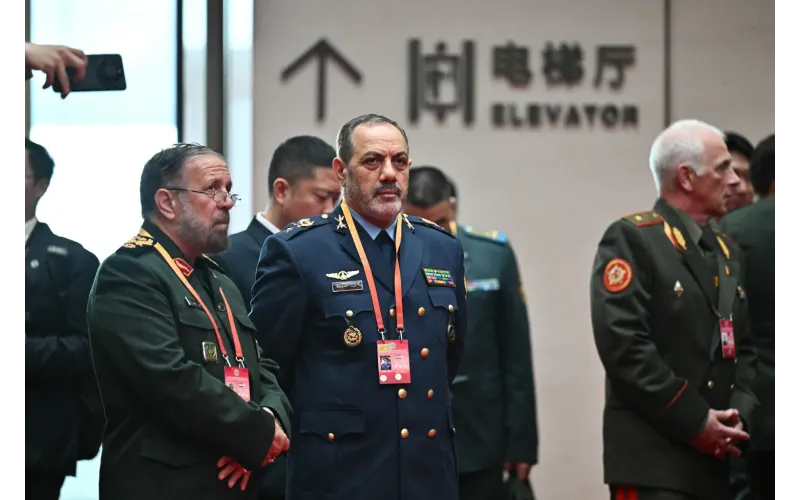
Two high-ranking Iranian military officials are
reported to have been killed during a wave of coordinated US-Israeli airstrikes
on Tehran, while uncertainty continues to surround the fate of Supreme Leader
Ali Khamenei.
Regional media sources claim that Iran’s Defence
Minister, Amir Nasirzadeh, and Revolutionary Guards commander Mohammad Pakpour
were among those killed in the strikes. Iranian authorities have not formally
confirmed the reported deaths, and speculation persists over the status of
other senior officials.
Satellite images circulating online appear to show
extensive damage to sections of a government compound in Tehran believed to be
connected to Khamenei’s official offices. His current location has not been
publicly disclosed.
Iran’s Foreign Minister, Abbas Araghchi, acknowledged
that senior personnel were lost in the attacks but sought to minimise the
impact. “We may have lost a few commanders, but that’s not such a big problem,”
he told NBC, without confirming specific names.
The strikes followed mounting tensions between
Washington and Tehran over Iran’s nuclear programme and regional influence. In
a televised address, US President Donald Trump said the operation was aimed at
defending American interests by “eliminating imminent threats from the Iranian
regime.”
“For 47 years, Iran’s regime has chanted ‘Death to
America’ and waged an unending campaign of bloodshed and mass murder,” Trump
said. “We are going to destroy their missiles and raze their missile industry
to the ground. It will be totally obliterated.” He also warned Iran’s
leadership to “lay down arms” or “face certain death.”
Within hours of the airstrikes, Iran launched
retaliatory missile attacks targeting Israel and several US military
installations across the Gulf, including bases in Bahrain, Qatar, Kuwait and
the United Arab Emirates. Missile interceptions were reported in multiple
countries, prompting airspace closures and widespread disruption to civilian
flights.
Plumes of smoke were seen rising near US facilities,
including the headquarters of the United States Navy Fifth Fleet in Bahrain.
Regional officials described the attacks as among the most serious directed at
American assets in the Middle East in recent years.
Iran has consistently rejected US demands to halt
uranium enrichment and scale back its ballistic missile programme, maintaining
that its nuclear activities are peaceful. Indirect diplomatic talks, reportedly
mediated by Oman, had been ongoing but appeared to stall ahead of the latest
escalation.
With both sides continuing to exchange strikes and
rhetoric intensifying, fears are mounting that the confrontation could widen
into a broader regional conflict.
Comments:
Leave a Reply