

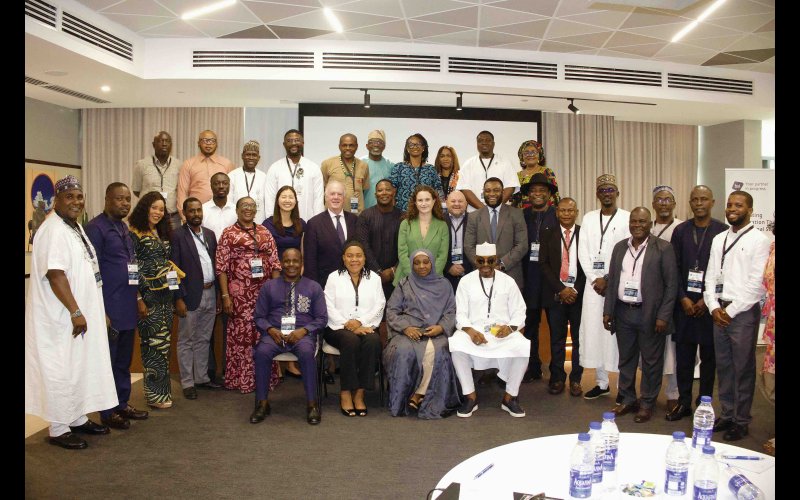
The British High Commission in Nigeria has reaffirmed
the UK's commitment to supporting Nigeria's digital transformation agenda,
following a successful series of engagements during a recent visit by the
British Standards Institution (BSI).
The centrepiece of the visit was an Executive Workshop
on Artificial Intelligence Governance and Standards, delivered in partnership
with the National Centre for Artificial Intelligence and Robotics (NCAIR) under
the UK Government's Digital Access Programme. The workshop brought together
senior government leaders, regulators and technology practitioners to
strengthen Nigeria's capacity for responsible AI adoption, governance and
oversight. It explored practical ways to apply internationally recognised standards
for AI governance, risk management, assurance and accountability, in support of
Nigeria's ambition to become a leading AI economy in Africa.
Participants examined leading standards, including
ISO/IEC 42001 for AI Management Systems and ISO/IEC 23894 for AI Risk
Management, along with other emerging frameworks designed to support safe and
trustworthy AI deployment.
The workshop builds on several years of collaboration
between BSI and Nigerian institutions, including the National Information
Technology Development Agency (NITDA), the Standards Organisation of Nigeria
(SON), the Nigeria Data Protection Commission (NDPC) and NCAIR. BSI has
supported capacity building, policy engagement and awareness raising on the use
of international standards for emerging digital technologies. Through the
partnership, the UK and Nigeria are promoting international best practice in AI,
digital trust, data governance, cybersecurity, smart infrastructure, digital
public services and electronic waste management.
The programme ended with a high-level close-out
reception in Abuja, attended by policymakers, regulators, standards experts,
industry representatives and development partners, to discuss the future of AI
governance and standards-led innovation in Nigeria. Successful participating
officials were recognised at the event, which was held at the Afreximbank trade
centre.
Speaking at the reception, Grace Bell, First Secretary
for Economic Partnerships and Digital at the British High Commission, stressed
the strategic importance of standards. "Artificial Intelligence presents
enormous opportunities for economic growth, innovation and social development.
However, realising these benefits requires the right governance frameworks,
strong institutions and trusted standards that can underpin safe, secure and
responsible adoption," she said.
She added that the UK is proud to support Nigeria's
digital transformation journey, and that its collaboration with BSI, NITDA, SON
and the Federal Ministry of Communications, Innovation and Digital Economy
reflects a shared belief that standards are strategic enablers of innovation,
investment, trade and public trust. According to her, the partnership has grown
into a broad platform for cooperation on digital trade, AI governance, digital
public infrastructure, cybersecurity and data protection, with potential to
expand into e-waste management and e-health.
Speaking on behalf of the Nigerian government, NCAIR
National Coordinator, Dr. Olubunmi Ajala, underscored the need to strengthen
national capability for AI governance and thanked the UK Government and BSI for
their continued support. "Together, we have moved beyond theoretical
conversations about emerging technology to build genuine, sovereign
institutional capacity," he said, calling for the creation of a permanent
cross-government Community of Practice.
Beyond the workshop, BSI also held engagements with
the National Environmental Standards and Regulations Enforcement Agency
(NESREA) and the FCDO Climate Finance team to assess e-waste management models
in Nigeria and explore ways to deepen cooperation on digital trade standards.
The British High Commission said it remains committed
to supporting Nigeria's vision of a digitally enabled economy and will continue
to champion standards-led approaches to sustainable and inclusive digital
transformation.
Comments:
Leave a Reply