

Argentina
was once one of the richest countries in the world, richer than France or
Germany.
And much of that
wealth was built on exports of beef, especially to Britain. But that was well
over 100 years ago.
Now, thanks to a
profound economic crisis, it languishes in around 70th place, according to the latest figures from the World Bank.
And a growing number
of people here simply can't afford to eat beef from the cattle that still roam
the fertile grasslands known as the Pampas. People like Oriana and Samir, a
young couple in their early 20s living in a run-down neighbourhood of the
capital Buenos Aires.
"It's very
difficult," Oriana says. "You're constantly asking yourself - 'how am
I going to make ends meet?'. We're the country of beef, but we only eat chicken
because it's cheaper."
Even chicken is a
treat. Last year, inflation soared to 211%, the highest rate in three decades.
In December alone, prices rose by more than 25%.
The family share a
small flat with their young daughter Chiara, and also Samir's parents and his
brother. Paying the bills is a constant worry. The costs of food, but also
rent, electricity and transport keep rising all the time.
Samir is a
self-employed delivery driver, but the economic crisis means that demand has
dropped sharply. His earnings can't keep up with rising prices.
Plus he worries
about growing insecurity on the streets, as people get more and more desperate.
"They might kill you just for your cell phone," he says.
At least 40% of the
population live in poverty, according to the last set of official government
figures. Most suspect the real figure is even higher.
Both Oriana and
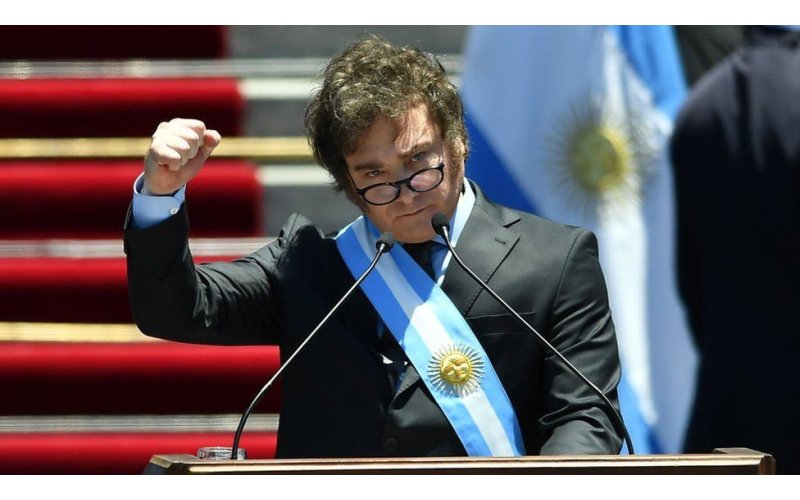
Samir voted for Argentina's new leader Javier Milei, the radical right-wing
libertarian with extravagant hair and an abrasive style. He came from behind in
last year's election to win more than 55% of the vote.
"He understands
people's problems," says Samir, "I think he's just what Argentina
needs… to deal with the inflation."
"If the
economic problems continue for three more months, I'll be in trouble and I
won't be able to cover my outgoings," he says.
More and more people
in Argentina are having to improvise to survive. Not far from one of Claudio's
shops, a small van is parked by the side of the road, the boot piled high with
trays of eggs.
The cheap price, $1
(79p) for a dozen eggs, has attracted a queue. But the van's owner does not
linger long, just in case the police come by.
The streets of
Buenos Aires may still be lined with the ornate architecture of the country's
19th-Century boom, but they're also teeming with street vendors, delivery app
riders and unofficial taxis. Analysis of official figures by the National University
of Salta suggests that the informal sector employs nearly half the workforce in
Argentina .
Added to which, few
people actually pay any income tax thanks to a law passed by the previous
government, just before the election. And that's bad news for a country that's
essentially broke and badly needs to generate income.
Argentina spends far
more than it earns, and it already owes eye-watering sums: currently, about
$44bn to the International Monetary Fund, making it the organisation's largest
single debtor.
He also promised to
blow up the central bank and get rid of the local currency - the peso -
altogether, and replace it with the US dollar. Both those ideas are currently
on the back-burner, not least because the government itself is so short of
dollars.
Instead, President
Milei has devalued the peso by half to boost competitiveness. And he's slashed
the number of government ministries by a similar amount.
And, with a raft of
proposals known as the "Omnibus" bill currently before Congress, it's
now the turn of public spending.
"For the last
30 years," says analyst Sergio Berensztein, "we've been printing
money like maniacs, which is why we have such high inflation. Now, for the
first time, we have a president who understands the problem."
The only solution,
says Mr Berensztein, is to try to balance the budget, something the
government's promised to do by the end of this year. But it's going to be
"rough", he adds.
His party, Freedom
Advances, won just 15% of the seats in the 2021 legislative elections. Add to
that, powerful opposition in the shape of the country's trade unions. They
called a general strike last week and organised big demonstrations across the
country. Tens of thousands of people took to the streets in a noisy protest.
Juan Cruz Díaz from
advisory firm, Cefeidas Group, worries that the impact of the proposed changes
may be too damaging. "Most of the people who voted for Javier Milei wanted
a change," he says. "But that doesn't mean they support this
libertarian approach to the economy and the state."
Next week, Congress
will vote on whether to approve the president's plan. It's by no means certain
it'll pass. And anyway, there's no guarantee that the measures will make any
difference to the rate of inflation. And ultimately, that's the only thing that
matters to most people here.
Mr Díaz believes the
president has just a "few months" to turn things around and for
people to start feeling better off. Mr Milei's political honeymoon is likely to
be very short.
Comments:
Leave a Reply