

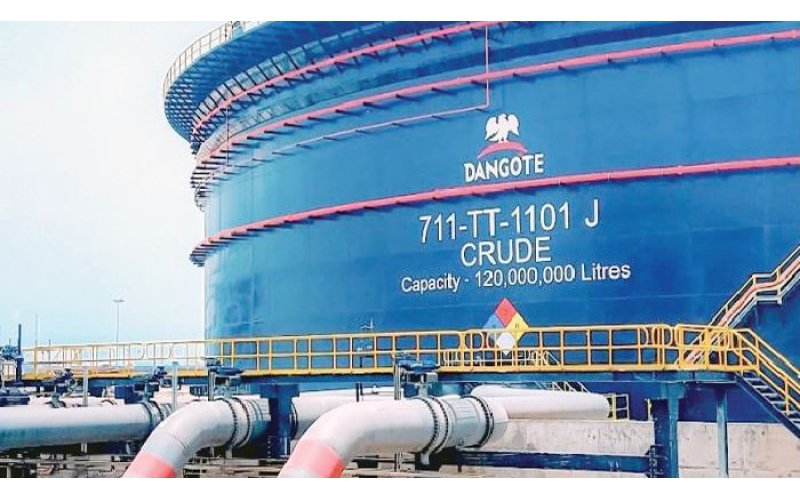
The Dangote Petroleum
Refinery imported approximately 1.46 billion litres of gasoline blendstock and
other refining intermediates between January and May 2026 as it intensified
efforts to maintain high petrol production and operate above its installed refining
capacity.
Latest industry figures
obtained from the Midstream and Downstream Petroleum Statistics report released
by the Nigerian Midstream and Downstream Petroleum Regulatory Authority showed
that the 650,000-barrels-per-day refinery continued to supplement crude oil
processing with imported feedstocks despite receiving substantial volumes of
both domestic and imported crude oil.
The data revealed that the
refinery maintained an average capacity utilisation rate of 101.25 per cent in
May while producing approximately 44.7 million litres of Premium Motor Spirit
(PMS), commonly known as petrol, per day.
Gasoline blendstock refers
to intermediate petroleum products such as reformate, alkylate, naphtha and
other high-octane components that are blended with refinery outputs to produce
finished petrol that meets required quality and environmental standards. These
materials are not sold directly to consumers but are used to enhance fuel
quality and increase production efficiency.
An analysis of the NMDPRA
report showed that Dangote Refinery imported 658.31 million litres of gasoline
blendstock in January, 306.89 million litres in February, 102.35 million litres
in March, 147.37 million litres in April, and 240.59 million litres in May.
The cumulative import volume
reached about 1.46 billion litres during the five-month period.
The refinery’s blendstock
imports initially declined as crude oil supply improved between January and
March. Crude receipts rose from 9.53 million barrels in January to 20.92
million barrels in March, while blendstock imports fell significantly during the
same period.
However, the trend reversed
in April and May as the refinery increased its intake of imported blendstock
despite maintaining strong crude supply levels. Imports rose from 147.37
million litres in April to 240.59 million litres in May, representing a 63.3
per cent increase within one month.
Industry analysts believe
the move reflects efforts to optimise refinery operations, improve fuel
quality, and maximise petrol output.
According to the report, the
refinery supplied approximately 41.5 million litres of petrol daily to the
domestic market in May while maintaining a closing stock of 9.4 million litres.
The facility also produced
24.5 million litres of diesel daily, supplying 18.2 million litres to the local
market and exporting 6.5 million litres. Aviation fuel production stood at 21.9
million litres per day, with 17.5 million litres exported and 2.8 million
litres supplied locally.
Data from the regulator
showed that total crude oil supplied to refineries in May stood at 17.92
million barrels, comprising 15.84 million barrels of domestic crude and 2.08
million barrels of imported crude.
Although this volume was
below the estimated 20.15 million barrels required for full-capacity operations
throughout a 31-day month, the refinery still achieved utilisation above 100
per cent, suggesting that imported blendstocks played a key role in boosting
output.
The report also highlighted
that Nigeria’s state-owned refineries—including the Port Harcourt Refining
Company, Warri Refining and Petrochemical Company, and Kaduna Refining and
Petrochemical Company—remained shut down as of May 2026.
Their continued inactivity
leaves Dangote Refinery as Nigeria’s primary operational refining hub and the
country’s largest supplier of locally refined petroleum products.
Commenting on the
development, Dayo Ayoade explained that importing gasoline blendstocks is a
standard practice in the global refining industry and should not be interpreted
as importing finished petrol.
According to him,
blendstocks enable refineries to improve fuel quality, comply with modern
environmental standards such as Euro V specifications, and optimise production
processes.
He noted that the materials
provide flexibility for refiners to adjust output based on market demand while
ensuring that secondary refining units continue operating efficiently,
particularly when crude oil supplies fluctuate.
However, Ayoade cautioned
that continued reliance on imported feedstocks carries economic implications,
particularly regarding foreign exchange outflows.
He explained that while the
strategy helps maximise refinery performance, it also means Nigeria must spend
foreign currency on imported inputs, exposing the industry to global market
risks.
Despite these concerns,
industry observers note that the refinery has significantly transformed
Nigeria’s fuel supply landscape by reducing dependence on imported refined
products and expanding local production capacity.
With petrol output remaining
above 44 million litres per day and blendstock imports rising once again in
May, the refinery appears focused on consolidating its position as Nigeria’s
leading fuel supplier while expanding exports to regional markets.
Comments:
Leave a Reply