

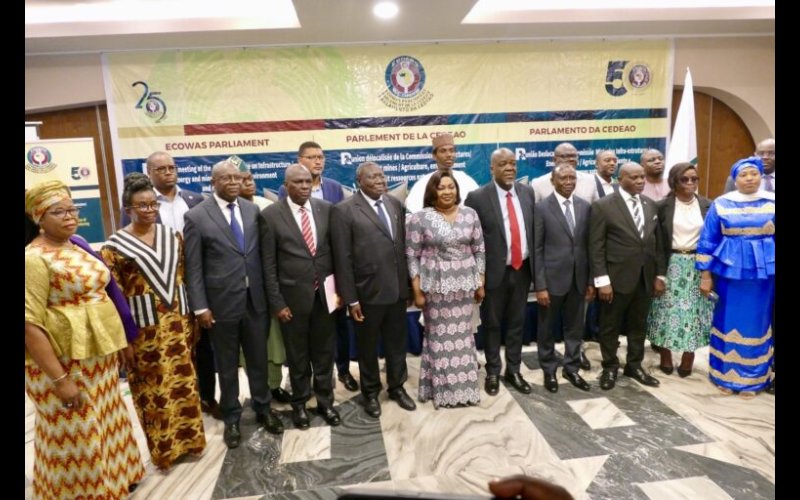
Speaker of the ECOWAS Parliament,
Mémounatou Ibrahima and other stakeholders have decried the high fares of
traveling by air within West Africa, saying such was inimical to subregional
economic growth.
They made this known at the opening session of a
Delocalised Meeting of ECOWAS Parliament’s Joint Committee on Infrastructure,
Energy and Mines, Agriculture, Environment, and Natural Resources, on Tuesday
in Lomé, Togo.
The News Agency of Nigeria (NAN) reports that the
event has as its theme: “Air Transport as a Means of Integration for West
African Peoples: A Strategy for Reducing Airline Ticket Costs.”
It was held to enable stakeholders and experts to
brainstorm on the development and chat the way forward.
The Speaker noted that there would not be free
movement of people within West Africa without effective and affordable
transportation, and air transport was a vital tool for regional economic
development and integration.
According to her, the prohibitive airfares are
obstacles to the successful implementation of the ECOWAS Free Movement
Protocols to achieve its ECOWAS of the People vision.
“The theme that brings us together today, ‘Air
Transport as a Means of Integration for West African Peoples: A Strategy for
Reducing Airline Ticket Costs,’ is of paramount importance to our community.
“It reflects a major issue facing our citizens: the
prohibitive costs of air travel between our countries, which hinder the free
movement of people and compromise our ambitions for regional integration.
“Therefore, there is no need to emphasise the
importance of air transport in a country’s economy, especially within a
sub-regional community. Indeed, air transport is an essential lever for
economic development and sub-regional integration,” she said.
The speaker further said that air transport promoted
trade, stimulated tourism, strengthened cultural and social ties, and
contributed to the growth of member states’ economies.
She attributed the soaring air fares to multiple taxes
and charges imposed across airports in the region.
“For my part, several factors may contribute to the
high cost of airfares in our region.
“The airports contribute financially to state budgets
in several ways, including landing fees, air ticket taxes, security taxes,
non-aviation taxes, and revenues from commercial activities at the airport.
“However, it is clear that all these fees make air
ticket costs prohibitive within the ECOWAS region, thus hampering a major
driver of development, which is tourism.
“Others are national airlines operating in isolation
rather than in synergy; lack of modern infrastructure adapted to the needs of
air transport; and weak implementation of agreements liberalising African
airspace, notably the Yamoussoukro Declaration,” she said.
Ibrahima warned that the ECOWAS Vision 2050 would
remain elusive without an efficient and affordable air transport system.
“If we are to achieve the objectives of the third
pillar of ECOWAS Vision 2050, ‘Economic Integration and Interconnectivity,’ it
is up to us, as representatives of the peoples of ECOWAS, to explore viable and
sustainable solutions.
“In view of our responsibility in the community’s
decision-making process, our role is crucial in the realisation of these
reforms.
“I am convinced that the discussions that will take
place during this meeting, to which we have invited African air transport
experts and leaders, will be fruitful and will lead to concrete proposals to
address this major challenge,” she stressed.
She urged the parliamentarians to develop strong
recommendations that would guide member states and relevant institutions in
establishing a policy framework for more accessible regional air transport.
Also speaking, ECOWAS Commissioner for Infrastructure,
Energy and Digitalization, Sédiko Douka, said that air transport fares within
the West African subregion was the highest globally.
He said the Authority of ECOWAS Heads of State and
Government was concerned about the situation and had mandated the Commission to
coordinate and harmonise member states’ air transport policies, programs, and
projects.
“The task now lies in working towards the
implementation of these community texts by ECOWAS member states, whose
effective implementation start date has been set for January 1, 2026, a
15-month period to allow them to prepare, particularly from a budgetary
perspective.
“The subregion is counting on you the members of
parliament to implement the community texts that the states themselves
initiated and participated in the development, review, and adoption process,”
Douka said.
The Vice President of the Togolese National Assembly,
Dzereke Yao, said West Africa’s air transport challenge must be urgently
addressed to foster stronger economic and human connections among ECOWAS
citizens.
He said prohibitive airfares were undermining the
region’s integration aspirations, adding that the outcome of the five-day
meeting should go beyond discussion.
“This paradoxical situation merits our attention
because our community boasts considerable potential, whether in population
size, economic growth, or youthful dynamism.
“I therefore hope that it will lead to solid,
pragmatic, and ambitious recommendations because a competitive and open
airspace would benefit all citizens in the region,” he added.
Comments:
Leave a Reply