

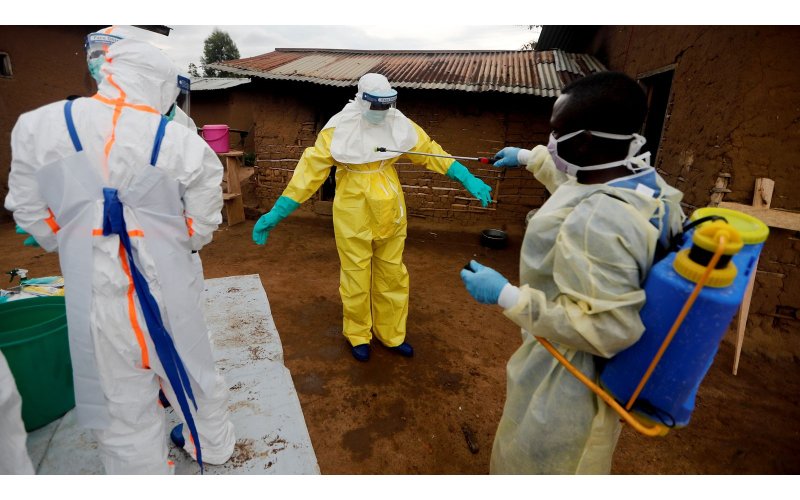
African governments and international allies have
committed nearly $498.8 million to combat the rapidly spreading outbreak of the
rare Bundibugyo Ebola strain in Central and East Africa.
Jean Kaseya, head of the Africa Centres for Disease
Control and Prevention (Africa CDC), announced the financial pledges following
a high-level ministerial meeting dedicated to coordinating the continent's
response. Kaseya noted that the funding highlights a strong sense of African
solidarity and global cooperation, emphasizing that rapid intervention,
regional coordination, and public trust are essential to containing the virus.
The urgency of the situation is heightened by the
nature of the virus itself. The Bundibugyo ebolavirus is exceptionally rare and
currently has no approved vaccine or specific treatment. Most existing Ebola
therapeutics and vaccines were developed to combat the more common Zaire
strain, which was responsible for the catastrophic West African epidemic
between 2014 and 2016. Historically, the Bundibugyo strain has only caused two
known outbreaks: one in Uganda in 2007 and another in the Democratic Republic
of the Congo (DRC) in 2012.
World Health Organization (WHO) Director-General
Tedros Adhanom Ghebreyesus recently issued a stark warning that the epidemic is
currently "outpacing" containment efforts. With the reported death
toll now at 220, the WHO recently escalated the crisis by declaring it a Public
Health Emergency of International Concern.
The $498.8 million pledge includes significant
contributions from global entities. The World Bank is providing approximately
$160 million specifically for the DRC's response, while the United States is
contributing $82 million, and European partners are adding roughly $57 million.
This follows a recent announcement by Tom Fletcher, the UN
Under-Secretary-General for Humanitarian Affairs, who allocated $60 million
from the UN’s emergency response fund to aid containment operations.
The outbreak continues to hit the DRC and Uganda the
hardest. In the DRC, health authorities are tracking more than 900 suspected
cases and over 100 confirmed infections, alongside hundreds of suspected
deaths. Uganda has reported seven confirmed cases and one fatality so far, with
health officials tracing several of these infections back to the initial cases.
Public health experts warn that until a targeted
vaccine is developed, the current outbreak will remain a complex and highly
challenging emergency to contain.
Comments:
Leave a Reply