

South African authorities deployed heavy security
across major cities on Tuesday as anti-immigrant protests intensified,
prompting thousands of foreign nationals to seek shelter and assistance to
return to their home countries.
Police officers were stationed in key locations to
prevent violence, looting and attacks linked to demonstrations organised by
groups calling for undocumented migrants to leave the country.
In Johannesburg, many businesses remained closed while
security personnel patrolled the city centre as residents travelled to work
under heightened security.
The protests were organised by a coalition of small
political parties and citizen-led groups that analysts say have gained momentum
through coordinated social media campaigns, some of which have been criticised
for spreading misinformation.
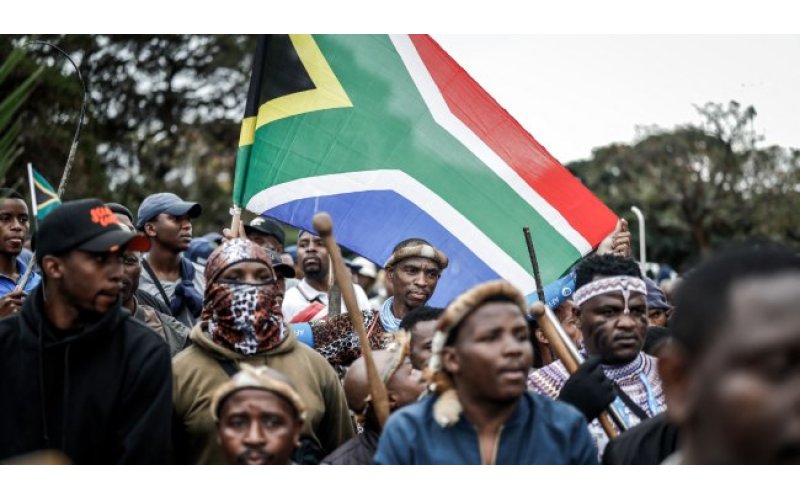
In Durban, groups of demonstrators dressed in
traditional Zulu attire marched through parts of the city carrying sticks and
shields while chanting slogans demanding that undocumented foreign nationals
leave South Africa. Security forces closely monitored the demonstrations to
prevent violence.
One protester, 64-year-old Selwyn Anderson, argued
that undocumented migrants had taken over many small businesses, reflecting
sentiments shared by some participants.
The demonstrations come amid rising tensions that have
already resulted in deadly attacks on foreign nationals. Reports indicate that
at least two Mozambicans, one Ethiopian and one Malawian have been killed in
recent anti-immigrant violence.
Several African governments have since begun
organising buses and flights to evacuate their citizens from South Africa.
South Africa, one of Africa's largest economies,
continues to attract migrants from across the continent despite facing high
unemployment, rising crime and growing pressure on public services.
Labour analyst Dale McKinley criticised the
anti-immigrant movement, arguing that migration has become a political tool
ahead of the country's local government elections scheduled for November.
According to him, the country's challenges stem
primarily from governance failures, corruption and poor public administration
rather than the presence of foreign nationals.
Uganda announced plans over the weekend to begin
evacuating nearly 750 of its citizens, while thousands of Malawian and
Zimbabwean nationals gathered outside diplomatic missions and designated
assembly points in Johannesburg, Cape Town and Durban awaiting transport home.
Many of those seeking repatriation said they had lost
their jobs or accommodation after employers and landlords became concerned
about possible attacks or sanctions linked to the ongoing protests.
Among them was Malawian builder Peter Madsoan, who
said he decided to return home out of fear for his safety.
"I would rather go home than risk being
killed," he said, explaining that he supports his family in Malawi.
Zimbabwean national Evelyn Chinooneka also described
difficult conditions after spending several days with her 10-month-old baby
outside her country's consulate in Cape Town while waiting for evacuation.
The leader of the March and March movement, Jacinta
Ngobese-Zuma, insisted that the campaign was intended to remain peaceful
despite calls for the removal of undocumented migrants.
She described June 30 as the beginning of a nationwide
campaign that would continue until undocumented foreign nationals were
deported, while maintaining that the movement does not support violence or
looting.
The South African government has responded by
deploying additional security personnel across the country to prevent a repeat
of the widespread unrest that erupted in July 2021, when riots and looting
claimed hundreds of lives.
President Cyril Ramaphosa has also announced tougher
measures to address illegal immigration while urging traditional leaders to
help calm tensions in affected communities.
KwaZulu-Natal Premier Thami Ntuli warned that
authorities would not allow criminal elements or xenophobic violence to
destabilise the province.
The current crisis marks one of the largest
coordinated repatriation efforts by African governments in response to
anti-immigrant tensions in South Africa, highlighting growing concerns over the
safety of foreign nationals living and working in the country.
Comments:
Leave a Reply