

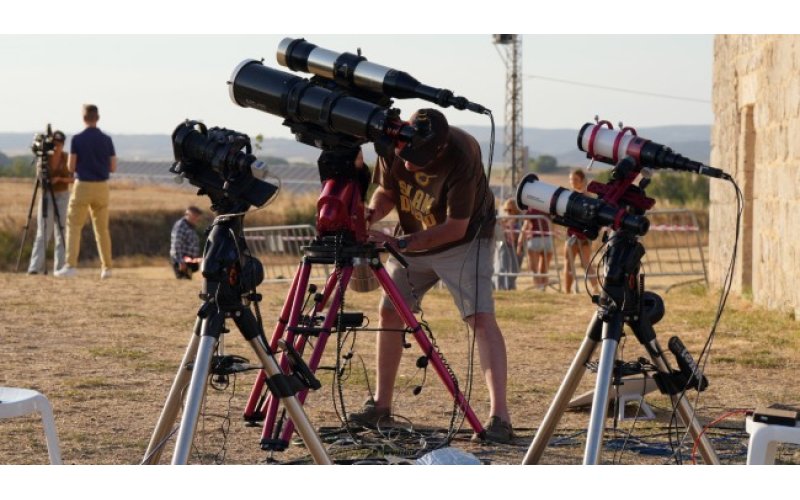
Millions of people across Europe are expected to turn
their eyes to the sky on Wednesday as a rare total solar eclipse sweeps across
parts of the continent, plunging sections of Spain into unusual daytime
darkness.
The eclipse will begin over Russia’s remote Arctic
region at around 1700 GMT before moving across Greenland and Iceland. In Spain,
where some of the best views are expected, the Moon’s shadow will travel
diagonally across the country from the northern Atlantic coast towards the
Mediterranean Sea, disappearing at about 1830 GMT.
Eclipse chaser and British solar physicist Lucie Green
was among those preparing to witness the spectacle from a boat off the Spanish
island of Mallorca.
“People do get addicted to it because it is such a
moving experience,” she said.
While totality will be visible only along a narrow
path, a partial eclipse will be seen across much of Europe, Canada, the
northern United States and northwest Africa.
The event marks mainland Europe’s first total solar
eclipse since 2006 and the first visible from mainland Spain in more than a
century.
Spanish Science Minister Diana Morant described the
occasion as “a Christmas Day that comes around every 100 years”, highlighting
the rarity of the event.
A Rare Celestial Spectacle
Solar eclipses have fascinated humanity for centuries,
often inspiring amazement, fear and religious significance.
During totality, the Moon completely blocks the Sun,
creating an unusual period of twilight. Temperatures can fall, shadows take on
unusual shapes and some animals may behave as though night has arrived.
However, the total eclipse will be brief. In Spain,
totality will last for less than two minutes shortly before sunset. Some areas
of Russia and Greenland will experience slightly longer periods, although
totality will remain under two-and-a-half minutes.
The partial eclipse, which occurs as the Moon begins
and completes its passage across the Sun, will last approximately one hour and
45 minutes.
Scientists will also use the event as an opportunity
to study the Sun’s atmosphere and outer layers, gathering information that
could help improve understanding of solar winds and the Sun’s magnetic field.
Spain Caught in ‘Eclipse Fever’
Eclipse enthusiasts have travelled across Europe in
search of the best vantage points, although weather conditions could affect
visibility in some areas.
Rain and clouds were forecast for parts of
northwestern Iceland, while the capital, Reykjavik, was preparing to witness
its first total solar eclipse since 1433.
In Spain, however, the weather agency AEMET predicted
generally clear skies across much of the country.
The eclipse has generated significant excitement in
Spain, with certified eclipse-viewing glasses reportedly becoming difficult to
find in some locations.
The country is also expecting a tourism boost from the
event. Spain’s economy ministry estimates that the eclipse could contribute
approximately €347 million ($400 million) to the economy and attract more than
446,000 additional tourists.
British astrophysicist and science communicator Graham
Jones described Spain’s position as particularly special because the narrow
path of totality crosses much of the Spanish peninsula.
Several small towns along the eclipse route have
experienced a sudden influx of visitors. In Benavente, a northwestern Spanish
town expected to offer excellent views, available accommodation had reportedly
sold out.
“We’re getting 50 calls a day to ask about where to
stay, where to see it,” said Laura del Teso, an official with the town’s
tourism office.
Extreme Heat and Wildfire Risks
Despite the excitement, authorities are also preparing
for potential challenges caused by the expected influx of visitors.
Temperatures in much of Spain are expected to exceed
35°C on Wednesday, with parts of the northeast potentially recording
temperatures above 40°C.
AEMET has also warned of a “very high” or “extreme”
wildfire risk across large areas of the country. Officials are particularly
concerned that large crowds could place additional pressure on dry rural areas
and congest smaller roads with vehicles.
Authorities expect up to 1.5 million additional road
journeys towards the path of totality.
Municipalities along the eclipse route have
established designated viewing areas and increased security measures to manage
the anticipated crowds.
Spain and neighbouring regions will not have to wait
long for another major celestial event. Another total solar eclipse is expected
to cross southern Spain and northern Africa in August 2027, while an annular
eclipse, known as a “ring of fire” eclipse, is scheduled to pass over the
Iberian Peninsula in 2028.
Comments:
Leave a Reply