

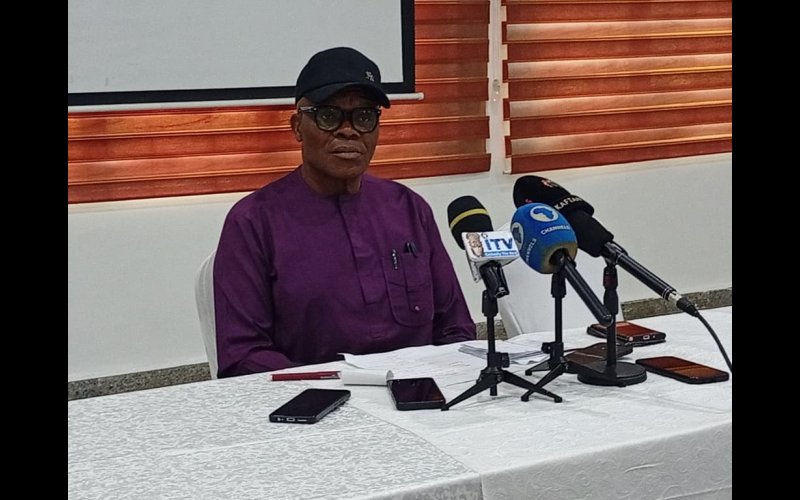
The former Nigeria Football Federation (NFF)
Fact-Finding Committee has raised concerns over alleged disparities in the
treatment and payment of members of Nigeria’s national team delegations.
The committee alleged that while NFF board members and
management staff receive payments, some players and officials are left
inadequately compensated.
Former NFF Ethics Committee member, Ambassador Fanny
Amun (MON), disclosed this on Monday in Abuja while briefing journalists after
the committee submitted its report on Nigeria’s recent struggles in
international football.
The committee was established following concerns over
the Super Falcons’ disappointing campaign at the 2026 Women’s Africa Cup of
Nations (WAFCON) in Morocco, where Nigeria failed to secure qualification for
the 2027 FIFA Women’s World Cup in Brazil.
According to Amun, the committee’s investigation
uncovered several administrative, technical, financial, regulatory and
organisational challenges affecting the development and performance of Nigerian
football.
One of the major issues identified was the alleged
unequal treatment of members of national team delegations. The report noted
claims that NFF board members and management staff receive payments, while
players and some officials are not adequately compensated.
The committee also examined allegations of financial
incentives involving NFF board members, management staff and coaches, including
claims that certain officials could influence player invitations and selection
into national teams.
It further highlighted allegations that some coaches
and officials may invite players to national team camps for financial benefits
or receive incentives to compromise technical decisions.
However, the committee stressed that such allegations
must be properly investigated through the appropriate internal mechanisms and
should not be allowed to damage the credibility of the federation.
On allegations of player influence, the committee said
it found no evidence that individual Super Falcons players exerted undue
influence over team selection or technical decisions.
It also reported that the players were generally
cooperative and found no evidence of factions disrupting the team’s
preparations.
The committee nevertheless called for clearer
definitions of responsibilities within technical teams, particularly concerning
analysts and other support personnel.
On the case of Super Falcons defender Ashleigh
Plumptre, the committee said its findings established that the player had
undergone surgery and was medically unfit to participate in the WAFCON. The
position was reportedly supported by medical personnel in Nigeria and her
foreign club.
The committee recommended that future national team
selections should be based on players’ fitness, medical assessments and clearly
defined performance indicators.
Amun’s committee also criticised what it described as
uncontrolled access by officials to national team camps, calling the practice
unacceptable. It recommended stricter regulations governing access to camps to
safeguard discipline, team cohesion and the authority of coaches.
On the broader development of Nigerian football, the
committee recommended the establishment of a structured framework for talent
identification, scouting, player development and national team management.
It also called for improved data management and the
adoption of modern age-verification technology.
The report further recommended earlier preparation of
national teams, improved coaching education and stronger regulation of domestic
competitions, including the Nigeria Premier Football League (NPFL), Nigeria
National League (NNL), Nationwide League One (NLO) and Nigeria Women’s Football
League (NWFL).
The committee also urged the NFF to explore
technology-driven and innovative revenue streams while restructuring government
and corporate support for football.
On governance, it recommended reforms to the
composition of the NFF Congress and proposed limiting members to a maximum of
two terms in office.
In its overall assessment, the committee urged the NFF
to demonstrate the political will required to implement its recommendations,
stressing that Nigeria’s football challenges cannot be solved through isolated
interventions.
It said sustainable progress would require
coordinated, long-term reforms across administration, finance, technical
development, governance and the domestic football structure.
Comments:
Leave a Reply