

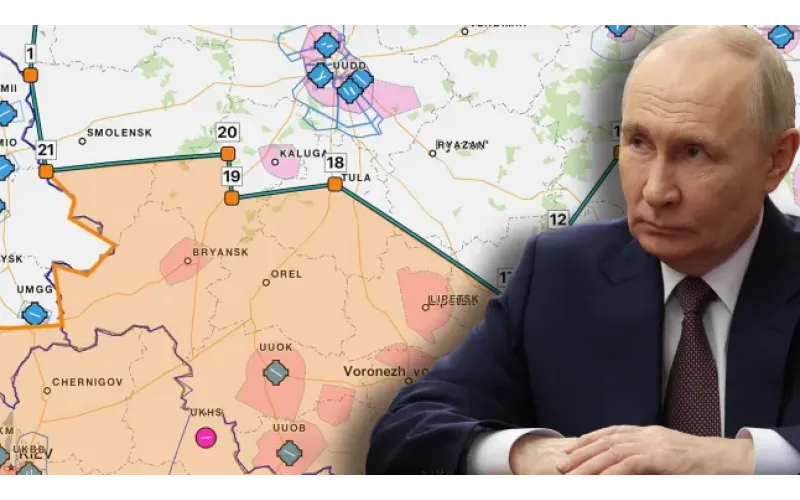
Russian President Vladimir Putin has restricted access
to a massive section of Moscow’s airspace, banning private planes and
helicopters in a move reportedly driven by escalating security concerns and
fears of potential assassination attempts.
The newly established no-fly zone reaches an altitude
of 16,700 feet and spans a vast central region of Russia roughly four times the
size of the United Kingdom. The restricted area stretches from the Belarusian
border, covering regions near St. Petersburg and extending toward the Ural
Mountains, before merging with the already restricted southern airspace near
the ongoing war zone.
Reports suggest that the tightening of airspace
controls is a direct response to Ukraine's growing drone activities and
long-range strike capabilities. In addition to the flight bans, Russian
authorities are reportedly upgrading air defense systems around the capital and
other high-security zones, notably those surrounding Putin’s personal
residences.
Formal aviation notices detailing the heavy
restrictions on private aircraft movements are expected to be issued soon.
Under the new rules, flight training and operations at civilian pilot schools
will be strictly prohibited within the zone, though certain pre-approved
private jets may still be granted clearance to fly.
These stringent security measures coincide with
heightened political tensions inside Russia. The Kremlin is reportedly
grappling with fears of internal instability, fueled by reports of underground
anti-government groups and the constant threat of external attacks.
While Russian authorities have not officially
confirmed that the airspace restrictions are specifically tied to assassination
threats, security sources describe the move as a necessary precaution based on
risk assessments regarding unauthorized aircraft and incoming drone strikes.
Comments:
Leave a Reply