

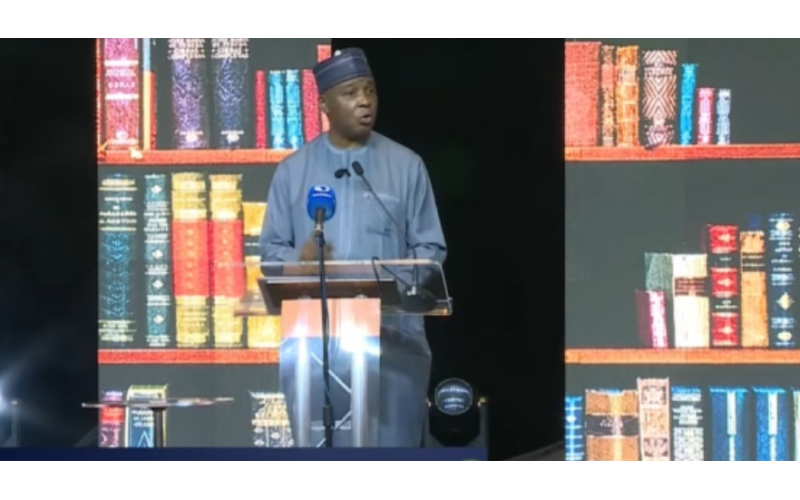
Former Senate President and ex-Kwara State governor,
Bukola Saraki, has stressed the importance of an independent and assertive
legislature, warning that democracy is endangered when lawmakers fail to hold
the executive accountable.
Speaking at the June 12, 2026 edition of The Platform,
a public policy forum organised by the Covenant Nation, Saraki argued that the
National Assembly must go beyond merely approving executive proposals and
instead subject them to rigorous scrutiny.
Drawing from his experience in the legislature, he
said a parliament that is unable or unwilling to reject flawed policies has
failed in its constitutional responsibility.
“What I learned during my years in the National
Assembly is that a legislature that cannot say no is not a legislature at all,”
he said. “If lawmakers simply receive proposals from the executive, approve
them without scrutiny, and move on, they have reduced their role to a
ceremonial exercise.”
Saraki warned that democracy becomes vulnerable when
institutions merely echo the decisions of those in power.
“A democracy made only of echoes is only one election
away from becoming something else entirely,” he said.
The former Senate President maintained that the
greatest threat to a democratic society is not necessarily a weak government
but one that operates without effective oversight.
According to him, the architects of Nigeria’s
Constitution intentionally created three separate arms of government to ensure
checks and balances through constructive tension and accountability.
“The executive, legislature, and judiciary were
designed to be interdependent yet independent,” Saraki explained. “The friction
between these institutions is not a flaw in the system; it is a safeguard for
citizens’ freedoms.”
He noted that many Nigerians misunderstand the
frequent disagreements between the executive and legislative arms, describing
such tensions as a necessary feature of democratic governance.
“By constitutional design, these institutions are
meant to challenge one another so that power is not concentrated in one place,”
he said.
Saraki further described the legislature as a critical
pillar of democracy, capable of preventing political grievances from escalating
into social unrest.
“Political tensions do not disappear when they are
suppressed,” he said. “They build up over time. The legislature provides a
platform where grievances can be heard, debated, and resolved before they erupt
on the streets.”
Reflecting on the significance of June 12, Saraki
argued that Nigeria’s democratic setback in 1993 was partly the result of weak
institutions that failed to defend the will of the people.
“We did not lose democracy because the people failed,”
he said. “We lost it because the institutions that should have protected the
people's mandate were too weak. The solution is stronger institutions, and the
legislature is central to that effort.”
To illustrate the importance of legislative oversight,
Saraki recounted an investigation into alleged irregularities in Nigeria’s fuel
subsidy regime during his time in the Senate.
He explained that lawmakers discovered instances where
subsidy payments were allegedly made for petroleum shipments that never arrived
in the country.
According to him, one vessel listed in subsidy
documentation as being in Nigeria was later traced to Colombia through
independent verification efforts.
“I checked the international registry and found that a
vessel supposedly delivering products to Lagos was actually somewhere else
entirely,” he recalled. “That is the kind of capacity and diligence a
legislature must possess if it is to effectively hold government agencies
accountable.”
Saraki concluded by emphasizing that strong
legislative institutions remain essential for transparency, accountability, and
the long-term survival of Nigeria’s democracy.
Comments:
Leave a Reply