

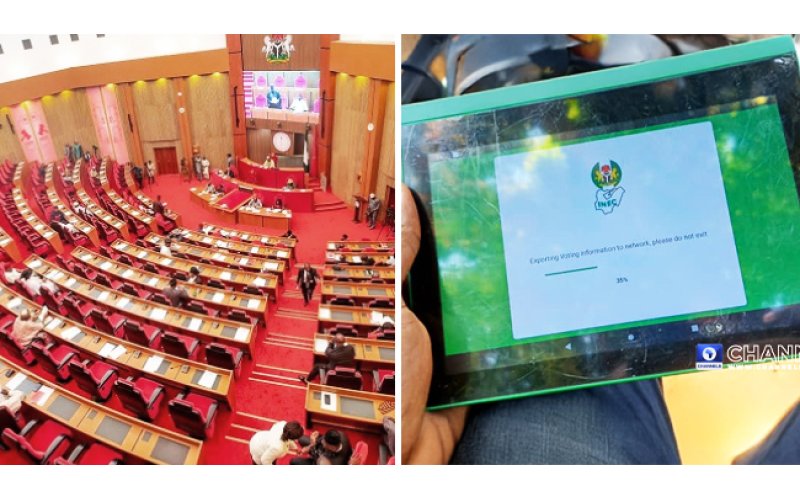
The Senate has defended its decision to amend Clause
60(3) of the Electoral Bill 2026, explaining that the move was informed by
practical realities rather than sentiment or political pressure.
In a statement issued on Sunday by his Directorate of
Media and Public Affairs, Senate Leader Opeyemi Bamidele said lawmakers
considered extensive consultations with stakeholders in the communications and
power sectors before reaching their conclusion. He stressed that lawmaking
carries significant responsibilities and must not jeopardize the welfare of
citizens.
Clause 60(3) had proposed that presiding officers
“shall electronically transmit the results from each polling unit to the INEC
Result Viewing Portal (IReV) in real time.” However, following deliberations,
the Senate revised the clause to strengthen electronic transmission while
removing the requirement for real-time upload. Under the new provision, Form
EC8A will serve as the primary method of collation if internet connectivity
fails.
According to Bamidele, while real-time transmission is
a reform many parliaments around the world might ordinarily adopt to enhance
transparency and public confidence in democratic institutions such as the
National Assembly and INEC, Nigeria’s current infrastructure poses serious
limitations.
Quoting figures from the Nigerian Communications
Commission, he noted that broadband coverage stood at about 70 percent in
2025, with internet penetration at just 44.53 percent of the population. He
also referenced the Speedtest Global Index, which ranked Nigeria 85th
out of 105 countries in mobile network reliability and 129th out of 150
countries in fixed broadband reliability.
The data showed Nigeria’s average mobile network speed
at 44.14 Mbps—far below countries such as the United Arab Emirates,
Qatar, and Kuwait. Similarly, Nigeria’s fixed broadband speed of 33.32 Mbps
placed it near the bottom globally.
Beyond telecommunications challenges, Bamidele
highlighted power sector constraints. He stated that about 85 million
Nigerians—roughly 43 percent of the population—still lack access to grid
electricity. Although national generation capacity is estimated between 12,000
and 13,500 megawatts, only about 4,500 megawatts can be transmitted and
distributed to households nationwide. He expressed optimism that the Electricity
Act, 2025 would drive improvements in the sector.
Given these conditions, the Senate Leader questioned
the feasibility of mandating real-time electronic transmission of election
results at this stage of Nigeria’s development. He warned that making it
compulsory could create electoral complications and potential instability.
Instead, he argued that retaining flexibility aligns
with Section 62(2) of the Electoral Act 2022, which already provides for the
National Electronic Register of Election Results. According to him, the
Senate’s decision to delete the phrase “real time” was aimed at ensuring the
law reflects current national realities while still advancing electoral
transparency.
The clause on electronic transmission has sparked
public debate and protests, drawing criticism from opposition figures including
former presidential candidate Peter Obi and former Rivers State governor
Rotimi Amaechi. The controversy led the Senate to hold an emergency
session to clarify concerns surrounding the amendment.
The upper chamber maintained that its decision was
guided by factual data and constitutional responsibility, rather than emotional
reactions, emphasizing that effective legislation must reflect the country’s
present realities to safeguard democratic stability.
Comments:
Leave a Reply