

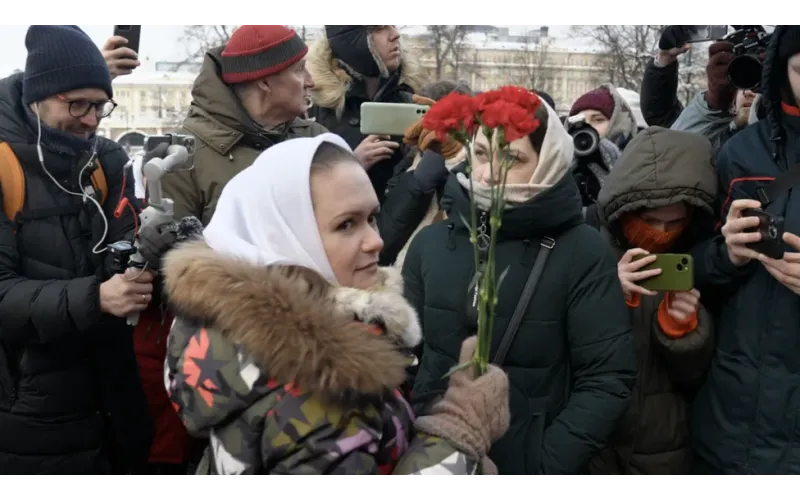
A group of women are
publicly criticising the Russian authorities. Their husbands are among the
300,000 reservists mobilised by Russian President Vladimir Putin for the war in
Ukraine in autumn 2022.
And they want them
home.
"When will our
husbands be considered to have discharged their military duty?" asks
Maria. "When they're brought back with no arms and legs? When they can't
do anything at all because they're just vegetables? Or do we have to wait for
them to be sent back in zinc coffins?"
The women met via
social media and have formed a group called The Way Home. They have differing
views on the war. Some claim to support it. Others are sceptical about the
Kremlin's "special military operation". What seems to unite them is
the belief that the mobilised men have done their fair share of the fighting
and should be back home with their families.
It is an opinion the
authorities do not share.
In Russia public
criticism of anything related to the war comes with a risk. Most of the
speakers choose their words very carefully. They know there's a string of laws
in place now in Russia for punishing dissent. Their frustration, though, is
palpable.
"To begin with
we trusted our government," Antonina says. "But should we trust them
now? I don't trust anyone."
Members of the group
are here to share their stories with a local councillor, Boris Nadezhdin. He
has been critical of the "special military operation" from the
outset.
Curiously Mr
Nadezhdin is one of the few government critics who has been allowed onto
national television since Russia's full-scale invasion of Ukraine. He's an
occasional guest on TV talk shows.
Right now, the
politician is trying to get on the ballot for the presidential election. He
maintains that the war has damaged Vladimir Putin's domestic popularity.
"Putin was very
popular in Russia because after the 1990s he brought stability and
security," Mr Nadezhdin tells me. "Stability and security were the
main reason for supporting Putin. Now more and more people have already
understood that stability and security are finished."
Russian women
campaigning for the return of their mobilised husbands, sons or brothers have
come in for criticism from different quarters. Opponents of the war have little
sympathy. They condemn the men for obeying the mobilisation order and for
taking part in the war.
Supporters of the Kremlin
portray the women as Western stooges.
In a recent
interview with the Fontanka news site, Russian MP Andrei Kartapolov, who heads
the Russian Duma's defence committee, claimed that the call for demobilisation
was the work of "[Russia's] enemies". He appeared to suggest that the
Ukrainian military or the CIA was behind it.
Mr Kartapolov also
invoked World War Two.
"Can you
imagine a delegation of wives coming to the Kremlin in autumn 1942 and telling
Stalin: 'Let those men who were called up in 1941 go home. They've been
fighting for a year already.' No-one would ever have thought of doing
that."
Maria Andreeva,
whose husband and cousin have been drafted and despatched to Ukraine, finds Mr
Kartapolov's comments insulting.
"He dares to
liken the special military operation to the Second World War," Maria tells
me. "Back then Russia's aim was survival. We'd been attacked. There was
full mobilisation and martial law. It's the total opposite of what is happening
now."
Maria says that she
is not only campaigning to bring back her family members. She wants to prevent
more Russians being called up and sent to the front line.
"We do not want
a second wave of mobilisation," she says. "We're against civilians
being used in a military conflict. And we want all Russian citizens to
understand this could affect them, too.
"Some people
act like ostriches. They stick their heads in the sand and try not to think
about what's happening. I can understand them. It's hard to accept that, in
your country, the state doesn't need you to be happy - it just treats you as
biological material. But if people want to survive, sooner or later they need
to recognise this and say that they don't agree."
How likely is a
"second wave" of mobilisation in Russia? Last December President
Putin appeared to rule it out - for now. Live on Russian TV the Kremlin leader
claimed that in 2023 the Russian authorities had managed to recruit nearly half
a million volunteers to fight in Ukraine.
"Why do we need
mobilisation? As things stand there is no need," the Kremlin leader
concluded.
Of course, "as
things stand" doesn't mean "never going to happen". Situations
can change.
For example, in
March 2022 President Putin declared: "Conscripted soldiers are not
participating and will not participate in the fighting. There will not be an
additional call-up of reservists, either. Only professional soldiers are taking
part."
"Partial
mobilisation" was announced six months later.
To raise awareness
Maria and other wives of mobilised reservists have started a new tradition.
Every Saturday they don white headscarves and travel into the centre of Moscow.
Near the Kremlin walls they lay flowers at the Tomb of the Unknown Soldier. Red
carnations are placed by the Eternal Flame. It is their form of peaceful
protest.
On its Telegram
channel The Way Forward explains that these flowers are for honouring "the
lives of loved ones. To honour the memory of those killed in all wars. To
honour the memory of our guys."
The group also
believes that flower-laying is a way of saying "never again".
But how aware is
Russian society? How much interest is there from the public in what the
families of mobilised reservists are saying? Antonina says that since her
partner was drafted, she hasn't felt much support from those around her. When he
received his call-up papers in October 2022, he'd asked friends to keep an eye
out for Antonina.
"They invited
me to celebrate new year with them a year ago," she says. "But all
evening they kept telling me that my husband was a total mug for going there
[to Ukraine]."
Antonina claims
that, despite being diagnosed with stomach ulcers, her partner was deployed to
an assault unit in Ukraine. She says that he telephoned her on 4 December.
"He was crying.
He was frightened. It sounded like he was saying goodbye."
She says he called
again on 13 December. That was the last time she heard from him. Antonina says
she's since been told that her partner was wounded in action.
"There are some
people who want to fight. Who volunteer for it and sign contracts," Antonina
says. "Let them fight. But send us back our husbands who don't want to be
there. They've done their duty to the motherland. Send them home.
"I used to have
enormous respect for Vladimir Putin. Now I'm more neutral. I still find it hard
to believe that he knows this kind of thing is happening. But if he really does
see us as traitors and outcasts for wanting our husbands back, I don't
understand why he'd have this attitude towards citizens who once voted for
him."
Comments:
Leave a Reply