

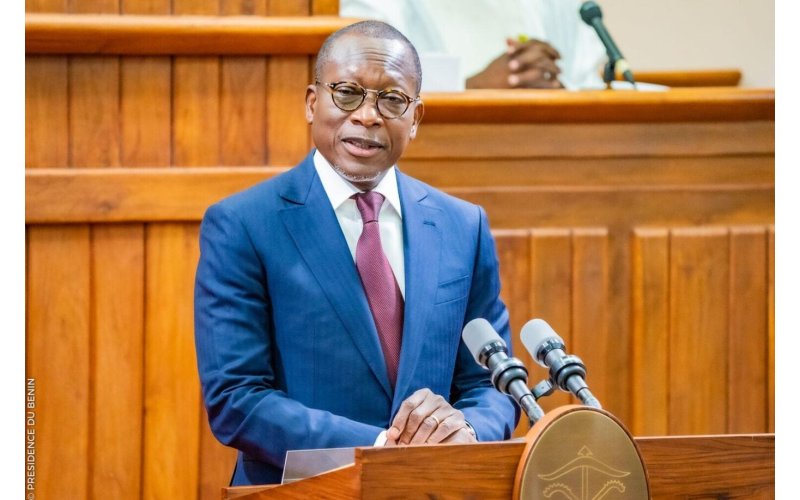
Benin Republic’s President, Patrice Talon, has hailed
the country’s military hierarchy for swiftly crushing a coup attempt on Sunday,
vowing that the perpetrators will be brought to justice.
The crisis began early Sunday when a group of mutinous
soldiers—who identified themselves as the Military Committee for
Refoundation—seized the state broadcaster, cut transmission, and declared
the dissolution of the government. The attempted takeover was short-lived, with
Interior Minister Alassane Seidou later announcing that the plot had been
“foiled.”
“This Treachery Will Not Go Unpunished” —
Talon
In a nationwide broadcast on Sunday evening, President
Talon lauded the professionalism and loyalty of Benin’s armed forces.
“I would like to commend the sense of duty of our army
and its leaders who remained republican and loyal to the nation,” he said.
“With them, we stood firm, recaptured our positions, and cleared the last
pockets of resistance. This treachery will not go unpunished.”
Talon expressed sympathy for families impacted by what
he termed a “senseless adventure,” acknowledging that some individuals remained
in the custody of fleeing mutineers. He assured citizens that rescue efforts
were underway to secure their release.
Arrests and Uncertainty Over Ringleaders
Local reports indicate that 13 soldiers have
been arrested so far. It remains unclear whether the alleged mastermind, Lt.-Col.
Pascal Tigri, is among those detained. Residents in parts of Cotonou
reported gunshots and intensified patrols earlier in the day, though calm later
returned as security forces restored control. Broadcast signals for state
television and public radio were also reinstated.
ECOWAS, Nigeria Step In
The attempted coup comes amid a troubling wave of
military takeovers in West Africa. Just weeks earlier, Guinea-Bissau
experienced its own post-election upheaval with the ouster of former President
Umaro Embalo.
ECOWAS responded swiftly to Benin’s crisis, deploying
troops from Nigeria, Sierra Leone, Ivory Coast, and Ghana to support
Benin’s loyalist forces. The regional bloc condemned the attack as “a
subversion of the will of the people of Benin.”
Nigeria’s President Bola Ahmed Tinubu, who
currently chairs ECOWAS, praised the rapid intervention of the Nigerian
military. According to presidential spokesman Bayo Onanuga, Benin made two
formal requests for Nigerian air and ground support.
“It took some hours before the government’s loyal
forces, assisted by Nigeria, took control and flushed out the coup plotters
from the National TV,” Onanuga said.
Political Tensions Ahead of 2026 Elections
Benin, historically troubled by coups after
independence in 1960, has enjoyed relative stability since 1991. But the failed
coup comes at a sensitive political moment.
President Talon—who has been in office since 2016—has
signalled he will step down next April. His party’s candidate, former Finance
Minister Romuald Wadagni, is considered the frontrunner. Lawmakers
recently extended the presidential term from five to seven years, though the
two-term cap remains intact.
Meanwhile, the electoral commission has barred
opposition hopeful Renaud Agbodjo from contesting, citing insufficient
sponsorship—raising further tensions.
A Region on Edge
Sunday’s failed coup underscores rising fragility
across West Africa, where a resurgence of military rule has seen coups or
attempted coups in Niger, Burkina Faso, Mali, Guinea, Sierra Leone, and
Guinea-Bissau in recent years.
Benin’s aborted uprising adds yet another warning sign
as the region confronts political volatility and weakening democratic
institutions.
Comments:
Leave a Reply