

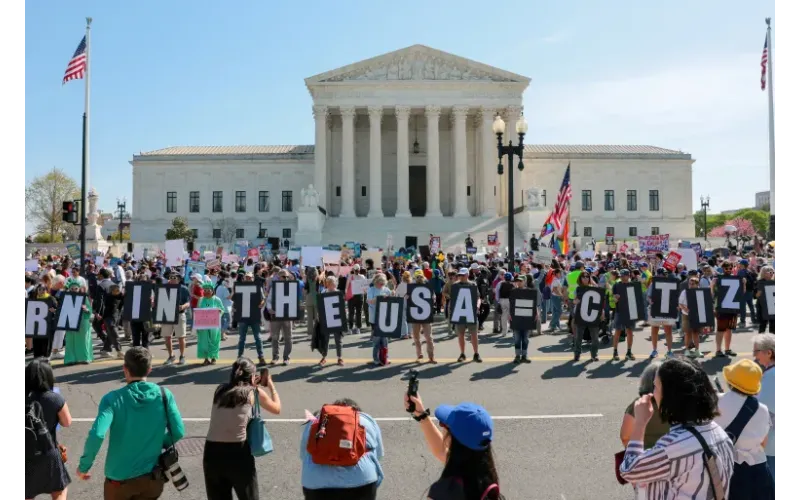
United States President Donald Trump has announced
plans to ask the US Supreme Court to rehear a landmark immigration case after
the court struck down his executive order seeking to end automatic birthright
citizenship.
The Supreme Court rejected the administration's
attempt to restrict the long-standing constitutional practice, but Trump said
he would immediately file a petition requesting the justices to reconsider the
ruling.
Writing on his Truth Social platform on Thursday, the
president strongly criticised the decision, insisting that American citizenship
should not be granted automatically under the current interpretation of the law
and describing the court's judgment as fundamentally flawed.
The 6-3 ruling marked a significant setback for the
administration's immigration agenda. Shortly after returning to office on
January 20, 2025, Trump signed an executive order aimed at denying automatic US
citizenship to children born in the country to parents who are either in the
United States illegally or on temporary visas.
Following the court's decision, Trump urged lawmakers
to pursue legislative reforms to limit birthright citizenship. However, legal
experts note that such efforts face major constitutional obstacles, as the
Supreme Court indicated that altering birthright citizenship would likely
require a constitutional amendment rather than executive action.
Legal analysts also say the administration's request
for a rehearing is unlikely to succeed, noting that the Supreme Court rarely
grants such petitions after issuing a final judgment.
Despite the setback, the Trump administration has
secured several legal victories on other immigration policies since returning
to office. Courts have allowed the government to begin ending Temporary
Protected Status (TPS) for nationals of certain countries and have upheld
tougher border enforcement measures aimed at limiting asylum claims.
However, the Supreme Court ruled that the executive
order on birthright citizenship violates the Fourteenth Amendment of the US
Constitution, which guarantees citizenship to individuals born in the United
States and subject to its jurisdiction.
Civil rights groups welcomed the ruling, describing it
as a reaffirmation of one of the Constitution's core protections.
Researchers also warned that ending birthright
citizenship could have had significant long-term consequences. A joint study by
the Migration Policy Institute and Penn State University estimated that the
policy would have left about 255,000 children born each year without legal
status, potentially increasing the undocumented population by 2.7 million
people by 2045.
Comments:
Leave a Reply