

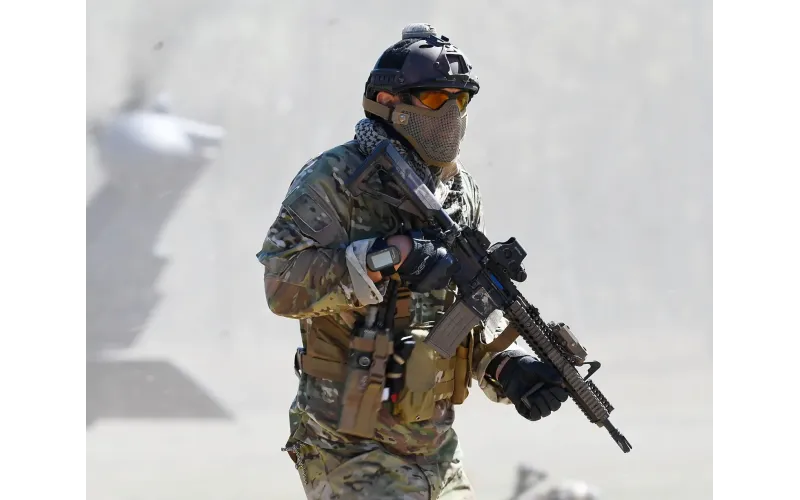
A U.S. airman found himself in a life-threatening
situation deep inside Iranian territory after his fighter jet went down,
sparking a high-stakes rescue mission as American forces raced against time to
retrieve him before enemy fighters could capture him.
The officer, a weapons systems operator aboard an F-15
fighter jet, was forced to eject over southwestern Iran after his aircraft
crashed. Injured during the incident, he landed in rugged mountainous terrain
and was left isolated behind hostile lines.
Despite suffering a leg injury, the airman relied on
his military training—particularly survival and evasion techniques—to stay
alive. He navigated the difficult landscape and eventually concealed himself
inside a narrow crevice, while armed local fighters actively searched the area,
reportedly incentivised by a reward for his capture.
The situation quickly evolved into a critical race
against time. According to former Royal Air Force pilot Mikey Kay, the chances
of a successful rescue diminish rapidly the longer a downed pilot remains
behind enemy lines.
As the threat escalated, the United States Armed
Forces launched a large-scale combat search-and-rescue operation. The mission
involved a range of military assets, including AC-130 gunships, A-10 attack
aircraft, MH-6 helicopters, surveillance drones, and elite special operations
teams.
Intelligence reports indicated that Iranian forces,
including members of the Islamic Revolutionary Guard Corps, were closing in on
the airman’s position. They were supported by advanced systems such as drones,
radar tracking, and surface-to-air missile capabilities, making the rescue
operation even more dangerous.
At one point, search teams reportedly came within just
a few kilometres of the stranded officer. To delay their progress, U.S.
intelligence operatives allegedly deployed misinformation tactics, spreading
false reports that the airman had already been captured and relocated.
Meanwhile, locating the airman proved challenging due
to the difficult terrain. His emergency beacon signal was partially obstructed
by his position in a ravine, making it harder for rescue teams to pinpoint his
exact location. Eventually, intelligence units successfully identified his
coordinates and relayed them to the rescue teams.
With his position confirmed, special forces launched a
daring extraction mission. Helicopters approached at low altitude while fighter
jets and gunships provided cover, neutralising potential threats from fighters
equipped with portable air defence systems.
Commandos on the ground made contact with the airman,
verified his identity using secure military procedures, and evacuated him
safely by helicopter. He was later transported to Kuwait, where he received
medical attention for his injuries.
The operation faced an additional setback when two
U.S. aircraft involved in the mission became immobilised in sand at a remote
base. To prevent sensitive military technology from falling into enemy hands,
the stranded aircraft were destroyed after personnel were safely evacuated.
Despite the intense risks, the mission was ultimately
successful, highlighting both the resilience of the stranded airman and the
extensive capabilities of U.S. military rescue operations under extreme
conditions.
Comments:
Leave a Reply