

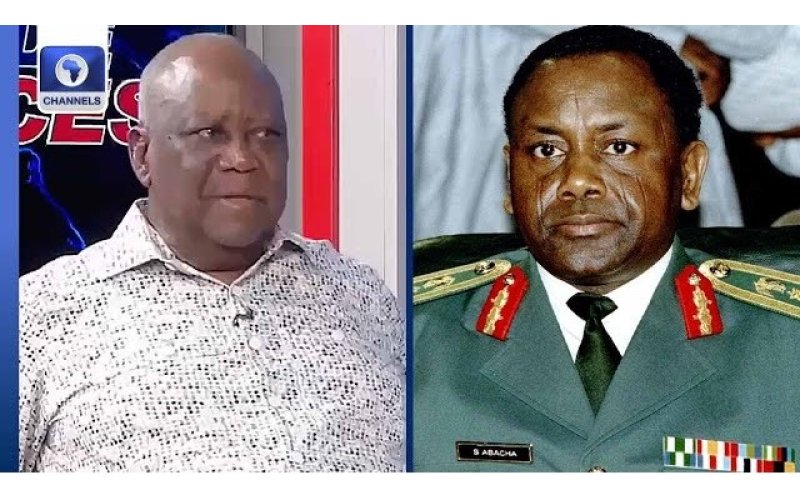
A retired colonel of the Nigerian Army,
Babatunde Bello-Fadile, said the late General Sani Abacha won’t have wrested
power from the interim government of late businessman Ernest Sonekan if he was
allowed to resume as the aide-de-camp (ADC) of the interim president.
“I was posted ADC to Sonekan. I don’t know why I was
not allowed to resume. Still, if I had been ADC, it (the takeover) probably
wouldn’t have happened,” Bello-Fadile said on the Friday edition ofInside
Sourceswith Laolu Akande, a socio-political programme aired on Channels
Television.
“Why didn’t I resume? The Chief of Army Staff said I
should wait until he (Sonekan) comes back from Malta where he went for the
Commonwealth Head of State meeting that year. So, I was hanging around. The
whole thing happened by the time he came back.”
The return of democracy in Nigeria followed a series
of events, some bloody and undesirable. In 1993, after a controversial
annulment of an election whose winner was adjudged to be the late MKO Abiola,
General Ibrahim Babangida who took over power in 1985 through a coup against
General Muhammadu Buhari resigned and formed an interim government with
businessman Sonekan as president and Abacha as Chief of Defence Staff and
Minister of Defence.
On November 18, 1993, three months into his
administration, Abacha overthrew Sonekan in a palace coup.
Over 30 years later, Bello-Fadile believes that the
circumstances behind Sonekan’s resignation were abnormal.
The lawyer and former head of the Legal Unit of the
Nigerian Army also took a trip down memory lane and narrated how he confronted
Abacha after he took over power from Sonekan.
He said, “The military decided to leave after June 12
and an interim government was set up and it was agreed that we would midwife
and elected government.
“The civilians that were elected were allowed to stay
but my friend (Abacha) decided to say no.
“The second in command to Sonekan (Abacha) organised a
resignation and threw away the agreement that the military had had enough, and
should set a path for democratic government.
“Likeminded persons in the military said that can’t
happen. Then Abacha said these are IBB boys behind the insistence for a return
to democracy. And all of a sudden, he announced their retirement.
“I was still in the military at the time and he
retired all my friends, 17 of them. I don’t know how I survived that.
“Then he (Abacha) set up panels to review everything.
Kayode Esho panel (of which I was a member) to review the judiciary. I was the
only military person there, all the others were judges and lawyers. Then, they
set up the police reform and called for a White Paper just to buy time.
“When we submitted the White Paper Committee Report,
he asked me what we were hearing, and I told him that the people wanted the
military to return to the barracks.
“The Decree 63 that Babangida set up and made you the
deputy with a clause that if anything happens to the interim president, you
will take over but taking over does not mean you should dispose of the decree;
it means you take over as the head of state and continue with the cabinet but
you took over and turned it upside down. That’s why the international community
is not happy with you.
“I didn’t want to overthrow the government. We wanted
an interim government back. I was the one doing all the running around. General
(Olusegun) Obasanjo was doing his own with his National Unity Organisation of
Nigeria. He was also calling for the military to go back to the barracks.
“General Shehu Yar’Adua was in the Constituent
Assembly where they set a date for the military to leave.”
Comments:
Leave a Reply