

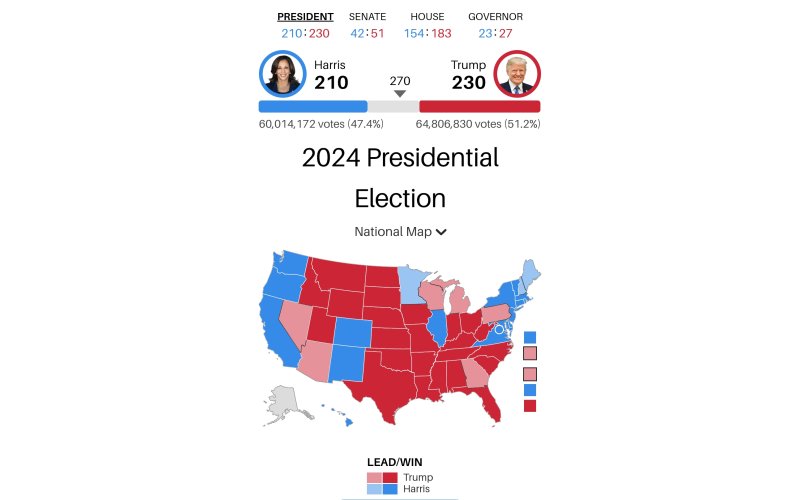
All 2024 election polls are now closed, leaving voters
to wait and see whether Donald Trump or Kamala Harris will win a historic
presidential election.
As the election stretched into Wednesday, Republicans
are seeing a map trending positively for their party, began to point to a shift
in demographic support among key voting groups who often lean Democrat.
Preliminary AP Vote Cast data suggested a shift among
Black and Latino voters, who appeared slightly less likely to support Harris
than they were to back Biden four years ago. About 8 in 10 Black voters backed
Harris, down from the roughly 9 in 10 who backed Biden.
More than half of Hispanic voters supported Harris,
but that was down slightly from the roughly 6 in 10 who backed Biden in 2020.
Trump’s support among those groups appeared to rise slightly compared to 2020.
Republican Sen. Marco Rubio told AP at Trump’s
election watch party in West Palm Beach, Florida, that he’s excited for the
exit polling in states like Pennsylvania and Georgia, where Republicans are
already seeing overperformance compared to this time in the election in 2020.
“I’m just really excited not just because I think it’s
going to be a victory but about how we won,” the Florida lawmaker said.
There are noticeable similarities between
then-Democratic nominee Hillary Clinton’s election night in 2016 and the one
that Harris had planned for tonight at Howard University.
Neither Clinton nor Harris, appeared at their election
night party, despite both heading into Election Day believing they were about
to defeat Donald Trump.
Both sent top aides to inform the demoralized audience
that the woman would not speak. And there were noticeable similarities between
what each man said.
“We still have votes to count. We still have states
that have not been called yet. We will continue overnight to fight to make sure
that every vote is counted,” Cedric Richmond, Harris’ campaign co-chair, told
the audience Tuesday. “So you won’t hear from the vice president tonight, but
you will hear from her tomorrow.”
“We’re still counting votes,” John Podesta, Clinton’s
campaign chairman, said in 2016. “And every vote should count. Several states
are too close to call. So we’re not going to have anything more to say
tonight.”
Even the mood of the events — and the trajectory they
took over the course of the night — was similar. The vibe at Clinton’s event at
Javits Center started jubilantly, with people dancing, smiling and eager to
make history — the campaign had even planned to launch reflective confetti in
the air when Clinton won to resemble a glass ceiling shattering. The same was
true for Harris, with the event resembling a dance party on the campus of the
Democrat’s alma mater.
By the time Podesta and Richmond had taken the stage,
the party had stopped, people had left, and those who remained looked forlorn.
Harris still has a path to the White House through the
Northern battleground states, but the map is getting less forgiving.
Harris’ campaign has long said her surest way to 270
electoral votes was through Michigan, Pennsylvania and Wisconsin, states Trump
won in 2016 and Biden captured narrowly in 2020.
Harris cannot lose Pennsylvania and reach 270
electoral votes. However, she can lose pieces of the blue wall — so named for
its longtime reputation as a Democratic firewall — and still reach 270.
If she loses Michigan, she can make it up by winning
Arizona and Nevada. She can lose Wisconsin and make up for it with Arizona.
But the map has surely shrunk for Harris, who cannot
lose more than one in the three-state northern arc.
With Trump’s victory in Georgia, the state becomes the
first to flip from the 2020 results.
Trump lost Georgia four years ago to Democrat Joe
Biden by 11,779 votes — a number that became memorable after he pleaded with
Georgia election officials to help him find one more vote than that to overtake
Biden’s victory.
He was later charged criminally in Georgia in a
sweeping racketeering indictment and has pleaded not guilty.
Comments:
Leave a Reply