

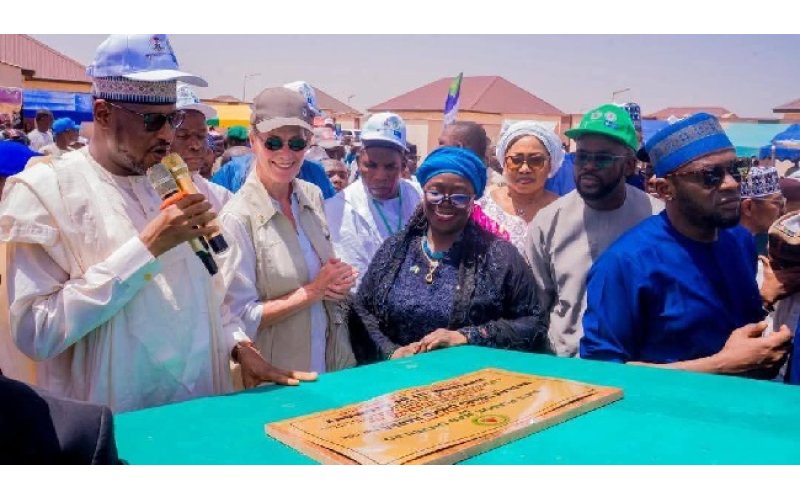
Katsina State Governor, Dikko Radda, has called on
bandits and other criminal elements to abandon violence and embrace peace,
assuring them that opportunities for dialogue, repentance, and reintegration
remain available.
The governor made the appeal during the inauguration
of a 152-unit Internally Displaced Persons (IDPs) Housing Estate in Jibia Local
Government Area. The project was delivered through the Northwest Prevention
Facility Project, a partnership between the Katsina State Government and the
United Nations Development Programme (UNDP).
The housing estate includes 152 homes for displaced
families, a climate peace hub, a veterinary clinic, an entrepreneurship centre,
and a 50-kilowatt mini solar grid aimed at supporting economic recovery and
sustainable livelihoods.
Addressing residents and stakeholders at the event,
Radda urged those involved in banditry, kidnapping, and other forms of violence
to lay down their arms and return to their communities.
According to the governor, the same opportunities
being provided to citizens through government programmes can also benefit those
who choose to abandon criminal activities and pursue a peaceful life.
He stressed the importance of prioritising family,
prosperity, and community development over violence, assuring repentant
individuals that the state government remains willing to support their
reintegration into society.
Radda identified poverty, displacement, climate
change, and youth unemployment as some of the major factors contributing to
insecurity. He noted that addressing these challenges requires the collective
efforts of government, traditional institutions, religious leaders, women, and
youth groups.
The governor also urged community leaders and
residents to remain vigilant, report suspicious activities, and resolve
disputes peacefully before they escalate into violence.
As part of efforts to support beneficiaries of the
housing project, Radda announced a grant of ?200,000 for each household to help
families rebuild their lives and strengthen their economic stability.
Earlier, the Commissioner for Rural and Social
Development, Abdulhamid Ahmad, explained that the houses were designed to
reflect local cultural and architectural traditions. Each unit features two
bedrooms, a bathroom, a toilet, and a spacious courtyard suitable for rural
family living.
He added that the beneficiaries, made up of 70 women
and 82 men, were selected through a transparent process from communities
affected by banditry across the eleven wards of Jibia Local Government Area.
Chairman of Jibia Local Government Council, Sirajo
Ado, described the initiative as a landmark achievement that would bring relief
and renewed hope to victims of insecurity across the area.
Speaking at the event, UNDP Resident Representative in
Nigeria, Elsie Attafuah, reaffirmed the agency’s commitment to supporting
recovery and development efforts in Katsina State. She noted that the project
would help families rebuild their lives while creating opportunities for a
safer and more prosperous future.
Also speaking, the Commissioner for Internal Security
and Home Affairs, Nasiru Danmusa, said security conditions in the state had
improved significantly due to the government’s sustained interventions. He
noted that many roads and markets had reopened, residents had returned to
farming and business activities, and agricultural productivity had increased.
The inauguration attracted several dignitaries,
including the German Ambassador to Nigeria and ECOWAS, Annette Günther, and the
Norwegian Ambassador to Nigeria, Svein Baera, alongside government officials,
development partners, and community leaders.
The housing estate is widely regarded as a significant
step toward restoring dignity to displaced families while supporting broader
efforts to promote peace, stability, and economic recovery across Katsina
State.
Comments:
Leave a Reply