

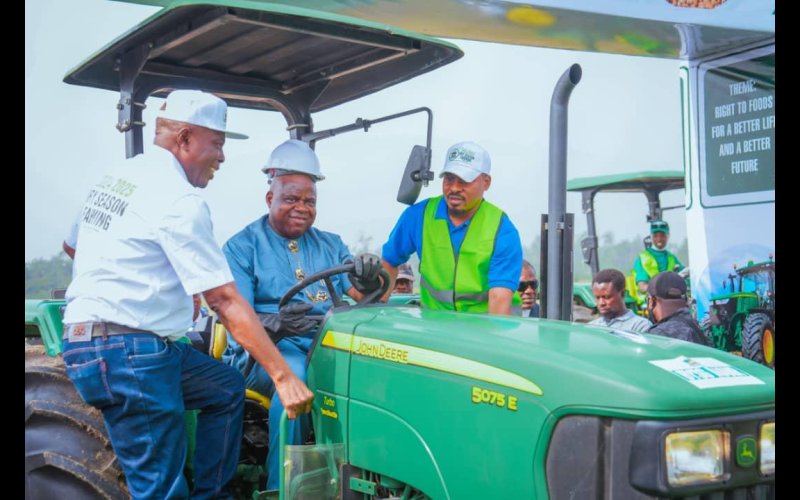
Bayelsa State has flagged off an expansive dry season
farming programme to boost agricultural productivity and ensure food security.
The programme entails supporting farmers with the
necessary inputs, offering technical assistance to ensure successful farming
season and harvest as well as organising training for farmers to enhance their
skills and knowledge in areas such as soil preparation, irrigation and
post-harvest management.
The Ministry of Agriculture and Natural Respurces will
also assist farmers in the state to embark on aggressive rice, cassava,
plantain farming as well as other crops the state had comparative advantage.
Flagging off the 2024/2025 Dry Farming Season on Friday at the Ministry
of Agriculture rice farm in Otuasega, Ogbia Local Government Area, Governor
Douye Diri urged Bayelsans to key into his administration's agricultural
revolution to promote food security in the state.
He particularly charged government officials to engage
in farming to complement government's effort towards ensuring that Bayelsa
became a productive rather than a consuming economy.
The governor said in his first term, more than 400
youths were trained at the CSS Integrated Farms in Nasarawa State and another
200 recently trained at the same centre.
He equally stated that his administration recently
completed the training of another 77 youths in soilless and green house farming
in Ogun State and assured that an additional 100 would be sent for training in
January next year.
Governor Diri, however, expressed displeasure that
despite the funds disbursed to each trainee after their CSS training, the state
had yet to see any positive results.
He directed the Commissioner for Agriculture to
ascertain the number of trainees that actually utilised the funds, stating that
the government will no longer give out cash incentive to trainees.
He said: “All of us should engage in farming,
including all appointees. It is a clarion call to own a farm no matter how
small. We are prepared to support farmers to change the narrative and ensure
food security.
“The era of subsistence farming is over. Farming now
is big business. That is why we are constructing roads to the hinterlands to
help farmers transport their produce.
"l am aware that a lot of farmers benefitted from
the Central Bank of Nigeria agricultural loan. Some of our CSS trainees
benefitted from the loan and N300,000 was given to each trainee of the two
batches.
"In each of the batches, not less than 200
persons were trained. But we are yet to see what came out of those who received
the money. The records are there.
"So, I have directed the Commissioner for
Agriculture that we will no longer give cash to any trainee because it appears
not to be the solution. Rather, we will encourage them and other farmers to
take advantage of the various agric loan schemes and repay whatever is
obtained.”
In his remarks, the Commissioner for Agriculture and
Natural Resources, Prof. Beke Sese, said this farming season, the government
would cultivate about 208 hectares of rice farms at Amassoma (100 hectares),
Otuasega (30 hectares), School-To-Land in Yenagoa (10 hectares) and 50 hectares
at the Niger Delta University.
“It is estimated that these rice farms will yield up
to 16,640 bags of rice paddies that can give up to 8,320 bags of 50kg milled
rice after the next harvest.
“We still have other locations for expansion of rice
farming at Isampou (4,500 hectares) and Peremabiri (2,500 hectares), both of
which can produce 560,000 bags of rice paddies that can give up to 280,000 bags
of 50kg milled rice. One of the major target milestones in the Bayelsa
Agriculture Prosperity Plan is one million tonnes of rice production per year
and the attainment of 100 per cent processing of rice in the state.”
Sese further stated that the ministry was
collaborating with the Federal Ministry of Agriculture and Food Security,
international development partners, non-governmental organisations and the
private sector.
“We are also working with international partners,
including France, South Korea, International Fund for Agricultural Development
(IFAD) and United States Agency for International Development (USAID) to bring
in global best practices and investments in our agricultural sector. These
partnerships are already yielding positive results and we are confident that
the impact will be far-reaching.”
Speaking on behalf of trainees of the third batch at
the CSS Farms, Miss Rhoda Enabogha said they underwent two weeks of intensive
agricultural training in livestock management, fisheries among others and
thanked Governor Diri for giving them the opportunity.
A representative of the Nigerian Women In Agriculture
(NIWA), Ebimotimi Leghemo, said they were mobilising women to go into cluster
farming across communities in the eight local government areas to increase food
production.


Comments:
Leave a Reply