

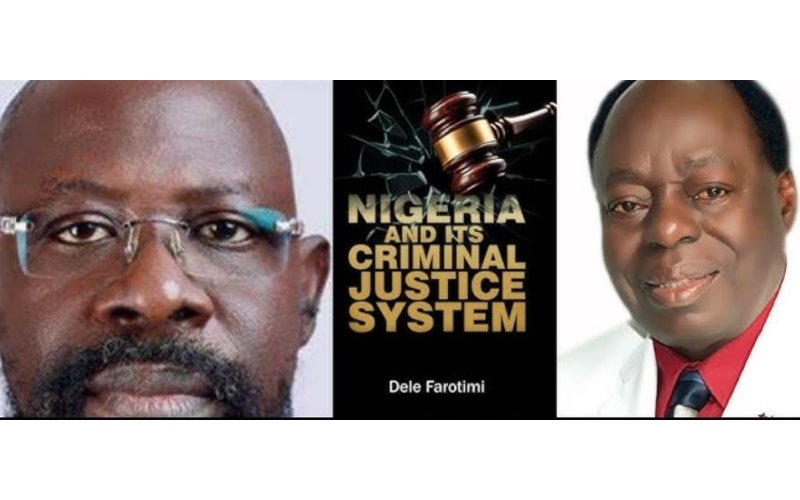
When 95-year-old legal luminary Afe Babalola
weaponized the Nigerian police to arrest and detain activist Dele Farotimi over
alleged defamation in his book, Nigeria and its Criminal Justice System, he
inadvertently succumbed to the notorious “Streisand effect.”
This is the same phenomenon I previously wrote about
in relation to former First Lady Aisha Buhari, whose dramatic abduction and
torture of a university student over a tweet about her weight transformed a
fleeting commentary into a nationwide cause célèbre in December 2022.
Farotimi’s arrest has catapulted his book from
obscurity to Amazon’s Best Sellers list, a trajectory likely unintended by
Babalola.
The very passages Babalola sought to suppress are now
illuminated under the unforgiving glare of global attention, which ensures that
they will be dissected by countless eyes rather than languishing in relative
anonymity.
In his obsessional bid to silence Farotimi, Babalola
exemplifies the adage of being “penny-wise and pound-foolish.” What was once a
limited audience—perhaps a handful of legal aficionados in Nigeria’s
southwest—has now exploded into a worldwide readership, all thanks to the
spectacle of Farotimi’s arrest and detention.
Thus, Babalola’s actions serve as a textbook
illustration of the Streisand effect: the paradox whereby attempts to obscure
information end up amplifying it.
The term itself originates from American entertainer
Barbra Streisand’s ill-fated attempt to suppress an aerial photograph of her
California mansion.
Before she sued the California Coastal Records Project
to remove the image, only six people had viewed it—two of whom were her
lawyers.
In other words, only four people had seen it
unprompted. Post-lawsuit, nearly half a million people downloaded or viewed the
photograph, all thanks to her efforts to bury it.
That’s precisely what’s happening to Afe Babalola. In
his attempt to stop Farotimi’s book from being read by people, he gratuitously
invited global publicity to the book.
Apart from climbing to Amazon’s global Best Sellers’
list, search for the book caused the website of Roving Heights Bookstore to
crash because of unusually high traffic.
According to Arise News, Farotimi’s book is now
“ranked number one in elections and 555 among all books on the platform,” and
that it “has also topped categories in general elections, political process,
and political commentary, with a 4.9-star customer rating.”
The book was initially self-published in July this
year. I can bet my bottom dollar that no more than 50 people initially bought
the book, and even fewer people read it.
However, in the aftermath of Babalola’s overreaction,
more people have bought and read the book, particularly the parts of the book
he wants hidden.
He has unwittingly given permission to millions of
people to insult him and repeat the “libel.”
The urge to repeat and publicize negative information
that someone wants suppressed through threats is called reactance in
psychology.
Babalola has provoked mass reactance in Nigeria,
similar to what Aisha Buhari did in 2022.
Babalola should never have ordered the arrest and
detention of Farotimi. He’s the top dog and Farotimi is the underdog.
All over the world, across countries, cultures, and
generations, whenever there is a battle between the top dog and the underdog,
the underdog almost always wins in the court of public opinion, even if the
underdog is in the wrong.
The passages Babalola objected to in Farotimi’s book
do strike me as potentially libelous if Farotimi can’t provide evidence to back
them up.
Libel is false publication that hurts someone’s
reputation and causes them to be shunned by right-thinking members of the
society.
Farotimi’s allegations aren’t opinions. They are
specific charges that claim to be statements of facts, which can irreparably
injure the reputation of Babalola.
As Kenneth Ikonne, a brilliant, dispassionate lawyer
who, by the way, is a fan of Farotimi, wrote in a Facebook post titled “THE WAY
FORWARD FOR DELE FAROTIMI!,” “anyone with a basic understanding of the
principles of the law of libel, will concede that Mr. Farotimi is in hot soup.”
Babalola erred in using his influence to cause
Farotimi to be arrested and detained. He could have just sued him quietly and
let the courts decide on the merits or otherwise of his suit.
If Farotimi had merely expressed strong, hurtful
opinions that skirt specifics, he would have been in the clear. Consider, for
example, activist Deji Adeyanju who recently disparaged two People’s Democratic
Party (PDP) officials with derisive monikers.
He is being threatened with a lawsuit by Umar Damagun,
the Acting National Chairman of the Peoples Democratic Party (PDP), and Sen.
Samuel Anyanwu, the Acting National Secretary of PDP, for using derogatory
terms to describe them.
He called Damagun a “tea man who goes to serve tea in
Femi Gbajabiamila’s house” and Anyanwu a “kilishi man” who serves “kilishi” at
Femi Gbajabiamila’s house. He also said, “This current PDP is in the pocket of
Nyesom Wike at the national level.”
These are opinions. Opinions are protected by law. In
fact, vigorous, vituperative, unflattering opinion uttered in moments of
inflamed passions can’t be defamatory in Nigerian law.
There are many precedents for this. For instance, in
Bakare v Ishola, the defendant, in a moment of heightened emotions, said to the
plaintiff in Yoruba, “Ole ni o! Elewon! Iwo ti o sese to ewon de yi.” English
translation: “You’re a thief! Ex-convict! You have just come out of prison.”
Justice C.J. Jibowu ruled that these were vulgar
insults that weren’t actionable. “It is a matter of common knowledge of which
this court takes judicial notice that people commonly abuse each other as a
prelude to a fight and call each other ‘ole! Elewon!… which…no one takes
seriously as they are words of heat and anger,” he said.
In another case, Ibeanu v Uba, the defendant was
accused of defaming the plaintiff by saying in Igbo, “Josiah, Josiah, Ongi kpo
ndi ori bia zulu ewum, bia malu uma najum.” Translation: “Josiah, Josiah, you
brought the thieves with whom you stole my goat, and you have now come to ask
me.” The judge in the case also ruled that this didn’t constitute defamation.
So, it has been established in Nigerian law that mere
“vulgar abuse” isn’t defamatory. In American media law, vulgar abuse, such as
calling someone a “criminal idiot” in the heat of anger, is called rhetorical
hyperbole, and is not defamatory.
Saying some people are in the pocket of another or
that they are servile to another isn’t even vulgar abuse or rhetorical
hyperbole; it’s simply innocuous, if uncomplimentary, opinion.
Only a litigious terrorist would sue anyone over that.
In the end, Babalola’s overreach has not only
backfired but also ensured Farotimi’s book and its contentious claims will live
on in public memory.
What could have been a quiet legal victory now stands
as a cautionary tale of hubris, miscalculation, and the unintended consequences
of silencing dissent in the digital age.
(Tribune)
Comments:
Leave a Reply