

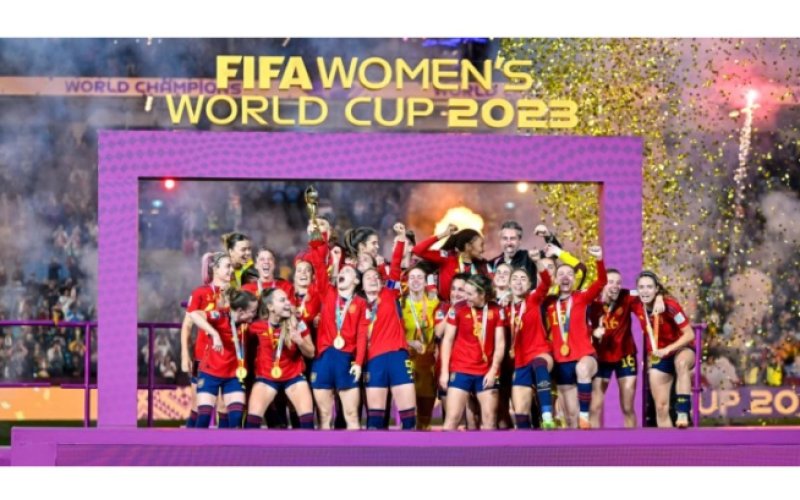
In a landmark decision aimed at growing
the global footprint of women’s football, FIFA announced Friday that the
Women’s World Cup will expand to 48 teams starting with the 2031 edition,
which will be hosted by the United States.
The move mirrors the expansion of the men’s
tournament, which is set to feature 48 teams in 2026.
While the development underscores FIFA’s push for
broader participation, it also brings a wave of uncertainty—particularly for
U.S. broadcaster Netflix, which secured the streaming rights to the 2027 and
2031 Women’s World Cups last year.
The expansion has sparked mixed reactions, with
questions arising over the potential quality and competitiveness of matches.
The disparity in talent between top-tier and lower-ranked nations has long been
a concern in international football. In women’s soccer, the gap is even more
pronounced, prompting memories of the U.S. women’s national team’s 13-0 rout of
Thailand in the 2019 World Cup.
Currently, teams ranked between 47th and 50th in
FIFA’s women’s standings include Thailand, Slovakia, Romania, and
Uzbekistan—raising fears that early-round blowouts could become more common.
Still, the expansion offers tangible benefits. For
Netflix, the increase in the number of games means more live content to offer
subscribers—without the constraints of traditional broadcast schedules. This
flexibility could prove valuable in attracting new audiences and capitalizing
on the growing popularity of women’s sports.
However, more games also mean higher production costs,
from additional commentary teams to increased logistical demands. The success
of the expanded tournament—and Netflix’s gamble—will likely hinge on viewer
interest in matches beyond the traditional powerhouses.
Notably, the Women’s World Cup has grown at a much
faster pace than its male counterpart. Since its inception in 1991 with just 12
teams, the tournament has expanded steadily—reaching 16 teams in 1999, 24 in
2015, and 32 in 2023. The jump to 48 in 2031 marks its most ambitious leap yet.
As FIFA continues its global growth strategy,
attention will soon turn to the bidding process for the 2035 Women’s World Cup.
That decision may come before the 2031 tournament provides concrete data on
whether expansion truly delivers—for fans, teams, and broadcasters alike.
Comments:
Leave a Reply