

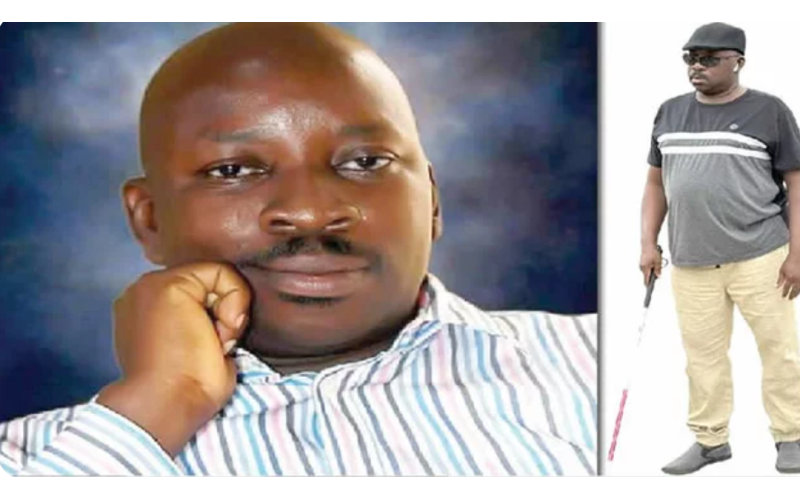
Could you share your journey as a journalist and experience in the printing press before losing your sight?
I earned my degree in English Language from
Ogun State University, now Olabisi Onabanjo University in 1990 and began my
career as a journalist at a health-focused media house.
This role required me to interpret complex
medical material and present it in a way that was accessible to the general
public.
Our emphasis on feature writing distinguished
it from conventional journalism and equipped me for future challenges.
Before losing my sight, I led an active life
filled with various leadership roles. I served as the president of my
residents’ association and chaired the Alimosho branch of professional
printers.
Additionally, I was the vice chairman of my
secondary school alumni association and held a principal officer position in my
university alumni chapter in Lagos. I also ran a successful printing press that
covered the entire value chain of the profession.
However, in an instant, my vibrant life
transformed into one of pain, redundancy, and loneliness reminiscent of the
biblical proverb about sudden downfall. This experience taught me a crucial
lesson – no matter how comfortable life may seem, circumstances can change
dramatically at any moment.
During a crisis when the industry was in
turmoil and salaries were nonexistent, I ventured into private business. After
several years, I returned to communications as a corporate affairs manager and
eventually worked as a public relations manager at an oil and gas company.
After a few years, I left to establish my own printing company, which was a
long-held dream.
As an Ijebu boy, printing runs in my blood. My
company, located in Ikotun, became known for book publishing. We started small,
but over time, it grew and became fairly successful.
My background in English allowed me to add
value to my clients, enhancing their projects with my editing skills. In
addition to my business endeavours, I engaged in community service and
continued to take on leadership roles.
How would you describe your
life before you became visually impaired, both personally and professionally?
I was doing well in my printing business,
handling notable clients and printing bestselling books. However, in February
2020, I faced a significant challenge. I had been diagnosed with glaucoma
earlier but was managing it well without glasses and visiting the hospital
regularly to take my medications.
Despite being diagnosed with glaucoma, I drove
very well. In February, after a trip to Ilorin with my wife, I noticed that my
left eye had turned red upon waking up the next day. Following a visit to an
optician, I was referred to a tertiary hospital in Lagos.
It was there that I experienced the harsh
reality of Nigeria’s health system. For three months, I visited the hospital
daily but only saw the consultant twice. After a procedure on my left eye, I
wasn’t provided with the necessary medications, and unfortunately, I lost
vision in that eye.
Reflecting on my experience, I wondered why I
hadn’t sought alternative healthcare sooner. Eventually, I went to a private
hospital, where the doctor asked if I had suffered an injury to my left eye
previously. After some thought, I recalled an incident from years earlier when
a traffic officer struck my left eye with a horsewhip while I was driving.
This injury, combined with the delayed
treatment, likely contributed to my vision loss.
Later, while managing my glaucoma and
attending a private hospital, the COVID-19 lockdown halted access to eye
clinics, which worsened my condition. My left eye became infected, and I
subsequently lost that eye completely.
The complications continued, and I started
losing vision in my right eye.
When the lockdown was lifted, I reached out to
my consultant and was advised to undergo surgeries to regain my sight. I had
numerous surgeries and even had implants placed in my eyes but perhaps the
implants weren’t fitted correctly. Unfortunately, the damage had already been
done. It was a deeply depressing moment for me; it was difficult. I had to stop
going to the hospital.
Imagine the experience of someone who had been
so active suddenly undergoing a complete 360-degree shift like that. I lost my
vision and fell into depression at one point because I saw my whole world
crashing down in front of me.
What were the biggest
challenges you faced after losing your sight?
My business collapsed due to the actions of
those I put in charge. I had to sell my machines and other equipment as scrap,
items I purchased for millions of naira.
Despite these challenges, some people stayed
with me. I will never forget the friends who consistently called and visited,
but there was only so much they could do.
After the COVID-19 lockdown, people returned
to their regular routines; my wife went back to her job, and my children
resumed school. It was then that it dawned on me that I was alone and had to
navigate this experience practically all by myself.
My wife tried her best for me. She is a truly
fantastic woman. However, as the stress of taking me to the hospital while
balancing her work became overwhelming, an Igbo neighbour offered to take me to
the hospital. Despite not being Yoruba, she was incredibly kind.
I discovered that the Igbo community stepped
up for me even more than the Yoruba community. Aside from a few friends, I felt
somewhat abandoned. I faced a choice between living and ending my life, but I
chose to live. Eventually, I turned to farming as a way to cope.
How did you adapt to your new
reality, and what tools or strategies helped you adjust to life without sight?
One day, a client who specialised in helping
people grow their ministries, Dr Akin John, called and asked me to meet him. He
told me he didn’t have any work for me but sensed something was wrong.
I explained my situation but made it clear
that I didn’t want pity; instead, I wanted solutions to help move my life
forward. He suggested that I write Christian books since I had been editing
books for him. Despite my reservations about not knowing the Bible well, he
offered to teach me online.
At that point, I had mastered using assistive
technology like TalkBack, which helped me navigate writing onFacebookand other
platforms. Most people, including my neighbours, didn’t realise I was visually
impaired because of how I interacted, spoke, and contributed.
Unfortunately, before our lessons could
progress, he passed away. Despite this setback, his suggestion had set me on a
new path.
The question became, how do I write as a
visually impaired person? How do I effectively use assistive technology?
I had to take lessons on how to use the
system. Before my vision loss, I could see the screen, which made using the
system easier. Losing my sight changed that and I could no longer navigate the
screen with a mouse or see the keypads.
It felt like starting all over again, like a
kindergarten student. My instructor, who was completely blind, taught me many
essential skills, including mobility.
Now, I can sit at a computer and write using
keystrokes. It took me over six months to adapt, and there were frustrating
moments.
Has losing your sight changed
your perspective on life?
Currently, I’m writing a book on loneliness
because I’ve experienced its highs and lows. Loneliness is not merely about
being alone; it’s about feeling disconnected from society.
Society’s treatment of disabled people,
especially the blind, is a mixed bag. Nigerians can be incredibly kind. For
instance, if you need help crossing the road, someone will assist you. People
also help you to board buses, sometimes even offering to help you get to your
stop.
Nigerians are very supportive in that regard.
However, on the other hand, once you become disabled, many people often no
longer see you as valuable. Accepting that feeling of abandonment was tough for
me.
A man who had been visually impaired since
childhood once told me, “When you lose your sight, people no longer see value
in you.” It was a hard truth, but I realised that I needed to make myself
useful to society.
I’ve come to believe that God allows adversity
in our lives to shape us, and how we respond to it is crucial.
What advice would you offer
to those facing similar challenges, whether it’s losing their sight or
undergoing another life-altering event?
I often say that anyone could potentially
become disabled. Five years ago, if someone had told me I would be in this
position, I wouldn’t believe it, but here I am. Through my experience, I have
gained a deeper understanding of the challenges that visually impaired
individuals face.
Many blind people in Nigeria are confined to
their homes by their families, treated almost like furniture, and merely kept
alive.
Most lack the capacity to care for themselves,
which is where my situation differs. I have the education and ability to be a
blessing to others, even in my current condition.
It’s not always about money, as I don’t have
much. However, I do have friends who help. When I receive assistance, I share
it with other visually impaired people, as some lack the means to break
barriers or open doors for themselves.
I recommend visiting government hospitals and
clinics. The crowds you encounter there reflect the state of our health
facilities.
When I was visiting a government health
institution for treatment, I noticed that the number of patients was
overwhelming, while the number of doctors was minimal, and they were
overworked.
It took me three months to see a glaucoma
consultant only once or twice because he was the only one available.
My advice is to never allow anyone to look
down on you. First, you must accept yourself as you are. I am on the verge of
registering a non-governmental organisation at the Corporate Affairs Commission
that will solely focus on those who are visually impaired.
This organisation will address education,
intervention in visual tools, and ICT. Those are my visions-to empower the
visually impaired to become independent and manage their own lives. I
understand the challenges they face.
Looking back, are there any
lessons or philosophies you adopted that have helped in your journey?
Losing my sight has changed my perspective on
life in many ways. First, I learned that there are things in life you cannot
control. Second, our government is not doing enough to support visually
impaired individuals or improve the country’s health situation.
The cost of healthcare is astronomical, and
average Nigerians can’t afford it. I use five different eye drops, and the
least expensive one costs around 8,000 Naira. I have noticed that about three
out of 10 Nigerians have some form of visual impairment, often due to poor
access to quality healthcare.
I am a Christian, and I believe in the prayer
that says, “Goodness and mercy shall follow us all the days of our lives.”
Goodness and mercy are like currency; you save
them by how you treat others and help those in need.
When challenges arise, you can draw on those
reserves. I have experienced this firsthand. Despite my challenges, there has
never been a day I was left hungry because people came to my aid, and I believe
it’s because of the goodwill I accumulated over time.
To the younger generation, especially men,
when you’re young and financially independent, take care of your family,
including your wife and children.
Show them love, because you don’t know what
the future holds. My family has been my pillar. I’ve also learned to manage my
expectations of others. Before my challenges, I used to get upset when people
disappointed me, but now, I am no longer bothered by such things.
Your first daughter recently
graduated as a medical doctor. How does that make you feel?
I should mention that I am a father of many
children. I have two biological children, along with several foster children.
Despite my own challenges, I have been able to train my children morally.
I also have the account details of many
children in school, whom I support financially with whatever I can, and this
gives me joy.
Yes, my first daughter recently graduated as a
medical doctor, and I am very proud of her.
However, her journey also exposed some
critical problems in our health system, particularly the lack of manpower.
Medical students spend around eight years in
training, including housemanship and NYSC service, totalling nearly 10 years,
only to earn less than N300,000. Meanwhile, politicians earn exorbitant
salaries. How can we expect our doctors not to leave the country under these
conditions? Until we properly remunerate essential professionals, we are only
deceiving ourselves.
Adversity will always come; it’s a part of
life. Those who face challenges aren’t any less close to God than those who
don’t.
It’s not the adversity that defines you but
how you react to it. For those who lose their sight later in life, like I did,
it’s particularly hard because you are acutely aware of what you’ve lost. But
it’s not the end of the world. You just need to retool yourself, learn new
skills, and adapt.
What are you grateful for?
I am grateful for many things, especially the
gift of life and the provisions from God. In my community, I’m not treated as
visually impaired. I contribute to discussions and share my opinions just like
anyone else.
Technology has made life easier, with tools
and resources available to help. I have taught myself how to use computers and
voice prompts. Retooling yourself is key.
Challenges can also serve as a way for God to
reveal things we may have overlooked in the hustle of life. I’ve discovered
aspects of myself—both strengths and weaknesses—that I didn’t know before.
I now appreciate people and friendships more.
Most of the people we call friends are often just acquaintances, but through
challenges, you learn who your true friends are.
My advice to anyone facing similar challenges
is to avoid indulging in self-pity. You will experience emotional turbulence,
but it’s crucial to create a routine that keeps you engaged.
I’ve developed my strategies to combat
loneliness. I spend time reading, walking, and staying active. Walking, in
particular, helps fight depression.
It’s important to engage in activities that
bring you joy and keep you mentally and physically fit.
Is there any kind of support
that should be given to people who are physically challenged?
As for support, there isn’t much provided by
the government. Lagos State has some programmes for the visually impaired, but
they are minimal. The government is not living up to its promises, whether for
the disabled or for women’s representation.
You have to rely on yourself for support
because there is little to nothing coming from the authorities.
People may show you love and offer the little
help they can, but the government isn’t addressing the situation.
I expect that there will be grants for
visually challenged individuals who want to start businesses. In terms of
education, the only support available to the visually impaired comes from
private individuals.
While there are vocational schools for the
blind, such as the one in Oshodi, they are privately owned.
When it comes to higher education, do
institutions have adequate facilities for the physically challenged? There is
so much support the government could provide, yet they have failed to assist
those who can speak, let alone the disabled.
That is why I want to work on my NGO. This
endeavour will bring me joy and fulfilment.
Although I am not rich and currently don’t
have a job, my situation is still much better than that of many visually
impaired individuals.
Comments:
Leave a Reply