

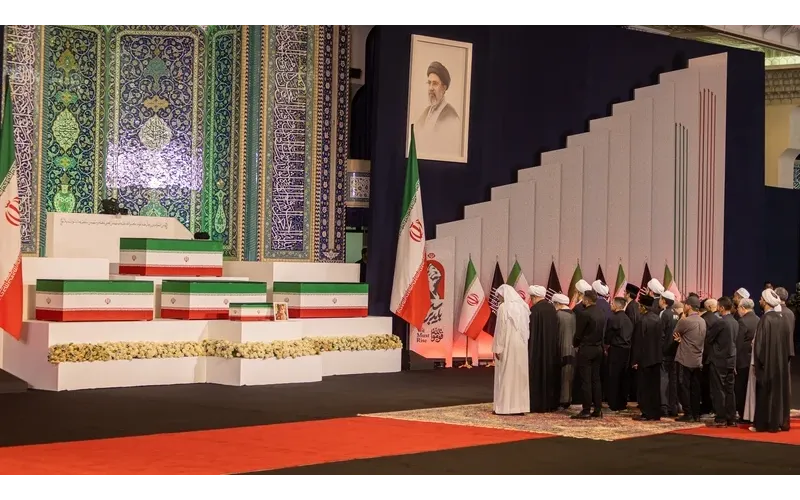
The body of Iran's Supreme Leader, Ali Khamenei, has
arrived at Tehran's Grand Mosalla ahead of his state funeral, with millions of
mourners and dozens of foreign dignitaries expected to attend the ceremony.
Khamenei, who was reportedly killed in U.S.-Israeli
strikes during the recent Middle East conflict, was carried into the Grand
Mosalla in a coffin draped with Iran's tricolour flag. The venue, one of the
country's most significant ceremonial sites, has been decorated with flowers,
banners and tributes in preparation for the funeral.
Thousands of mourners dressed in black gathered for
the pre-funeral ceremony, paying their respects as the coffin was placed before
them. Among those in attendance was Ahmad Vahidi, head of Iran's Revolutionary
Guards, making his first public appearance since the outbreak of the conflict.
The public funeral, which was initially delayed due to
the war, comes as Iran and the United States observe a fragile ceasefire
following a preliminary agreement aimed at ending hostilities.
Several countries have confirmed they will send
official delegations to the ceremony. Pakistan announced that Prime Minister
Shehbaz Sharif will attend, while China, Afghanistan and several neighbouring
Caucasus nations are also expected to be represented.
Workers continued final preparations at the Grand
Mosalla under tight security as authorities restricted vehicle movement around
the venue.
"We are planting flowers and preparing the
grounds for the farewell ceremony of our martyred leader," one worker
said, expressing confidence that mourners would travel from across Iran to
attend the event.
Iran's chief negotiator and Speaker of Parliament,
Mohammad Bagher Ghalibaf, urged citizens to participate in large numbers,
describing the funeral as a defining moment in the country's history.
He called on Iranians to honour Khamenei's legacy with
a massive turnout, saying the ceremony would send a message to the
international community.
Khamenei, who died at the age of 86, will lie in state
at the Grand Mosalla for three days. The bodies of several of his slain
relatives will also be present during the mourning period.
Officials estimate that between 15 and 20 million
people could attend the funeral, potentially making it the largest state
funeral in Iran's history.
Public holidays have been declared in Tehran, Qom and
Mashhad to accommodate the ceremonies, while government offices and many
businesses in the capital will remain closed through Monday. Authorities have
also imposed traffic restrictions and announced a phased closure of Tehran's
airspace during the funeral events.
Following the ceremonies in Tehran, Khamenei's body is
expected to be taken to the Iraqi holy cities of Najaf and Karbala before being
buried on July 9 at the shrine of Imam Reza in Mashhad, his birthplace.
Representatives from about 30 countries are expected
to attend the funeral, with pilgrims and mourners continuing to arrive from
neighbouring Iraq, Afghanistan and Pakistan.
Comments:
Leave a Reply