

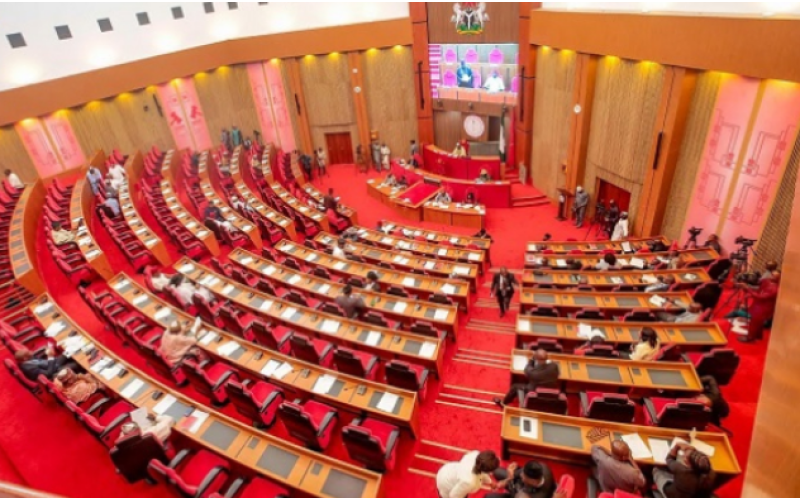
Senate President Godswill Akpabio has announced an expansion
of the Senate conference committee on the Electoral Act Amendment Bill,
increasing its membership from nine to twelve.
Akpabio disclosed the decision during an emergency plenary
session held on Tuesday, explaining that the adjustment followed consultations
with the Senate leadership.
“After consulting with the leadership, we agreed to increase
the number from nine to twelve. I will now read out the names of the Senate
members of the conference committee,” he told lawmakers.
The committee is chaired by Senator Simon Bako Lalong, with
Senators Mohammed Tahir Monguno, Adamu Aliero, Orji Uzor Kalu, Abba Moro,
Asuquo Ekpenyong, Aminu Iya Abbas, Tokunbo Abiru, Niyi Adegbonmire (SAN),
Jibrin Isah, Ipalibo Banigo, and Onyekachi Nwebonyi serving as members.
Akpabio charged the committee to treat its assignment with
urgency, expressing confidence that its work could be completed within days.
According to him, a timely conclusion would allow President Bola Tinubu to
assent to the amended Electoral Act before the end of February.
He added that once finalised, the committee’s report would
be promptly forwarded to the President for approval within the month. The
Senate President then formally constituted the committee by striking the gavel.
The emergency session was marked by moments of disorder, as
lawmakers frequently interrupted one another during deliberations. Tensions
rose following a motion introduced by Senator Tahir Monguno, which proposed
that the Senate reconsider its earlier approval of Clause 60(3) of the
Electoral Act (Repeal and Enactment) Bill, 2026. The clause addresses the
procedure for transmitting election results electronically.
Akpabio supported a proposal that makes electronic
transmission the primary method, while allowing manual submission of results
using Form EC8A only in cases of technical failure. This position triggered
intense debate on the floor, with Senator Enyinnaya Abaribe initially calling
for a division vote before later withdrawing the request.
The emergency plenary was convened against the backdrop of
public criticism over recent amendments to the Electoral Act, particularly
those affecting electronic transmission of results. The dispute centres on
Clause 60(3), where the Senate removed the requirement for “real-time”
transmission, maintaining provisions from the 2022 Act that give the
Independent National Electoral Commission (INEC) discretion over the mode of
result transmission.
The development has sparked nationwide protests, including
the Occupy National Assembly demonstration in Abuja, where civil society
groups, opposition parties, and political figures such as Peter Obi called for
compulsory real-time electronic transmission to enhance electoral transparency.
Responding to the backlash, Akpabio clarified that the
Senate had not opposed electronic transmission. He explained that the removal
of the phrase “real time” was meant to avoid legal challenges arising from
network disruptions and to grant INEC operational flexibility.
While critics maintain that the amendment could weaken
transparency, several senators insist that the majority of the chamber supports
electronic transmission, stressing that the disagreement lies in the wording of
the law rather than the underlying principle.
Comments:
Leave a Reply