

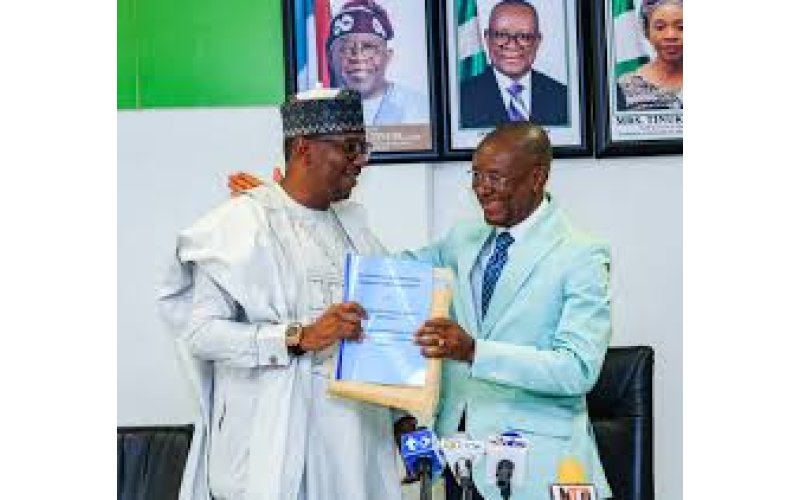
It is over two weeks now since the return of the
National Sports Commission (NSC) as the apex sports governing body of Nigeria.
Beyond the naming of Shehu Dikko as the Chairman, nothing more has been made
public regarding the role of the NSC and its composition.
In simple terms, what has happened so far is a mere
change of nomenclature from the Federal Ministry of Sports Development to
the National Sports Commission. Beyond that, Sports organisation in the country
have been downgraded as the man at the apex cannot sit at the weekly Federal
Executive Council since is not a cabinet-ranked administrator.
Beyond that, the leadership of sports organisation is
reduced to that of sole administrator since there is no board or board members
as it was when there were extant laws setting up the NSC.
Such laws included the Decree 34 of 1971 and the
amended version, Decree 34 of 1979. Those laws spelt out the roles and mode of
composition of the National Sports Commission.
For instance, Decree 34 of 1971 established the NSC as
a replacement for the National Sports Council, which was previously a
parastatal under the Federal Ministry of Labour.
It did not stand in isolation. It worked under a
commissioner *now a minister in the current dispensation). It had at the apex,
a chairman overseeing a board with a well-defined composition.
Also, there was an Executive Committee, of which the NSC Charman is the
head.
The composition of both the NSC and its executive
committee was well articulated. So also, were their roles. Within the NSC, was
also another board, the National Stadia Management Board which the NSC Chairman
heads.
Others include the commission’s secretary and
five other members drawn from the NSC.
Like what happens in present-day Morocco, where
most of the kingdom’s owned stadiums are being kept in good condition by the
state-run company, Société nationale de réalisation et de gestion des stades
(SONARGES) which in English translates to National stadium construction and
management company., the stadia management board in the previous NSC was
charged with that same responsibility of maintenance.
As it is now, a chairman has been named for the NSC.
Without a board, he becomes a sole administrator and will rule according to his
understandings as the public has not been informed of any specific assignment
for the chairman.
The ideal would have been the establishment of a board
for the NSC and mode of composition well laid out as were the instances
with the Decree 34 of 1971 and the amended version of 1979 – Decree 34 of 1979.
Whatever the situation, the NSC deserves to have a
minister of cabinet ranking for direct liaison with the Federal Government.
Alternatively, the chairman should be upgraded to the ministerial position and
supervision a board that will be an upgrade of the ones stipulated in the
decrees 34 of 1971 and 1979.
With the Decree 7 of 1991dissolving the NSC, the
nation appears to have lost track of the essence of the commission. Even when
it was brought back under later regimes, it was just another nomenclature for
the sports ministry as the NSC existed without a board.
Changing names from Ministry to Commission will not
necessarily translate to getting improvement in sports administration. An
NSC in the present situation is just a substitute to the Ministry of Sports. It
is not an alternative.
Comments:
Leave a Reply