

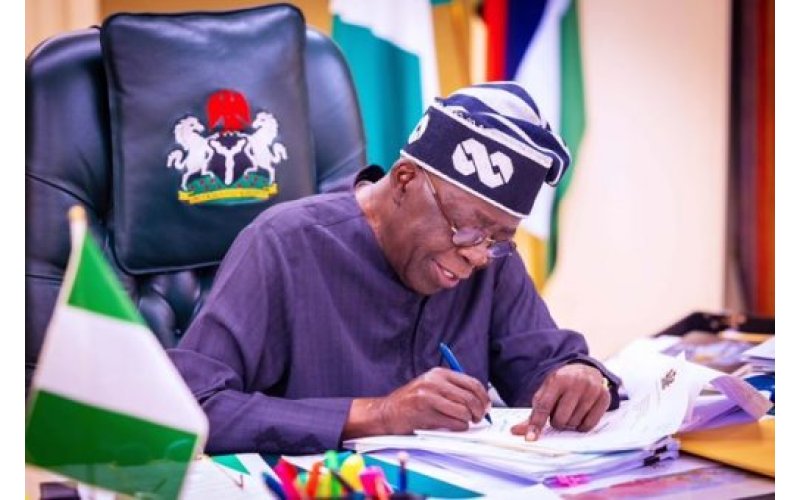
President Bola Tinubu has signed a new executive order
establishing a coordinated regulatory framework for virtual assets in Nigeria,
with the Central Bank of Nigeria (CBN), the Nigeria Revenue Service (NRS), and
the Securities and Exchange Commission (SEC) taking the lead in overseeing the
sector.
The Presidency announced on Friday that the
Presidential Executive Order on Virtual Assets Coordination, 2026, takes
immediate effect.
In a statement issued by the President's Special
Adviser on Information and Strategy, Bayo Onanuga, the government said the
directive is aimed at harmonising the regulation of virtual assets, improving
cooperation among financial regulators, protecting consumers from fraud, and
promoting responsible innovation.
According to the Presidency, the executive order was
introduced to address gaps in the country's fragmented regulatory framework, as
virtual assets increasingly blur the distinction between currencies,
securities, commodities, and other financial instruments.
The government warned that regulatory loopholes have
exposed Nigeria to money laundering, terrorism financing, cybercrime, fraud,
and significant revenue losses, while allowing unregistered operators to
exploit unsuspecting investors.
To strengthen oversight, the order establishes a Virtual
Asset Council, which will be chaired by the CBN, with the Nigeria Revenue
Service and the Securities and Exchange Commission serving as
vice-chairpersons.
Other members of the council include the Nigerian
Financial Intelligence Unit (NFIU) and the Office of the National Security
Adviser (ONSA).
The council will provide policy direction, enhance
collaboration among relevant agencies, and work with the Attorney-General of
the Federation to develop a unified legal and institutional framework for
regulating virtual assets in Nigeria.
The executive order also creates a Virtual Asset
Office within the CBN to coordinate information sharing, regulatory
applications, and reporting among participating institutions.
The Presidency clarified that the order does not
establish a new regulatory agency or transfer the statutory powers of existing
institutions.
Instead, each agency will retain its legal mandate
while operating within a coordinated regulatory framework.
Under the new arrangement, virtual assets classified
as securities will continue to be regulated by the SEC, while the CBN will
oversee payment, settlement, custody, and other services involving virtual
assets that do not qualify as securities. Where regulatory jurisdiction
overlaps, the Virtual Asset Council will determine the appropriate supervising
authority.
The Presidency also disclosed that the CBN is moving
forward with plans to establish a regulatory sandbox that will allow
approved operators to test virtual asset products, blockchain-based services,
and other innovations under regulatory supervision before they are introduced
into the broader market.
In addition, the Nigeria Revenue Service is expected
to issue a comprehensive tax policy for the virtual assets sector to clarify
the application of existing tax laws and encourage voluntary compliance.
The Federal Government is also finalising a Virtual
Assets White Paper, which will outline Nigeria's long-term strategy for the
industry.
To ensure swift implementation, the newly inaugurated
Virtual Asset Council has been directed to produce a harmonised implementation
framework within 30 days.
Comments:
Leave a Reply