

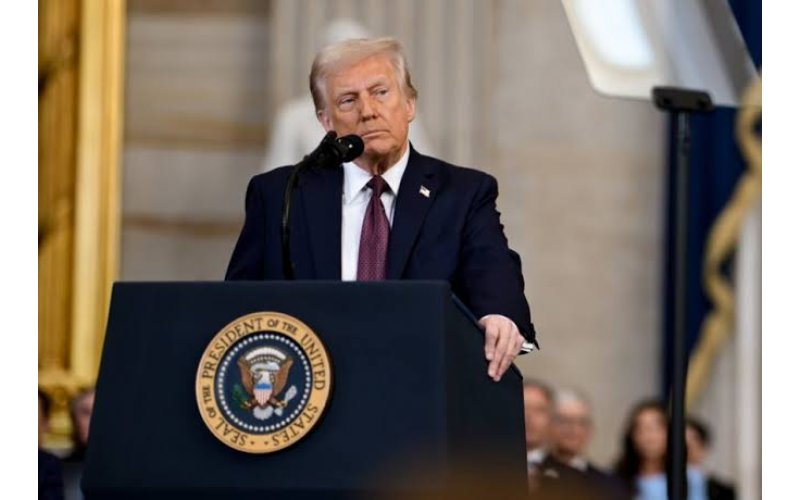
US President Donald Trump has signed orders
significantly expanding the goods exempted from his new tariffs on Canada and
Mexico that were imposed this week.
It is the second time in two days that Trump has
rolled back his taxes on imports from the US's two biggest trade partners,
measures that have raised uncertainty for businesses and worried financial
markets.
On Wednesday, he said he would temporarily spare
carmakers from 25% import levies just a day after they came into effect.
Mexican President Claudia Sheinbaum thanked Trump for
the move, while Canada's finance minister said the country would in turn hold
off on its threatened second round of retaliatory tariffs on US products.
Canadian Prime Minister Justin Trudeau said on
Thursday morning he had had a "colorful" conversation about tariffs
in a phone call with Trump.
The US president used profane language more than once
during Wednesday's heated exchange, according to US and Canadian media reports.
Trudeau told reporters that a trade war between the
two allies was likely for the foreseeable future, despite some targeted relief.
"Our goal remains to get these tariffs, all
tariffs removed," he said.
Sheinbaum said she had had an "excellent and
respectful" call with Trump, adding that the two countries would work
together to stem the flow of the opioid fentanyl from Mexico into the US and
curb the trafficking of guns going the other way.
The carveout from the duties applies to goods shipped
under North America's free trade pact, the US-Mexico-Canada Agreement (USMCA) ,
which Trump signed during his first term.
Items that currently come into the US under the pact's
rules include televisions, air conditioners, avocados and beef, according to
analysis by the firm Trade Partnership Worldwide.
The measures also reduced tariffs on potash - a key
ingredient for fertilizer needed by US farmers - from 25% to 10%.
A White House official said about 50% of US imports
from Mexico and 62% from Canada may still face tariffs. Those proportions could
change as firms change their practices in response to the order.
The White House has also continued to promote its
plans for other tariffs, promising action on 2 April, when officials have said
they will unveil recommendations for tailored "reciprocal" trade
duties on countries around the world.
As US and Canada trade barbs, it's so far so good for
Mexico's Sheinbaum
What are tariffs and why is Trump using them?
The trade war tensions have rattled markets and raised
fears of economic turbulence.
The S&P 500 share index, which tracks the biggest
listed American companies, ended down nearly 1.8% on Thursday.
George Godber, fund manager at Polar Capital, said the
"hokey cokey" with Trump's tariffs has it made it "nigh on
impossible" for firms to manage their production lines and is
"putting pressure on the US economy".
Meanwhile, he said it is "galvanizing a response
from Europe, especially Germany, so we've seen a more positive reaction to
European markets".
In signing the orders, Trump dismissed the suggestion
that he was walking back the measures because of concerns about the stock
market.
"Nothing to do with the market," Trump said.
"I'm not even looking at the market, because long term, the United States
will be very strong with what's happening."
Comments:
Leave a Reply