

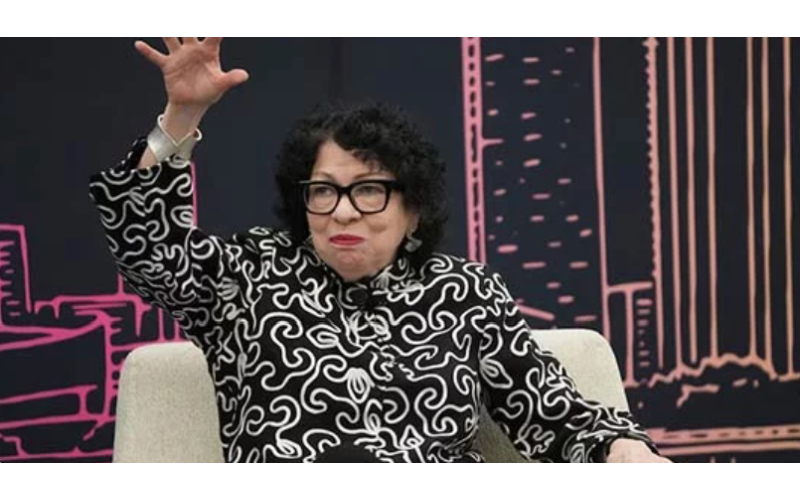
Liberal Supreme Court Justice Sonia Sotomayor said
Tuesday that courts must use their “soft power” to persuade people to comply
with rulings on contentious issues.
She made the comments at an event at Miami Dade
College in Florida in the wake of a growing chorus among some allies of
President Donald Trump, including Vice President JD Vance, who have pushed back
against recent court rulings that have stymied some of his aggressive executive
orders.
Justice Sonia Sotomayor, speaking at a Florida college
on Tuesday, made pointed remarks about the limits of presidential power and her
fear that government officials might flout court decisions.
“Our founders were hellbent on ensuring that we didn’t
have a monarchy,” she said, “and the first way they thought of that was to give
Congress the power of the purse.”
The justice made clear that she was speaking in
general terms, but against the backdrop of President Trump’s blitz of executive
orders to halt federal programs and the scores of legal challenges that
followed, her comments took on a more telling cast.
In the first weeks of his new administration, Mr.
Trump has argued that he is free to root out what he says is fraud and waste in
the federal government even in the face of congressional commands to spend
allocations. A federal judge ruled on Monday that the administration had defied
his order to release billions in grant money.
The president said on Tuesday he would seek appeals of
unfavorable court decisions but abide by them. But Vice President JD Vance and
others in Mr. Trump’s orbit have said in recent days that some of his actions
are not subject to review by the courts.
Justice Sotomayor, a member of the court’s
three-justice liberal minority, said she expected government officials to abide
by the Supreme Court’s decisions.
She had faith, she said, “that other actors in the
system, whether it’s Congress or others, will follow the law, because it’s what
we all take an oath of office to do.”
She did not seem confident, however, that court
rulings would always be obeyed in the short term. “Court decisions stand
whether one particular person chooses to abide by them or not,” she said. “It
doesn’t change the foundation that it’s still a court order that someone will
respect at some point.”
Justice Sotomayor, whose public appearances have often
included discussions with civics-minded aims, seemed to have given the question
of the relationship between the Supreme Court and the president quite a bit of
thought. She praised Chief Justice John Marshall for his decision in 1803,
Marbury v. Madison, which managed to rebuke the Jefferson administration
without issuing a ruling requiring it to do anything.
“The court knew Jefferson wasn’t going to obey that
order,” she said, adding that “it was a very elegant way of avoiding the
crisis.”
She recounted other clashes, including ones involving
Presidents Abraham Lincoln and Andrew Jackson.
“So we’ve had moments where it’s been tested, but, by
and large, we have been a country who has understood that the rule of law has
helped us maintain our democracy,” she said.
But prudence and judgment are required, she said. “The
court has proceeded cautiously,” she said. “It can’t get so far ahead of the
society that the society rebels and ignores it, but it can’t fall so far behind
the society to not do the right thing.”
She spoke about relations with her colleagues. The
other justices, she said, had acted in good faith even when she had profoundly
disagreed with them. “Good colleagues sometimes have silly thoughts, but it
doesn’t make them bad or silly,” she said.
Justice Sotomayor said the court should be wary of
overturning precedents. “We must be cognizant that every time we upset
precedent, we upset people’s expectations and the stability of law,” she said.
“It rocks the boat in a way that makes people uneasy about whether they’re
protected or not protected by the law.”
She did not name particular decisions, but the court
has in recent years overturned major precedents on abortion, affirmative action
and administrative law.
The justice’s interviewer, Maribel Pérez Wadsworth,
president of the Knight Foundation, asked about the role of the news media in a
democracy.
Justice Sotomayor responded with a kind of nostalgia
for the information environment of her youth: three television networks and a
handful of other trusted intermediaries.
“The press has always brought transparency to whatever
the other three branches are,” she said, adding: “The internet is creating an
extraordinary challenge to the press and to the world.”
“The lack of news literacy these days,” she said, is a
looming catastrophe.
“We’re going to lose our democracy,” she said, looking
out over an auditorium at Miami Dade College that included many students.
Unless, she said, everyone, “particularly you young people,” took steps to be
informed in their decision making.
Comments:
Leave a Reply