

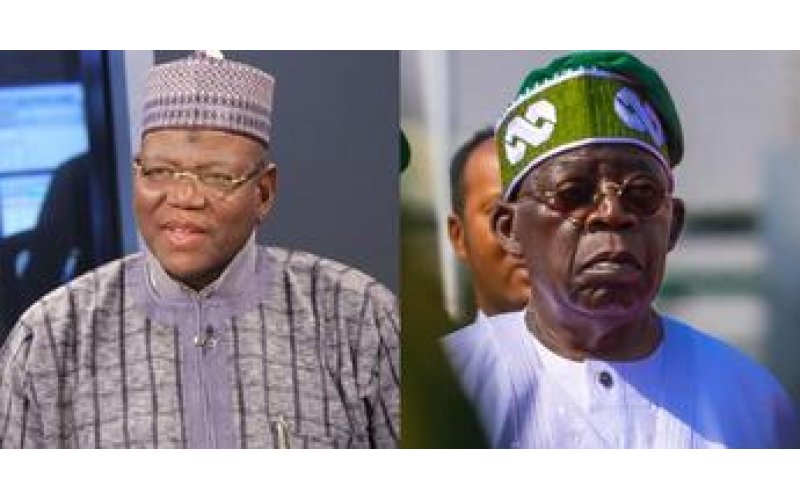
Alhaji Sule Lamido, a former Minister of
Foreign Affairs and two-term governor of Jigawa State, in this interview with
Mannir Dan Ali on Trust TV’s 30-minute programme, traced the current crisis
bedevilling his party, the People’s Democratic Party (PDP), partly to the
fallout among northern leaders in 2007 and explained why the current crop of
political leaders in Nigeria must fear President Bola Ahmed Tinubu, among other
things.
Starting with the PDP, you’re one of the few
politicians who has been with the party since its founding, remaining steadfast
without switching allegiances. Yet the PDP seems fraught with internal
conflicts. Many people find it hard to understand why it’s so divided. What’s
your take on the current state of the party?
Well, understanding what the PDP stands for might be
challenging for those under 30. We’re talking about events from 1998 to
now—nearly 30 years. Anyone who was around 10 years old back then would be in
their early 30s now.
So, explaining the PDP’s philosophy is complex, which
is why history matters. You can’t judge today’s party without looking at where
it started and its journey. Back in 1998, Nigeria was in a serious crisis of
trust and unity. As a federation, we had lost hope in one another, and the
country was heavily divided. This rift was largely due to the annulment of the
June 12 election, which was the fairest and most transparent election ever held
in Nigeria. It demonstrated that Nigerians could unite around a shared vision:
the candidate, Abiola, was a southerner, and his running mate, Baba Gana
Kingibe, was a northerner—both Muslims. This unity was groundbreaking for
Nigeria.
Abiola won the election fairly, and Nigerians felt a
sense of cohesion across regions and religions. Then, suddenly, the election
was annulled. People started questioning why—was it because the Yoruba
candidate won? Interestingly, many Yoruba people didn’t initially support
Abiola. They felt a certain resentment toward him, likely because Abiola was a
self-made man who had once opposed Chief Obafemi Awolowo under the NPN. So,
despite winning, some in the Yoruba community didn’t necessarily see him as their
representative.
Once the election was annulled, certain groups, like
Afenifere and other Yoruba elders who hadn’t actively supported June 12, began
to claim the victory as part of a ‘Yoruba agenda.’ But in reality, Abiola’s
victory was about uniting Nigerians, not about regional interests. This
misappropriation laid part of the groundwork for the issues we see today.
When the PDP was formed, we reflected on how to
restore Nigerians’ trust, which had been shattered by the June 12 crisis. At
that time, the focus wasn’t on infrastructure or economic policies; it was
about rebuilding Nigeria as a united nation, a place where people could believe
in one another again.
Did the PDP succeed in restoring that trust?
When we established the PDP, we decided that the first
order of business was to address the crisis of confidence caused by June 12.
Normally, political offices aren’t assigned to specific regions; democracy is
meant to be led by the majority of votes. But we realised we needed to set
aside strict democratic principles temporarily to heal our wounds. So, we
decided to locate the presidency in the South West as a symbolic gesture to
appease the Yoruba people for the pain caused by June 12.
At that time, Baba (Olusegun Obasanjo) was in prison,
but we saw him as a figure who transcended regional interests. Among the Yoruba
leaders, we had options like Olu Falae, Pa Adesanya, and Bola Ige. However,
they were largely seen as tribal leaders. Obasanjo, in contrast, was widely
regarded as a nationalist—someone who had fought in the civil war and helped
restore democracy. We felt he could symbolise a new, united Nigeria, so he
became the face of this reconciliatory effort.
Even with Obasanjo’s presidency, some Yoruba people
criticised him for not prioritising Yoruba interests, as they expected him to
act primarily as a Yoruba leader. But Obasanjo insisted his focus was on
Nigeria as a whole, not on ethnic agendas. He served two terms but resisted
attempts to extend his tenure.
During his presidency, he successfully stabilised the
country within a few years. The economy began to recover, and Nigeria was on
the path toward a new renaissance. The focus was on addressing fundamental
human issues and development, with a genuine drive to unify the nation
politically and socially. So, the PDP has done what is almost impossible in
Nigeria, to restore Nigeria.
So, is this history part of the reason you’re still in
the PDP, despite the current crisis?
No, no, I’ll get to that. By Obasanjo’s third year in
office, the country had stabilised, and some of his former allies felt he
should step down after four years, paving the way for someone else. This marked
the start of internal tensions, even among close associates and former military
colleagues who began opposing him.
Here was a man who had worked to restore Nigeria’s
unity, only to face resistance for wanting a second term. He was undermined
and, reportedly, had to humble himself just to secure that second chance. I
heard he was even made to kneel and beg.
Is that factual, or is it one of those rumours?
Well, on the eve of the 2003 primaries, his vice
president supposedly claimed he held full control over the PDP and could decide
if Obasanjo would get a second term or not. I’m just recalling history
here—there’s no intent to embarrass anyone.
How does that history relate to the PDP’s current
state, which is so divided?
To understand today, you have to look back at
yesterday’s events. Obasanjo ultimately secured the ticket, but under
humiliating circumstances. This was a former general, a past head of state—yet
he was subjected to this. Given his sacrifices for Nigeria, he felt he should
be allowed to complete his two terms and exit on his terms.
By his second term, he might have thought, “If I
almost didn’t get through my first term, what happens when I leave?” The human
instinct to secure his legacy kicked in.
Did you encourage him to pursue a third term?
No, I’m speculating here, just trying to put myself in
his shoes. I believe that after all he did for Nigeria—from stabilising the
country to resolving our debt crisis in Europe—he deserved recognition.
But Obasanjo has since distanced himself from the PDP,
while you’ve remained, despite the party not measuring up.
Yes, he did attempt a third term. I heard he justified
it by saying, “If I leave now, with just four months left, I’ll be betrayed by
those I considered allies”. Maybe that’s why he tried for a third term. But it
collapsed, and he brought in Yar’Adua.
Yar’Adua had strong leadership qualities, and he came
from a respected family. And those who contested against him were northerners,
allies of his late older brother. In 2007, the PDP was powerful, controlling
over 25 states, while Buhari had no stronghold. Yet, Buhari claimed he won
against the PDP and challenged the results up to the Supreme Court. We started
seeing cracks in the North from that point.
Are you saying these cracks in the North are behind
the PDP’s current weakness?
That’s part of it. Yar’Adua won but passed away, and
then we saw crisis after crisis, much of it from within. By 2014, prominent PDP
members had defected to the APC, attacking the PDP as corrupt and divisive.
They were former governors, ambassadors, and even past presidents.
If you look at the election results from 1999, 2003,
2007, and 2011, the PDP outperformed all other parties combined. But it was
these former PDP members, who switched to the APC that defeated the PDP in
2015.
Today’s APC crisis stems from PDP issues. Many key APC
figures were once influential PDP members. So, in a way, the APC is itself a
product of the PDP’s internal conflicts.
But the current president was never in the PDP.
True, but about 90% of today’s APC members came from
the PDP. Just look at the National Assembly—the Senate president, his deputy,
the Speaker of the House, key figures in the Assembly, and many governors.
Almost anyone significant in the PDP back then is now in the APC.
Some might say this is ancient history. People expect
the PDP, as the main opposition, to deliver more.
Ancient? How about those in the federal government,
those leading the National Assembly? They aren’t ancient; they’re current. But
they form a paralysed half, the APC. The only way forward is for both sides to
set aside their grievances. They should reflect on how Nigeria has helped them
and reconcile for the country’s sake. Otherwise, how can the PDP stand strong
when a chunk of it is in the APC?
Do you mean like the current FCT minister, a former
PDP member, now serving the APC and possibly dividing the PDP?
Leave Wike alone. Wike is a very small boy in PDP
history. Where was he in 1999? Everything he’s doing, he learnt from
others—betrayal, treachery. There have always been PDP members fighting the
party from within. But, frankly, Wike is now inconsequential. I’m more focused
on PDP leaders who understand the party’s history and mission. If they return,
we could unify the PDP and offer a credible alternative to the APC.
For me, the PDP that governed from 1999 to 2014 was
the real PDP. We had a good PDP and a bad PDP. The government we’ve had from
2014 to today is a bad PDP. Yet I believe those who called PDP corrupt and left
to join the APC should reconsider and work together to solve Nigeria’s
problems.
Do you see that happening before the next election?
God can touch their hearts and restore their sense of
dignity and responsibility to see that their actions affect Nigeria’s history
and future. I believe it’s possible.
Are you doing anything to promote this?
We’re working, but we’re keeping our strategies
private. We are praying and working underground for the PDP’s restoration—not
for personal gain but for Nigeria’s sake. The Nigerian people are suffering
because of PDP’s past failures.
So, you have no personal political ambition? You once
wanted to be president—has that dream passed?
For now, we must focus on restoring and uniting the
PDP. Any personal ambition should follow that goal. We should rebuild the party
first, then talk about individual aspirations. The party should come first, for
Nigeria’s sake. Once it’s stable, then people can declare their intentions.
What about the current president’s approach to
governance?
I’ve known him since the days of the SDP, and I know
his political style and his skill for getting what he wants, even when it’s
questionable. His rise is remarkable. Look at his history, from Chicago to
Nigeria. His strategies, some of which have left many astounded, reflect a
calculated persistence. For example, in 2003, PDP swept the western region but
couldn’t defeat him. Then, when Buhari was struggling, he called him, offering
support and saying, “I’ll make you president.” And he did. Now, it’s “his turn.”
Is that why you think Nigerian politicians should fear
the president?
The fear isn’t of him, but rather his capacity to
stand firm for the wrong reasons. That’s the real worry.
But he says he’s made courageous decisions for
Nigeria.
No, no. Every decision he’s made has been for his
interests. Just look at the government—it’s essentially an extension of him.
But aren’t all politicians like that? Don’t you all
look after your interests?
That’s exactly my point. Those in the APC have
essentially empowered him. If you’re part of a group that relies on deception,
there’s always a “con boss” who outdoes everyone else. They’ve been conned.
Meanwhile, you’re wallowing in a divided opposition,
seemingly stuck.
I’m not “wallowing.” I’m simply saying that Nigeria
has given me so much—a space to grow and achieve what I have. So, my focus is
on how to give back, to create opportunities for others. This isn’t just
personal. No Nigerian leader gets where they are alone; it’s about building
something meaningful for future generations.
So, are you saying that past leaders, whether Ironsi,
Gowon, Murtala or even Obasanjo and Buhari, were shaped more by the
institutions or constituencies that backed them rather than their own
personalities?
Exactly. None of them were made by their personality
alone; they came from institutions, from contexts that empowered them. Tinubu,
however, is different. He’s defined largely by his personality, not any
institutional backing. Buhari tried four times and couldn’t win alone, which
shows it wasn’t just about him.
But isn’t that something to admire—being able to rise
on personal merit?
If it were for the country’s benefit it would be worth
celebrating. But this feels different. It is pharaonic—a rule that’s about
consolidating power, like a pharaoh.
Are you saying that we need a “Moses” now?
Yes, a leader who can truly guide people towards
positive change. But the question remains—are Nigerians willing to follow a
“Moses” figure and make the necessary sacrifices? Honestly, I doubt it. The
people here are, in a sense, like Pharaoh’s people—resistant to the changes we
need.
Comments:
Leave a Reply