

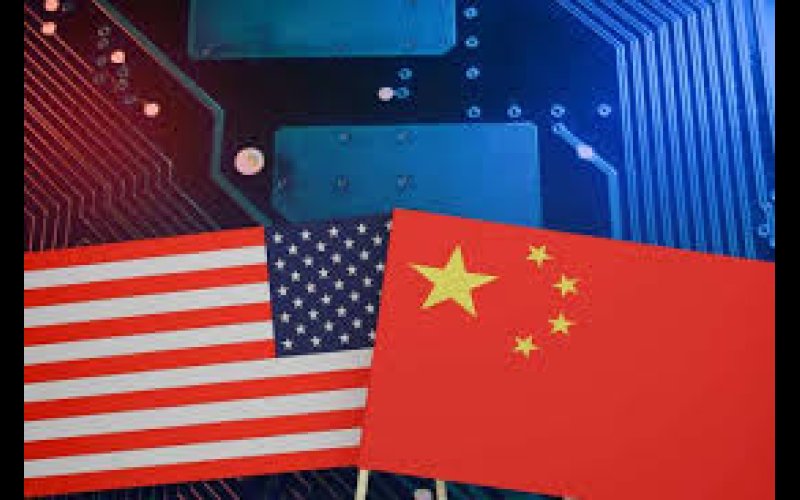
US chip giant Nvidia is once again caught in the
middle of the growing technological and trade rivalry between the United States
and China.
On Thursday, Nvidia CEO Jensen Huang visited Beijing
to meet senior Chinese officials, just days after Washington imposed fresh
export restrictions on the company’s AI chips.
The US Commerce Department announced that Nvidia will
now need a special license to export its H20 AI chip to China—a move officials
say is essential for protecting America’s national and economic security.
Nvidia confirmed that these new rules will remain in effect indefinitely.
Why Nvidia Matters
Nvidia designs high-performance AI chips, essential
for powering generative artificial intelligence tools like ChatGPT. The
company’s success has been meteoric—so much so that it briefly surpassed Apple
last year to become the world’s most valuable company by market cap.
Because of its importance to the global AI race,
Nvidia’s ties with China have drawn increased scrutiny from Washington.
The US hopes these restrictions will slow China's AI
advancements, especially those that could benefit its military and defense
sectors, while boosting the US’s strategic edge.
What’s Behind the New Curbs?
The H20 chip was specifically created to comply with
earlier US restrictions imposed in 2022 under President Biden. But a surge of
interest in the chip from Chinese tech giants like Tencent, Alibaba, and
ByteDance has reignited concerns.
The trigger appears to be the rise of DeepSeek, a
Chinese AI company that claims it can run advanced applications using less
powerful chips—suggesting that even toned-down Nvidia products could still give
China an AI advantage.
Now, Nvidia faces the loss of roughly $5.5 billion in
unfulfilled orders due to the immediate nature of the new ban.
China’s Push for Chip Independence
While China has been working on its own chips,
including from companies like Huawei, analysts believe they still lag behind
Nvidia in terms of capability. But US export controls may push China to double
down on its efforts.
"It will introduce challenges to China's AI
scene, but it won't massively slow it down," said Chim Lee, a senior
analyst at the Economist Intelligence Unit.
China remains a major market for Nvidia, accounting
for 13% of its total revenue last year, second only to the US.
Nvidia's Diplomatic Mission
Huang’s visit is seen as a strategic move to preserve
Nvidia’s footprint in China. He met with key officials, including Ren Hongbin
of the China Council for the Promotion of International Trade, and DeepSeek
founder Liang Wenfeng.
Chinese officials emphasized the country’s strong
market potential, while Huang reaffirmed his commitment to cooperation with
China during talks with Shanghai’s mayor.
Shifting the Global Tech Landscape
The export controls are part of a broader US strategy
to reduce reliance on China in high-tech industries and bring more chip
manufacturing back to America.
Nvidia recently unveiled plans to build $500 billion
worth of AI server infrastructure in the US. Meanwhile, chip manufacturing
partner TSMC is investing $100 billion in new facilities in Arizona.
"Technology is becoming more polarized—less
global and more restricted," said Gary Ng, senior economist at Natixis.
The global tech world is increasingly dividing into
two ecosystems: one led by the US, the other by China.
Comments:
Leave a Reply