

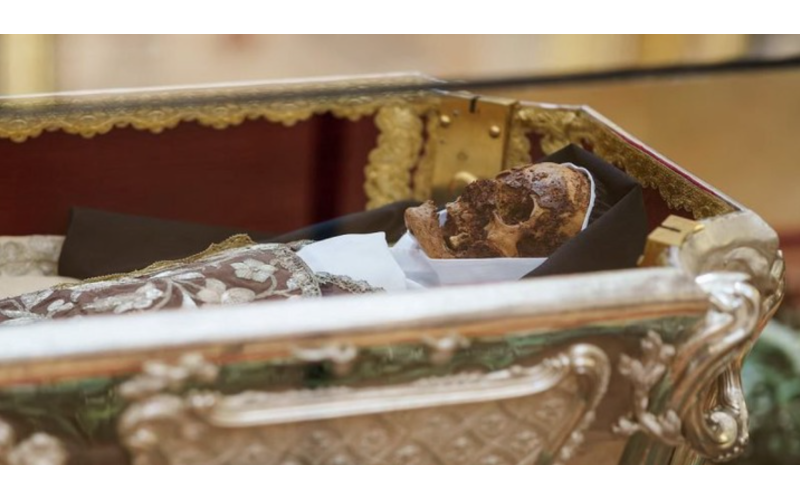
The corpse of Saint Teresa of Jesus, who died
nearly 500 years ago, has been displayed to the public for the first time since
1914. Saint Teresa, also referred to as Saint Teresa of Avila, passed away 440
years ago in 1582. In August, her body was removed from a church in Spain,
astonishing experts with its remarkable preservation. Images show St Teresa’s
remains laying in a silver coffin encased in marble, her face still ‘clearly
visible’ and her limbs ‘incorrupt’.
Crowds of faithful gathered to view the body of
the holy woman at the Basilica of the Annunciation of Our Lady of Mount Carmel
in Alba de Tormes, Salamanca, Spain. The saint is hailed as one of ‘God’s
miracles’ due to her near perfect preservation, and when her coffin was opened
last year, experts were able to understand the health conditions that plagued
her during life. St Teresa’s body was exhumed by Marco Chiesa, the General
Postulator of the Order, at the Diocese of Avila in Spain on August
28.
Church officials shared the news on social media
at the time, where Catholics said: ‘Her body is still incorrupt. Look for God’s
miracles.’Upon opening the tomb, a team of doctors compared photos taken of St
Teresa’s face and foot in 1914, and the postulator said it was ‘difficult to
make a comparison’ because the images were in black and white. They did not
release images of the saint from 1914, but said they plan to eventually share
them.
Father Marco Chiesa explained that ‘there is no
color, there is no skin color, because the skin is mummified, but it can be
seen, especially in the middle of the face. It can be seen well. The expert
doctors can see Teresa’s face almost clearly.’ St Teresa is the patron saint of
chess players, lace makers, loss of parents, people in need of grace, people in
religious orders, people ridiculed for their piety, and those who are sick.
She was a Spanish nun and became the first woman to be
elevated to doctor of the church in 1970, an honor given to deceased saints for
their significant contribution to the church’s doctrine. St Teresa was
canonised – meaning she was declared a saint – in March 1622. Since her body
was last exhumed, it has been described as ‘incorrupt,’ meaning it hasn’t
undergone the normal process of decomposing after death.
Researchers want to uncover how St Teresa’s body
has still not deteriorated and hope that it can provide information about how
to preserve relics in the future. Chiesa confirmed they’re still in the early
stages of analyzing St Teresa’s body, adding that it is too early to release
the details about their additional examinations. The Diocese has taken
stringent measures to protect the saint’s remains, including requiring a total
of 10 keys to access her coffin. Three of the keys are held by the Duke of
Alba, another three are possessed by the city of Alba de Tormes and the
Discalced Carmelite Father General in Rome has an additional three.
The 10th key – known as the King’s key – is also
needed to access St Teresa’s remains, with three needed to open the outer gate,
three to open the tomb and four to open the coffin. Her remains were relocated
to a locked room where a team of doctors and scientists will conduct visual
examinations and take photographs and X-rays of the remains. The samples were
sent to a lab in Italy and is expected to take several months before the data
can be gathered and released to the public.
‘The Order sees fit to do this work and it will be the
specialists who, after their exhaustive work, will give us conclusions,’ Chiesa
stated. ‘We know, from similar studies, that we will be able to learn data of
great interest about Teresa and also recommendations for the conservation of
the relics, but that will be at another stage.’ While studying her body,
experts have also observed a health condition called calcareous spines on her
feet, which they said were indicative of her religious commitment. Calcareous
spines are sharp bones recognizant of endoskeletons found on starfish and sea
urchins.
St Teresa also suffered from convulsions, stomach
problems, dizziness and loss of consciousness. She defended her mystical
experiences in her memoirs where she related her symptoms to having a
connection to God. ‘We know that the last years were difficult for her to walk,
in the pains that she herself describes,’ Chiesa explained, adding: ‘Sometimes,
looking at a body, one discovers more than the pers on had.
‘Analysing the foot in Rome, we saw the presence
of calcareous thorns that make it almost impossible to walk. But she walked
[to] Alba de Tormes and, then died.’ In 1582, when St Teresa was about 67 years
old and sick, she set out for Alba de Tormes to visit an old friend alongside
Anne-of-St Bartholomew. Chiesa said that despite her affliction, St Teresa’s
‘desire was to continue and move forward, despite the physical defects.’
While on the road, she grew exhausted and gravely
ill and three days after St Teresa and her companion arrived at the local
convent, she said to Anne: ‘At last, my daughter, I have reached the house of
death.’ St Teresa’s coffin was last opened in 1914 after Father Clemente de los
Santos, the superior general of the Discalced Carmelites at the time, said he
wanted to see the bodies of the founding saints during his visit to Spain.
At the time, the Diocese of Ávila stated the body
was still ‘completely incorrupt,’ just as it was when it was first opened in
1750.
Comments:
Leave a Reply