

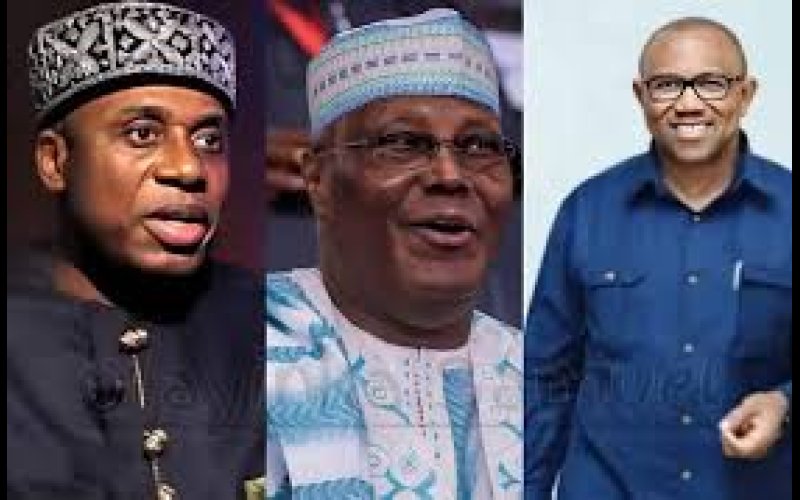
It comes as no surprise that news headlines this week
have been dominated by the formation of a coalition by opposition politicians
plotting to defeat President
Bola Tinubu in the 2027 presidential election.
The Africa Democratic Congress (ADC) was adopted as a
platform to challenge Mr Tinubu’s All Progressives Congress (APC). Leading the
ADC coalition is former Vice President Atiku Abubakar and ex-Governor of
Anambra State Peter Obi, both runners-up in the last presidential election.
They are joined by other experienced politicians,
including former Senate President David Mark, who like Atiku is leaving the
PDP, along with the opposition party’s former chairman Uche Secondus, former
Kaduna State Governor Nasir El-Rufai and former Minister of Transportation
Rotimi Amaechi. At the unveiling of the coalition on Wednesday, interim
chairman David Mark said it was an attempt to save the country’s democracy and to stop
Nigeria from becoming a one-party state.
However, analysts said the coalition is bound to be
torn apart by the ambition of some of the key political figures on the question
of which part of the country should its presidential candidate come from.
Although there’s a long way to go before candidates
are officially announced, political commentators are predicting that
78-year-old Atiku will have another shot at the presidency. Atiku’s supporters
feel that with him being the only former vice president seeking the presidency,
every other politician naturally comes second.
Aside from Atiku, Mr Amaechi has indicated his
interest in running for the country’s top job in 2027. The former minister came
a distant second in the APC presidential primary in 2022, losing to Mr Tinubu.
In an interview on Channels TV on Thursday, Mr Amaechi said
he believes the power-sharing deal between northern and southern Nigeria should
be respected.
He recalled how he fought for the return of power to
the North in 2015, saying he believes in power sharing between the two major
regions of the country. “I led the fight against the PDP government. Why?
Because there was an agreement that the government at that time would spend
four years. But after four years, the government reneged on it, and I said no,
that would be unfair. That will be instability at its peak because the North
will react.”
Mr Amaechi added that in line with the power-sharing
principle, he would be a one-term president if given the chance to lead the
country in 2027. “I won’t do more than four years,” he said, adding that “the
South must be allowed to complete its tenure. If the South is not allowed to
complete its tenure, then I have made a mistake in supporting it.”
Mr Amaechi’s stance is not very different from that of
Mr Obi, who came third in the last presidential election, surprising many
pundits to win in 11 of Nigeria’s 36 states and Abuja.
Mr Obi has also declared his intention to contest in the 2027
presidential election under the coalition. Mr Obi said the platform would offer
Nigerians “a competent, capable, and compassionate” leadership.
“Our commitment is to sacrifice and work together
towards the 2027 general elections, ensuring that Nigeria gets a competent,
capable, and compassionate leadership that will prioritise the nation’s future
by putting the welfare of Nigerians first,” he said.
The former Anambra governor said he would be willing
to serve for a four-year tenure if he reached an agreement with those who
support his ambition. “If there is any form of agreement that will restrict me
to four years in office, I will comply with the agreement and be ready to leave
office by 28th May 2031,” Mr Obi said.
Messrs Obi and Amaechi will thus hope that the ADC
zones its presidential ticket to the South and that the candidate, if elected,
would serve only one term before power returns to the North again. Atiku, who
has tried to be Nigeria’s president since 1993, is, however, expected to
challenge that belief and seek to be the ADC candidate.
“Ultimately, the success of the coalition would depend
on their establishing a level playing ground for intra-party democracy to
produce the best candidate,” said Jibrin Ibrahim, a professor of political
science. “If they fail to do so, their success cannot be guaranteed.”
Sectional Interests
The politics of region, geography, religion, and
ethnicity is one of the major fault lines in Nigerian democracy. This was a
major issue in 2010, after the death in office of President Umaru Yar’Adua,
also in 2011, and again in both 2015 and 2023.
It would most certainly be the case in 2027, too.
After eight years of the Buhari/Northern Presidency,
the Southern partners in the emerging coalition would naturally insist that to
replace Mr Tinubu, who would have spent four years in 2027, the remaining four
years must naturally go to a presidential candidate of Southern extraction.
Meanwhile in the northern camp of the coalition, there
are recommendations that the party should throw its presidential primaries open
to contestants from every part of Nigeria.
Some are saying the party should just focus on
producing a credible and worthy candidate that can defeat the incumbent
president.
If the party decides to zone the ticket to the South,
such a decision will automatically shut the door on the faces of some of the
party’s most prominent and enduring aspirants like Atiku, who has been seeking
to be Nigeria’s president since 1993.
If on the other hand, the coalition throws the race
open to all contenders, the aspirants from the southern region will feel
shortchanged at having to contest against a more experienced and better
connected northern rival.
In any case, the issue of zoning can make or mar the
coalition ahead of the 2027 elections. The same issue contributed largely to
the defeat of the PDP in the 2015 presidential election that ended the party’s
16 years hold on the presidency. It also affected the main opposition during
the 2023 presidential election.
The PDP had adopted the concept of zoning from its
inception, saying this was to promote national unity. Section 7 (2) (c) of the
party’s constitution states, “In pursuance of the principle of equity, justice
and fairness, the party shall adhere to the policy of rotation and zoning of
the party and public executive offices.”
But the party jettisoned that agreement and threw the contest open
in 2022. That factor led to the breakaway of five governors from the PDP led by
former Rivers State Governor Nyesom Wike.
To be sure, PDP did not invent the policy. At the dawn
of the Second Republic in 1978, the National Party of Nigeria (NPN) had
introduced zoning as a power-sharing arrangement between the North and South.
It nominated Shehu Shagari from Sokoto State as its presidential candidate, who
went on to nominate Alex Ekwueme from Anambra State as his running mate.
Although the four other parties did not proclaim the
same policy, they all also balanced their presidential tickets with North and
South nominees, except the Unity Party of Nigeria (UPN) whose candidate,
Obafemi Awolowo, chose to run with Philip Umeadi from the old Anambra State in
the only South-South ticket in the 1979 presidential election.
The PDP adopted the policy at its inception, which has
since seen its presidential ticket oscillate between the two regions. In 1999,
prominent northern aspirants like Adamu Ciroma, Bamanga Tukur and Atiku
Abubakar stayed out of the race to allow the new party to choose principally
between a former military head of state, Olusegun Obasanjo, and Second Republic
Vice President, Mr Ekwueme. Radical Kano politician, the late Abubakar Rimi,
who rebelled against the decision, was eventually persuaded by his northern
colleagues to drop his nomination form.
The APC also adopted the same policy. When former
President Buhari was to complete his tenure in 2023, the majority of the APC
governors insisted that power must shift south and that led to the emergence of
Mr Tinubu as the party’s flagbearer for the 2023 presidential elections. Mr
Tinubu is not expected to face any major challenge within the APC for the 2027
presidential ticket of the party.
As the coalition plots to challenge the ruling party
in the 2027 general elections, its biggest test yet is how to produce the best
candidate and which part of the country should its presidential candidate come
from.
Comments:
Leave a Reply