

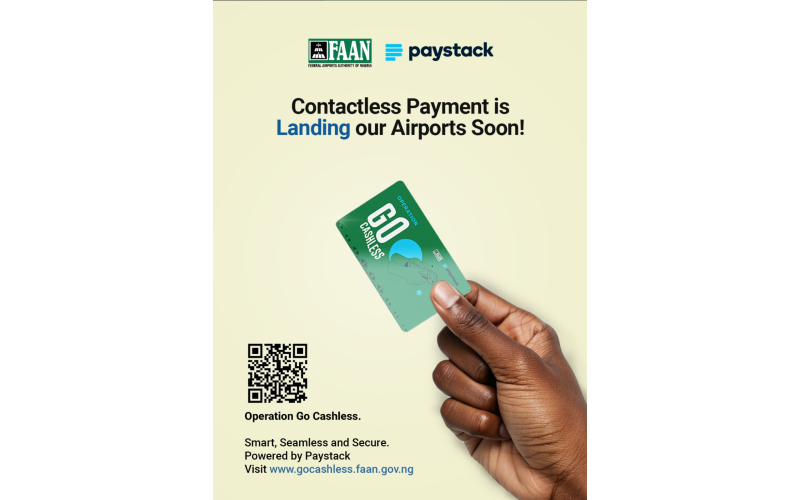
The Federal Airports Authority of Nigeria (FAAN), in
partnership with fintech giant Paystack, has introduced a prepaid NFC card that
allows drivers to pay airport access fees with a simple tap.
The innovation, unveiled on August 28, 2025, will
debut at Lagos’ Murtala Muhammed International Airport (MMIA) and Abuja’s
Nnamdi Azikiwe International Airport, with nationwide deployment across
FAAN-managed airports expected before year-end.
How it Works
At airport gates, the Paystack Terminal automatically
displays the fee based on vehicle type. A quick tap of the FAAN Prepaid NFC
Card processes payment instantly—no PIN required—lifting the boom gate within
seconds.
Drivers can obtain the cards at FAAN terminals in
Lagos and Abuja. Activation involves registering on the FAAN cashless payment
portal or scanning a QR code, verifying details with a one-time password, and
loading a minimum of ?1,000 into a linked virtual account. Once registered, the
card works at any FAAN-powered access gate.
FAAN says the system will reduce bottlenecks at busy
airports, cut reliance on cash, and improve transparency in revenue collection.
Driving Nigeria’s Cashless Shift
The initiative reflects Nigeria’s broader move toward
cashless payments, following the success of the Cowry card for Lagos public
transport since 2021. Paystack’s infrastructure ensures encrypted, real-time
transactions designed to withstand high traffic volumes.
“Smart, seamless, and secure — that’s the future of
Nigeria’s airports,” FAAN declared in a statement on social media.
Reforms Under Olubunmi Kuku
The NFC card rollout builds on sweeping reforms led by
FAAN Managing Director Olubunmi Kuku since 2023.
Kuku has overseen major infrastructure upgrades,
including the rehabilitation of MMIA’s Runway 18R/36L and expansion of the Zulu
Terminal. Airports in Enugu, Ilorin, Kano, Katsina, Jos, and Yola have also
seen improvements in car parks, cooling systems, airfield lighting, and power
reliability.
Security has been a key focus. FAAN has deployed
advanced X-ray machines, CCTV upgrades, and 3,000 handheld radios for security
personnel. A recent ICAO Security Audit praised the agency’s enhanced access
control and emergency response systems, with passenger screening times cut by
80% during peak hours.
Boosting Revenue and Efficiency
Financial performance has also improved. Between
January and November 2023, FAAN recorded ?343.87 billion in revenue, an 82.5%
year-on-year increase, thanks to automated systems and smarter tariffs. Debt
recovery efforts reclaimed ?3.13 billion, while the upcoming rollout of
Business Central ERP software in June 2025 aims to further streamline
operations.
Staff welfare has been prioritised, with nearly 10,000
employees and 5,000 pensioners receiving new minimum wage payments, and over
6,800 staff completing targeted training.
A Smarter Gateway for Passengers
Customer experience upgrades now include modern
lounges, improved accessibility for the elderly and disabled, and dedicated
hotlines for passengers with special needs. FAAN also introduced a refund
policy for cancelled flights and streamlined boarding procedures to ease
congestion.
The FAAN-Paystack NFC card is the latest step in this
transformation, positioning Nigeria’s airports as modern, technology-driven
gateways aligned with global standards.
Comments:
Leave a Reply