

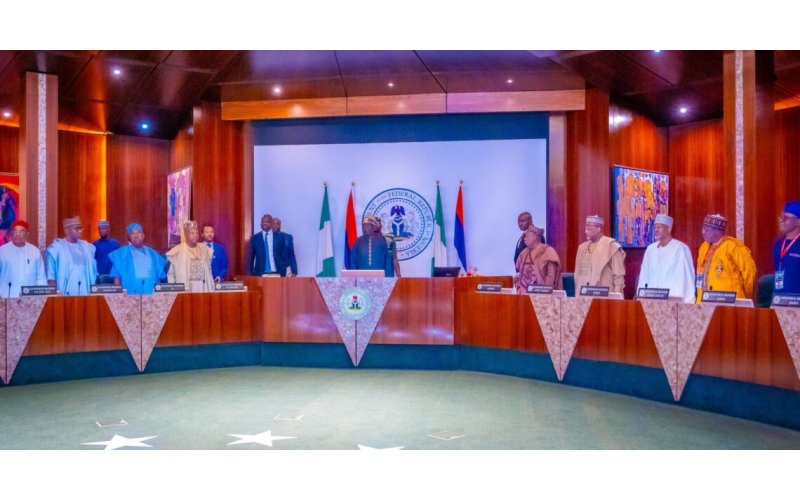
The Federal Executive Council (FEC) has approved a
package of road infrastructure projects and contract reviews valued at more
than ?400 billion, signaling a renewed commitment by the Tinubu
administration to modernize Nigeria’s transport network and stimulate economic
growth.
Minister of Works, Dave Umahi, disclosed this
to State House correspondents after Thursday’s FEC meeting, presided over by President
Bola Tinubu at the Presidential Villa, Abuja.
Umahi said he presented 11 memos to the council
— nine on reviewed projects inherited from previous administrations and two for
new contract awards.
“Our focus remains delivering durable road
infrastructure to support economic growth and ease of movement across the
federation,” the minister stated.
Key Approvals
Among the new projects approved is Phase Two,
Section Two of the Lagos–Ibadan Expressway, valued at ?43 billion.
The work will address failed portions and complete critical underpasses and
ramps on the busy route, which serves as one of the country’s most vital
transport corridors.
Also approved was the dualisation of the
Mushin–NNPC Junction–Apapa Oshodi Expressway in Lagos, whose cost was
revised from ?11 billion to ?19 billion due to updated design and
material costs.
Another major highlight is the construction of
Section Three of the Sokoto–Badagry Superhighway, covering 162.97
kilometers from Badagry through Ogun State to the Oyo State border,
estimated at ?3.39 billion per kilometer.
Reviews of Legacy Projects
The FEC also reviewed several ongoing projects
inherited from past governments for cost and design optimization:
Umahi noted that some state governments have taken
over federal roads within their territories to accelerate completion and
relieve funding pressure on the federal budget.
Regional Upgrades and Concrete Focus
The council also approved a review of the
Ota–Idi-Iroko Road project in Ogun State, incorporating rigid concrete
pavement and an additional bridge, raising its cost from ?38 billion to ?52
billion.
Other projects approved include:
Umahi reaffirmed the government’s preference for concrete
pavement construction, citing its durability and reduced maintenance costs.
“We are prioritizing concrete pavement to ensure our
roads last longer and serve Nigerians better,” he said.
Additional Context
In September, the Federal Government approved
additional funding for waste excavation and design modification on the
Lagos segment of the Lagos–Calabar Coastal Road.
According to Umahi, engineers discovered a 50-year-old
refuse dump more than 10 metres deep and two kilometres long, necessitating
realignment of the road to protect nearby infrastructure, including Landmark
Beach and adjoining properties.
“We encountered engineering and environmental
challenges that required design changes to preserve existing assets while
maintaining project quality,” he added.
Comments:
Leave a Reply